



Alkaline Phosphatase/ALPL Protein, Mouse (HEK293, His)

Based on 1 Customer Validation
Alkaline Phosphatase/ALPL Protein is a phosphatase whose physiological function is to dephosphorylate compounds. ALPL is also a membrane-bound glycosylated enzyme that catalyzes the hydrolysis of phosphate esters at alkaline pH. Mice that lack ALPL show symptoms of osteomalacia, softening of the bones. Moreover, ALPL stimulates mineralization mainly through modulation of the balance between inorganic phosphate (Pi) and inorganic pyrophosphate (PPi) and also has a role in cardiovascular remodelling. Alkaline Phosphatase/ALPL Protein, Mouse (HEK293, His) is the recombinant mouse-derived Alkaline Phosphatase/ALPL protein, expressed by HEK293 , with C-8*His labeled tag.
- Species: Mouse
- Source: HEK293
-
Storage:Stored at -20°C for 2 years from date of receipt. After reconstitution, it is stable at 4°C for 1 week or -20°C for longer (with carrier protein). It is recommended to freeze aliquots at -20°C or -80°C for extended storage.


To place orders, for customer services and technical support, please contact: MedChemExpress USA
Tel: 609-228-6898 E-mail: [email protected] [email protected]


-
 Biological Activity
-
Technical Parameters
-
Product Properties
- Documentation
- Help & FAQs




Biological Activity
Description
Alkaline Phosphatase/ALPL Protein is a phosphatase whose physiological function is to dephosphorylate compounds. ALPL is also a membrane-bound glycosylated enzyme that catalyzes the hydrolysis of phosphate esters at alkaline pH. Mice that lack ALPL show symptoms of osteomalacia, softening of the bones. Moreover, ALPL stimulates mineralization mainly through modulation of the balance between inorganic phosphate (Pi) and inorganic pyrophosphate (PPi) and also has a role in cardiovascular remodelling. Alkaline Phosphatase/ALPL Protein, Mouse (HEK293, His) is the recombinant mouse-derived Alkaline Phosphatase/ALPL protein, expressed by HEK293 , with C-8*His labeled tag.
Background
Alkaline phosphatase (ALPL) is a phosphatase whose physiological function is to dephosphorylate compounds. ALPL is also a membrane-bound glycosylated enzyme that catalyzes the hydrolysis of phosphate esters at alkaline pH. The mature peptide maintains the ratio of inorganic phosphate to inorganic pyrophosphate required for bone mineralization. Mice that lack ALPL show symptoms of osteomalacia, softening of the bones. In humans, mutations in this gene are associated with hypophosphatasia, an inherited metabolic bone disease in which deficiency of this enzyme inhibits bone mineralization leading to skeletal defects. ALPL is highly expressed in the cells of mineralized tissue and plays a critical function in the formation of hard tissue. And ALPL increases inorganic phosphate local rates and facilitates mineralization as well as reduces the extracellular pyrophosphate concentration, an inhibitor of mineral formation. Moreover, ALPL stimulates mineralization mainly through modulation of the balance between inorganic phosphate (Pi) and inorganic pyrophosphate (PPi) and also has a role in cardiovascular remodelling[1][2][3].
Verified Bioactivity
Measured by its ability to cleave 25 μM fluorogenic substrate, 4-Methylumbelliferyl phosphate (4-MUP) that at room temperature for 5 minutes. The specific activity is 60917.96 pmol/min/µg.
MCE Validation Data
-
Purity - SDS-PAGE
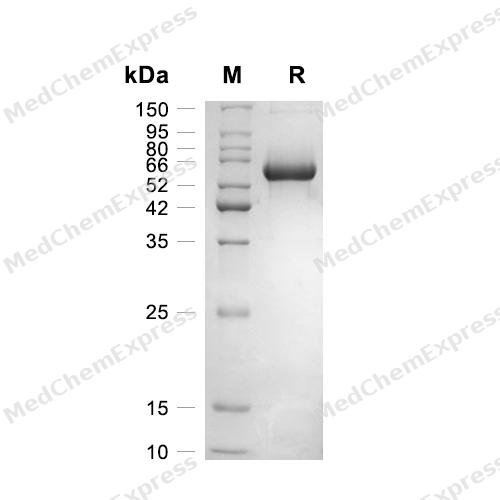
Purity - SDS-PAGE


Technical Parameters
-
Species Mouse
-
Source HEK293
-
Tag C-8*His
-
Accession
B7XGA6/BAH03518.1 (F18-S502)
-
Molecular Construction
-
N-term
-
ALPL (F18-S502)
Accession # B7XGA6/BAH03518.1 -
8*His
-
C-term
-
-
Protein Length
Partial
-
Synonyms
ALPL; Alkaline Phosphatase, Liver/Bone/Kidney; Prev. HOPS; TNS-ALP; TNSALP; Liver/Bone/Kidney-Type Alkaline Phosphatase; Alkaline Phosphatase, Tissue-Nonspecific Isozyme; Tissue-Nonspecific ALP; Alkaline Phosphatase Liver/Bone/Kidney Isozyme; Alkaline Pho
-
AA Sequence
FVPEKERDPSYWRQQAQETLKNALKLQKLNTNVAKNVIMFLGDGMGVSTVTAARILKGQLHHNTGEETRLEMDKFPFVALSKTYNTNAQVPDSAGTATAYLCGVKANEGTVGVSAATERTRCNTTQGNEVTSILRWAKDAGKSVGIVTTTRVNHATPSAAYAHSADRDWYSDNEMPPEALSQGCKDIAYQLMHNIKDIDVIMGGGRKYMYPKNRTDVEYELDEKARGTRLDGLDLISIWKSFKPRHKHSHYVWNRTELLALDPSRVDYLLGLFEPGDMQYELNRNNLTDPSLSEMVEVALQILTKNPKGFFLLVEGGRIDHGHHEGKAKQALHEAVEMDQAIGKAGAMTSQKDTLTVVTADHSHVFTFGGYTPRGNSIFGLAPMVSDTDKKPFTAILYGNGPGYKVVDGERENVSMVDYAHNNYQAQSAVPLRHETHGGEDVAVFAKGPMAHLLHGVHEQNYIPHVMAYASCIGANLDHCAWAGS
-
Molecular Weight
Approximately 55 kDa
-
Purity
≥ 95%, as determined by reducing SDS-PAGE.


Product Properties
Lyophilized powder
Lyophilized from a 0.2 μm filtered solution of 20 mM PB, 150 mM NaCl, pH 7.4.
<1 EU/μg, determined by LAL method.
It is not recommended to reconstitute to a concentration less than 100 μg/mL in ddH2O. For long term storage it is recommended to add a carrier protein (0.1% BSA, 5% HSA, 10% FBS or 5% Trehalose).
Stored at -20°C for 2 years from date of receipt. After reconstitution, it is stable at 4°C for 1 week or -20°C for longer (with carrier protein). It is recommended to freeze aliquots at -20°C or -80°C for extended storage.
Room temperature in continental US; may vary elsewhere.


Documentation
-
Data Sheet (239 KB)
-
SDS (254 KB)
- English - EN (254 KB)
- Français - FR (254 KB)
- Deutsch - DE (254 KB)
- Norwegian - NO (254 KB)
- Español - ES (254 KB)
- Swedish - SV (254 KB)
- Italian - IT (254 KB)
- Korean - KR (254 KB)
- Portuguese - PT (254 KB)
-
Handling Instructions (2659 KB)

Calculators
Concentration (start) × Volume (start) = Concentration (final) × Volume (final)


 Powered by Bioz

