



BCA-1/CXCL13 Protein, Cynomolgus (His)

Based on 1 Customer Validation
CXCL13, known as BCA-1 (B cell-attracting chemokine 1) or BLC (B-lymphocyte chemoattractant), is an efficacious attractant selective for B lymphocytes through binding to the BLR1/CXCR5 receptor. CXCL13 is a homeostatic chemokine, and is constitutively secreted by stromal cells in B-cell areas of secondary lymphoid tissues (follicles), such as spleen, lymph nodes, tonsils, and Peyer's patches. BCA-1/CXCL13 Protein, Cynomolgus (His) is produced in E. coli with a N-Terminal His-tag.
- Species: Cynomolgus
- Source: E. coli
-
Storage:Stored at -20°C for 2 years from date of receipt. After reconstitution, it is stable at 4°C for 1 week or -20°C for longer (with carrier protein). It is recommended to freeze aliquots at -20°C or -80°C for extended storage.


To place orders, for customer services and technical support, please contact: MedChemExpress USA
Tel: 609-228-6898 E-mail: [email protected] [email protected]


-
 Biological Activity
-
Technical Parameters
-
Product Properties
- Documentation
- References
- Help & FAQs




Biological Activity
Description
CXCL13, known as BCA-1 (B cell-attracting chemokine 1) or BLC (B-lymphocyte chemoattractant), is an efficacious attractant selective for B lymphocytes through binding to the BLR1/CXCR5 receptor[1]. CXCL13 is a homeostatic chemokine, and is constitutively secreted by stromal cells in B-cell areas of secondary lymphoid tissues (follicles), such as spleen, lymph nodes, tonsils, and Peyer's patches[2]. BCA-1/CXCL13 Protein, Cynomolgus (His) is produced in E. coli with a N-Terminal His-tag.
Background
CXCL13, also known as B lymphocyte chemoattractant, is originally identified in stromal cells in B cell follicles as regulating homing of B cells and subsets of T cells. CXCL13 plays a key role in orchestrating cell migration within spatially distinct regions of the secondary lymphoid organs. It strongly attracts B lymphocytes while promoting migration of only small numbers of T cells and macrophages. CXCL13 and its receptor, CXCR5, play fundamental roles in inflammatory, infectious, cancer and immune responses[1][2][3].
The amino acid sequence of human CXCL13 protein has low homology with mouse CXCL13 protein.
CXCL13 exerts its functions through its receptor CXCR5. CXCR5 is highly expressed on mature recirculating B-lymphocytes, a subpopulation of follicular helper T cells (TFH) and skin-derived migratory dendritic cells (DCs), and controls their migration into secondary lymphoid organs towards the gradient of CXCL13. As the loss of the BLR1/CXCR5 receptor is sufficient to disrupt organization of follicles in spleen and Peyer's patches, BCA-1 may act as a B cell homing chemokine. Human BCA-1 competes with radiolabeled IFN-γ inducible protein 10 (IP-10) for binding to the human CXCR3 receptor expressed in Ba/F3 and 293EBNA cell lines. Furthermore, human BCA-1 is an efficacious attractant for human CXCR3 transfected cells. BCA-1 does oes not induce calcium release in B-lymphocytes. In addition, human BCA-1 is an agonist in stimulating GTP gamma S binding. Human BCA-1 is a specific and functional G-protein-linked chemotactic ligand for the human CXCR3 receptor. CXCL13 has been widely implicated in the pathogenesis of a number of autoimmune diseases and inflammatory conditions, as well as in lymphoproliferative disorders. In addition, the CXCL13:CXCR5 axis orchestrates cell-cell interactions that regulate lymphocyte infiltration within the tumor microenvironment[1][2][3].
Dysregulation of the CXCL13:CXCR5 axis affecting both B- and TFH cell function is major player in autoimmune disorders, and potentially serves as a biomarker for disease progression and therapeutic response. Moreover, expression of CXCR5 and CXCL13 is shown to be dysregulated in HIV infection, such that the number of CXCR5+ B cells decreases with progression of HIV infection, together with an increase in plasma levels of CXCL13. CXCL13/CXCR5 signaling modulates cancer cell ability to grow, proliferate, invade, and metastasize. CXCL13 drives spinal astrocyte activation and neuropathic pain via CXCR5[1][2][3][4].
Verified Bioactivity
Measured by its ability to chemoattract Ramos cells. The ED50 for this effect is 0.019 μg/mL, corresponding to a specific activity is 5.263×10⁴ U/mg.
MCE Validation Data
-
Purity - SDS-PAGE
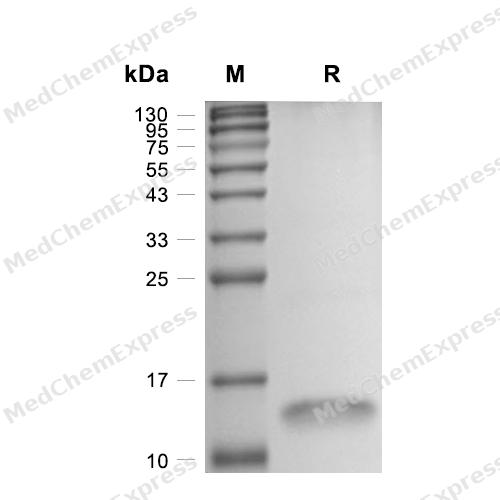
Purity - SDS-PAGE
-
Bioactivity - Cell-Based Assay
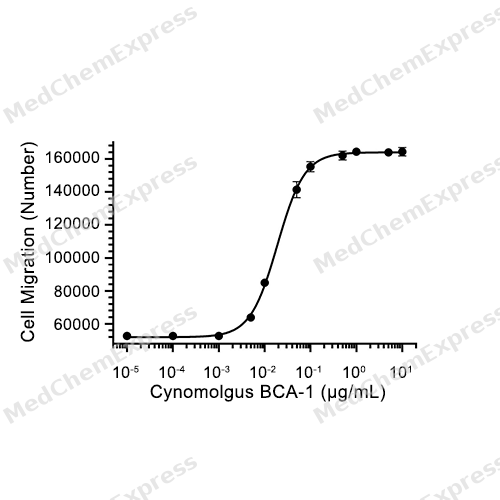
Bioactivity - Cell-Based Assay


Technical Parameters
-
Species Cynomolgus
-
Source E. coli
-
Tag N-10*His
-
Accession
A0A2K5V497 (V23-P109)
-
Gene ID/
-
Molecular Construction
-
N-term
-
His
-
CXCL13 (V23-P109)
Accession # A0A2K5V497 -
C-term
-
-
Protein Length
Full Length of Mature Protein
-
Synonyms
CXCL13; C-X-C Motif Chemokine 13; Prev. SCYB13; CXC Chemokine BLC; BCA-1; BCA1; BLC; B-Cell-Homing Chemokine (Ligand For Burkitt'S Lymphoma Receptor-1); ANGIE2; Chemokine (C-X-C Motif) Ligand 13 (B-Cell Chemoattractant); BLR1L; Chemokine (C-X-C Motif) Lig
-
AA Sequence
VLEVYYTHLRCRCVQESSVFIPRRFIDRIQISPRGNGCPRKEIIVWKKNKSVVCVDPQAEWIQRIMEMLRKKSSSTAPVPVFKRKIP
-
Predicted Molecular Mass
10.3 kDa
-
Molecular Weight
Approximately 14 kDa, based on SDS-PAGE under reducing conditions, due to the glycosylation.
-
Purity
≥ 95%, as determined by reducing SDS-PAGE.


Product Properties
Lyophilized powder.
Lyophilized from a 0.22 μm filtered solution of 10 mM Tris, 250 mM NaCl, pH 8.0.
Note: For SPR assay, please replace the buffer. Primary amine components (e.g., Tris, imidazole) can affect protein-coupled chips.
<1 EU/μg, determined by LAL method.
It is not recommended to reconstitute to a concentration less than 100 μg/mL in ddH2O. For long term storage it is recommended to add a carrier protein (0.1% BSA, 5% HSA, 10% FBS or 5% Trehalose).
Stored at -20°C for 2 years from date of receipt. After reconstitution, it is stable at 4°C for 1 week or -20°C for longer (with carrier protein). It is recommended to freeze aliquots at -20°C or -80°C for extended storage.
Room temperature in continental US; may vary elsewhere.


Documentation
-
Data Sheet (264 KB)
-
SDS (251 KB)
- English - EN (251 KB)
- Français - FR (251 KB)
- Deutsch - DE (251 KB)
- Norwegian - NO (251 KB)
- Español - ES (251 KB)
- Swedish - SV (251 KB)
- Italian - IT (251 KB)
- Korean - KR (251 KB)
- Portuguese - PT (251 KB)
-
Handling Instructions (2659 KB)


References
[1]. Jenh CH, et al. Human B cell-attracting chemokine 1 (BCA-1; CXCL13) is an agonist for the human CXCR3 receptor. Cytokine. 2001 Aug 7;15(3):113-21. [Content Brief]
[2]. Muzammal Hussain, et al. CXCL13/CXCR5 signaling axis in cancer. Life Sci. 2019 Jun 15;227:175-186. [Content Brief]
[3]. Marcelo G Kazanietz, et al. CXCL13 and Its Receptor CXCR5 in Cancer: Inflammation, Immune Response, and Beyond. Front Endocrinol (Lausanne). 2019 Jul 12;10:471. [Content Brief]
[4]. Bao-Chun Jiang, et al. CXCL13 drives spinal astrocyte activation and neuropathic pain via CXCR5. J Clin Invest. 2016 Feb;126(2):745-61. [Content Brief]

Calculators
Concentration (start) × Volume (start) = Concentration (final) × Volume (final)


 Powered by Bioz

