



Calreticulin/CALR Protein, Human (His)

Based on 1 Customer Validation
The calreticulin/CALR protein is a calcium-binding molecular chaperone that promotes ER folding and quality control. It interacts with monoglucosylated glycoproteins and promotes nuclear export of NR3C1. Calreticulin/CALR Protein, Human (His) is the recombinant human-derived Calreticulin/CALR protein, expressed by E. coli , with N-6*His labeled tag.
- Species: Human
- Source: E. coli
-
Storage:Stored at -20°C for 2 years from date of receipt. After reconstitution, it is stable at 4°C for 1 week or -20°C for longer (with carrier protein). It is recommended to freeze aliquots at -20°C or -80°C for extended storage.


To place orders, for customer services and technical support, please contact: MedChemExpress USA
Tel: 609-228-6898 E-mail: [email protected] [email protected]


-
 Biological Activity
-
Technical Parameters
-
Product Properties
- Documentation
- Help & FAQs




Biological Activity
Description
The calreticulin/CALR protein is a calcium-binding molecular chaperone that promotes ER folding and quality control. It interacts with monoglucosylated glycoproteins and promotes nuclear export of NR3C1. Calreticulin/CALR Protein, Human (His) is the recombinant human-derived Calreticulin/CALR protein, expressed by E. coli , with N-6*His labeled tag.
Background
Calreticulin/CALR protein is a calcium-binding chaperone that plays a crucial role in the endoplasmic reticulum (ER) by promoting folding, oligomeric assembly, and quality control. It achieves this through the calreticulin/calnexin cycle, where it interacts transiently with almost all monoglucosylated glycoproteins synthesized in the ER. Additionally, calreticulin/CALR protein interacts with the DNA-binding domain of NR3C1, facilitating its nuclear export. It is also involved in the regulation of maternal gene expression and may participate in oocyte maturation by regulating calcium homeostasis. During oocyte activation, calreticulin/CALR protein is exocytosed from cortical granules and potentially contributes to the blockage of polyspermy. It exists as a monomer and is part of an EIF2 complex composed of various proteins such as CELF1/CUGBP1, CALR, CALR3, EIF2S1, EIF2S2, HSP90B1, and HSPA5. Calreticulin/CALR protein interacts with several other proteins, including PDIA3/ERp57, SPACA9, TRIM21, NR3C1, PPIB, PDIA5, GABARAP, HLA-E-B2M, HLA-G-B2M complexes, HLA-F, and CLCC1.
Verified Bioactivity
When Recombinant Human CALR is immobilized at 2.5 µg/mL(100 µL/well) can bind Anti-CALR Antibody. The ED50 for this effect is <15 ng/mL.
MCE Validation Data
-
Purity - SDS-PAGE
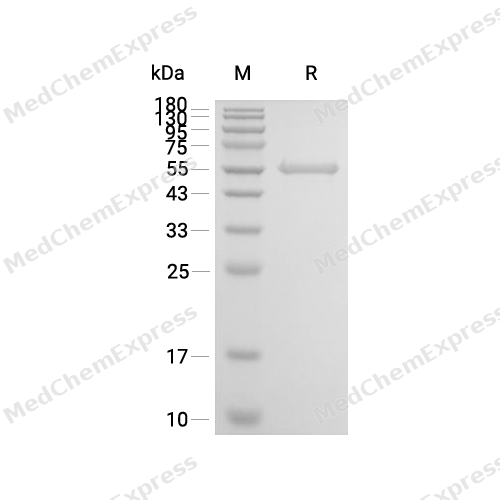
Purity - SDS-PAGE
-
Bioactivity - ELISA
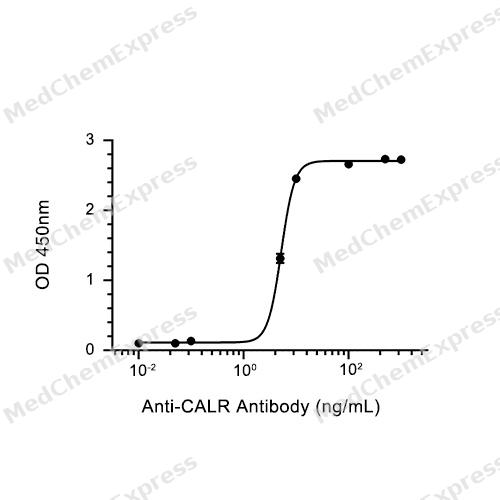
Bioactivity - ELISA


Technical Parameters
-
Species Human
-
Source E. coli
-
Tag N-6*His
-
Accession
P27797 (E18-L417)
-
Molecular Construction
-
N-term
-
6*His
-
CALR (E18-L417)
Accession # P27797 -
C-term
-
-
Protein Length
Full Length of Mature Protein
-
Synonyms
CALR; FLJ26680; Calreticulin; CRP55; Calregulin; ERp60; CC1qR; HACBP; CALR1; Grp60; SSA; Epididymis Secretory Sperm Binding Protein Li 99n; CRT; Autoantigen Ro; RO; HEL-S-99n; Sicca Syndrome Antigen A (Autoantigen Ro; Calreticulin); CRTC; Endoplasmic Reti
-
AA Sequence
EPAVYFKEQFLDGDGWTSRWIESKHKSDFGKFVLSSGKFYGDEEKDKGLQTSQDARFYALSASFEPFSNKGQTLVVQFTVKHEQNIDCGGGYVKLFPNSLDQTDMHGDSEYNIMFGPDICGPGTKKVHVIFNYKGKNVLINKDIRCKDDEFTHLYTLIVRPDNTYEVKIDNSQVESGSLEDDWDFLPPKKIKDPDASKPEDWDERAKIDDPTDSKPEDWDKPEHIPDPDAKKPEDWDEEMDGEWEPPVIQNPEYKGEWKPRQIDNPDYKGTWIHPEIDNPEYSPDPSIYAYDNFGVLGLDLWQVKSGTIFDNFLITNDEAYAEEFGNETWGVTKAAEKQMKDKQDEEQRLKEEEEDKKRKEEEEAEDKEDDEDKDEDEEDEEDKEEDEEEDVPGQAKDEL
-
Molecular Weight
Approximately 54 kDa, based on SDS-PAGE under reducing conditions.
-
Purity
≥ 90%, as determined by reducing SDS-PAGE.


Product Properties
Lyophilized powder.
1.Lyophilized from a 0.22 μm filtered solution of 20 mM Tris-HC1, 0.5 M NaCl, 6% Trehalose, pH 8.0.
2.Lyophilized from a 0.22 μm filtered solution of PBS, pH 7.4, 8% trehalose.
Please refer to the lot-specific COA for specific buffer information.
Note: For SPR assay, please replace the buffer. Primary amine components (e.g., Tris, imidazole) can affect protein-coupled chips.
<1 EU/μg, determined by LAL method.
It is not recommended to reconstitute to a concentration less than 100 μg/mL in ddH2O.
Stored at -20°C for 2 years from date of receipt. After reconstitution, it is stable at 4°C for 1 week or -20°C for longer (with carrier protein). It is recommended to freeze aliquots at -20°C or -80°C for extended storage.
Room temperature in continental US; may vary elsewhere.


Documentation
-
Data Sheet (238 KB)
-
SDS (252 KB)
- English - EN (252 KB)
- Français - FR (252 KB)
- Deutsch - DE (252 KB)
- Norwegian - NO (252 KB)
- Español - ES (252 KB)
- Swedish - SV (252 KB)
- Italian - IT (252 KB)
- Korean - KR (252 KB)
- Portuguese - PT (252 KB)
-
Handling Instructions (2659 KB)

Calculators
Concentration (start) × Volume (start) = Concentration (final) × Volume (final)


 Powered by Bioz

