



Carnosine Dipeptidase 1/CNDP1 Protein, Human (HEK293, His)

Based on 1 Customer Validation
Carnosine Dipeptidase 1 Protein, Human (HEK293, His) is a human carnosine dipeptidase 1 protein with a his-flag, expressed in HEK293 cells. Carnosine Dipeptidase 1 is a member of the M20 metalloprotease family, encoded by the CNDP1 gene.
- Species: Human
- Source: HEK293
-
Storage:Stored at -80°C for 1 year from date of receipt. It is stable at -20°C for 3 months after opening. It is recommended to freeze aliquots at -80°C for extended storage. Avoid repeated freeze-thaw cycles.


To place orders, for customer services and technical support, please contact: MedChemExpress USA
Tel: 609-228-6898 E-mail: [email protected] [email protected]


-
 Biological Activity
-
Technical Parameters
-
Product Properties
- Documentation
- References
- Help & FAQs




Biological Activity
Description
Carnosine Dipeptidase 1 Protein, Human (HEK293, His) is a human carnosine dipeptidase 1 protein with a his-flag, expressed in HEK293 cells. Carnosine Dipeptidase 1 is a member of the M20 metalloprotease family, encoded by the CNDP1 gene[1].
Background
Carnosine Dipeptidase 1 (CNDP1) is a member of the M20 metalloprotease family, a 57 kDa protein encoded by the CNDP1 gene. In humans, CNDP1 is secreted from the liver into the serum. In other mammals, CNDP1 is expressed exclusively within the kidney and lacks a signal peptide[1]. The function of CNDP1 is not fully defined, but it displays carboxy-and dipeptidase activity and its main substrates appear to be the dipeptides carnosine (β-alanyl-histidine) and homocarnosine (γ-aminobutyryl-L-histidine). Furthermore, this protein is shown to be reduced in metastatic prostate cancer and glioblastoma[1][2].
Verified Bioactivity
Measured by its ability to cleave carnosine (beta -Ala-L-His) in a two-step assay. The specific activity is 186.51 pmol/min/µg, as measured under the described conditions.
MCE Validation Data
-
Purity - SDS-PAGE
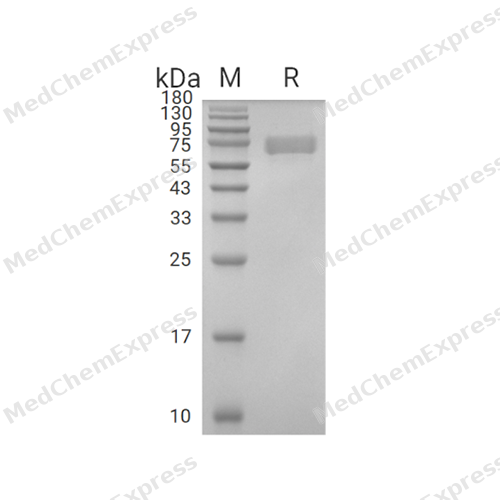
Purity - SDS-PAGE


Technical Parameters
-
Species Human
-
Source HEK293
-
Tag C-6*His
-
Accession
Q96KN2 (S27-L506)
-
Molecular Construction
-
N-term
-
CNDP1 (S27-L506)
Accession # Q96KN2 -
6*His
-
C-term
-
-
Protein Length
Full Length of Mature Protein
-
Synonyms
CNDP1; HsT2308; Carnosine Dipeptidase 1; Carnosine Dipeptidase 1 (Metallopeptidase M20 Family); CPGL2; CNDP Dipeptidase 1; CN1; Serum Carnosinase; Glutamate Carboxypeptidase-Like Protein 2; Carnosinase 1; Beta-Ala-His Dipeptidase; MGC10825
-
AA Sequence
SPSPPPALLEKVFQYIDLHQDEFVQTLKEWVAIESDSVQPVPRFRQELFRMMAVAADTLQRLGARVASVDMGPQQLPDGQSLPIPPVILAELGSDPTKGTVCFYGHLDVQPADRGDGWLTDPYVLTEVDGKLYGRGATDNKGPVLAWINAVSAFRALEQDLPVNIKFIIEGMEEAGSVALEELVEKEKDRFFSGVDYIVISDNLWISQRKPAITYGTRGNSYFMVEVKCRDQDFHSGTFGGILHEPMADLVALLGSLVDSSGHILVPGIYDEVVPLTEEEINTYKAIHLDLEEYRNSSRVEKFLFDTKEEILMHLWRYPSLSIHGIEGAFDEPGTKTVIPGRVIGKFSIRLVPHMNVSAVEKQVTRHLEDVFSKRNSSNKMVVSMTLGLHPWIANIDDTQYLAAKRAIRTVFGTEPDMIRDGSTIPIAKMFQEIVHKSVVLIPLGAVDDGEHSQNEKINRWNYIEGTKLFAAFFLEMAQL
-
Predicted Molecular Mass
54.9 kDa
-
Molecular Weight
Approximately 65-78 kDa, based on SDS-PAGE under reducing conditions.
-
Glycosylation
Yes
-
Purity
≥ 95%, as determined by reducing SDS-PAGE.


Product Properties
Solution
Supplied as a 0.22 μm filter solution of 20 mM Tris-HCl, 150 mM NaCl, pH 7.5.
Note: For SPR assay, please replace the buffer. Primary amine components (e.g., Tris, imidazole) can affect protein-coupled chips.
<1 EU/μg, determined by LAL method.
Stored at -80°C for 1 year from date of receipt. It is stable at -20°C for 3 months after opening. It is recommended to freeze aliquots at -80°C for extended storage. Avoid repeated freeze-thaw cycles.
Shipping with dry ice.


Documentation
-
Data Sheet (264 KB)
-
SDS (252 KB)
- English - EN (252 KB)
- Français - FR (252 KB)
- Deutsch - DE (252 KB)
- Norwegian - NO (252 KB)
- Español - ES (252 KB)
- Swedish - SV (252 KB)
- Italian - IT (252 KB)
- Korean - KR (252 KB)
- Portuguese - PT (252 KB)
-
Handling Instructions (2659 KB)


References
[1]. Michael Teufel, et al. Sequence identification and characterization of human carnosinase and a closely related non-specific dipeptidase. J Biol Chem [Content Brief]
[2]. Peter Arner, et al. Circulating carnosine dipeptidase 1 associates with weight loss and poor prognosis in gastrointestinal cancer. PLoS One. 2015 Apr 21;10(4):e0123566. [Content Brief]

Calculators
Concentration (start) × Volume (start) = Concentration (final) × Volume (final)


 Powered by Bioz

