



CD39 Protein, Mouse (HEK293, His)

Based on 1 Customer Validation
The CD39 protein is expressed in the nervous system and regulates purinergic neurotransmission by hydrolyzing ATP and other nucleotides. It also prevents platelet aggregation by hydrolyzing platelet-activated ADP to AMP. CD39 Protein, Mouse (HEK293, His) is the recombinant mouse-derived CD39 protein, expressed by HEK293 , with C-6*His labeled tag.
- Species: Mouse
- Source: HEK293
-
Storage:Stored at -80°C for 1 year from date of receipt. It is stable at -20°C for 3 months after opening. It is recommended to freeze aliquots at -80°C for extended storage. Avoid repeated freeze-thaw cycles.


To place orders, for customer services and technical support, please contact: MedChemExpress USA
Tel: 609-228-6898 E-mail: [email protected] [email protected]


-
 Biological Activity
-
Technical Parameters
-
Product Properties
- Documentation
- Help & FAQs




Biological Activity
Description
The CD39 protein is expressed in the nervous system and regulates purinergic neurotransmission by hydrolyzing ATP and other nucleotides. It also prevents platelet aggregation by hydrolyzing platelet-activated ADP to AMP. CD39 Protein, Mouse (HEK293, His) is the recombinant mouse-derived CD39 protein, expressed by HEK293 , with C-6*His labeled tag.
Background
CD39 protein, prominently expressed in the nervous system, plays a crucial role in the regulation of purinergic neurotransmission by hydrolyzing ATP and other nucleotides. Additionally, CD39 is implicated in preventing platelet aggregation through the hydrolysis of platelet-activating ADP to AMP. Notably, CD39 exhibits equal proficiency in hydrolyzing both ATP and ADP, underscoring its versatility in modulating purinergic signaling pathways and contributing to regulatory mechanisms that influence neurotransmission and platelet function. The dual enzymatic activity of CD39 highlights its significance in maintaining the delicate balance of purinergic signaling within the nervous system and the broader context of hemostasis.
MCE Validation Data
-
Purity - SDS-PAGE
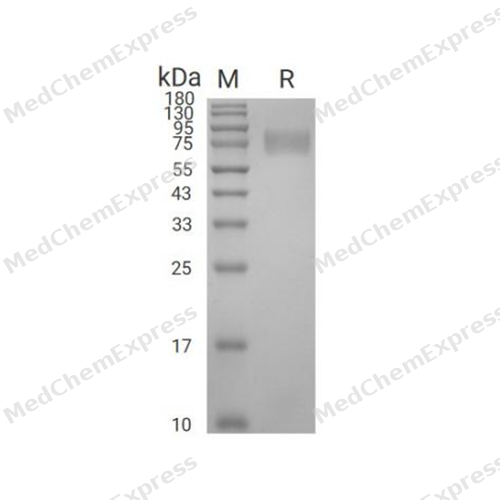
Purity - SDS-PAGE


Technical Parameters
-
Species Mouse
-
Source HEK293
-
Tag C-6*His
-
Accession
P55772 (T38-I478)
-
Molecular Construction
-
N-term
-
CD39 (T38-I478)
Accession # P55772 -
6*His
-
C-term
-
-
Protein Length
Extracellular Domain
-
Synonyms
ENTPD1; ATP Diphosphohydrolase; Prev. CD39; Ecto-ATPase 1; ATPDase; CD39 Antigen; NTPDase-1; Ecto-Apyrase; SPG64; NTPDase1; Nucleoside Triphosphate Diphosphohydrolase 1; ATP-DPH; Lymphoid Cell Activation Antigen; Alternative Protein ENTPD1; Ecto-ATP Dipho
-
AA Sequence
TQNKPLPENVKYGIVLDAGSSHTNLYIYKWPAEKENDTGVVQQLEECQVKGPGISKYAQKTDEIGAYLAECMELSTELIPTSKHHQTPVYLGATAGMRLLRMESEQSADEVLAAVSTSLKSYPFDFQGAKIITGQEEGAYGWITINYLLGRFTQEQSWLSLISDSQKQETFGALDLGGASTQITFVPQNSTIESPENSLQFRLYGEDYTVYTHSFLCYGKDQALWQKLAKDIQVSSGGVLKDPCFNPGYEKVVNVSELYGTPCTKRFEKKLPFDQFRIQGTGDYEQCHQSILELFNNSHCPYSQCAFNGVFLPPLHGSFGAFSAFYFVMDFFKKVAKNSVISQEKMTEITKNFCSKSWEETKTSYPSVKEKYLSEYCFSGAYILSLLQGYNFTDSSWEQIHFMGKIKDSNAGWTLGYMLNLTNMIPAEQPLSPPLPHSTYI
-
Predicted Molecular Mass
50.5 kDa
-
Molecular Weight
Approximately 60-90 kDa, based on SDS-PAGE under reducing conditions.
-
Glycosylation
Yes
-
Purity
≥ 95%, as determined by reducing SDS-PAGE.


Product Properties
Solution
Supplied as a 0.22 μm filtered solution of 20 mM Tris-HCl,500 mM NaCl, 10% glycerol, pH 7.4.
Note: For SPR assay, please replace the buffer. Primary amine components (e.g., Tris, imidazole) can affect protein-coupled chips.
<1 EU/μg, determined by LAL method.
Stored at -80°C for 1 year from date of receipt. It is stable at -20°C for 3 months after opening. It is recommended to freeze aliquots at -80°C for extended storage. Avoid repeated freeze-thaw cycles.
Shipping with dry ice.


Documentation
-
Data Sheet (238 KB)
-
SDS (251 KB)
- English - EN (251 KB)
- Français - FR (251 KB)
- Deutsch - DE (251 KB)
- Norwegian - NO (251 KB)
- Español - ES (251 KB)
- Swedish - SV (251 KB)
- Italian - IT (251 KB)
- Korean - KR (251 KB)
- Portuguese - PT (251 KB)
-
Handling Instructions (2659 KB)

Calculators
Concentration (start) × Volume (start) = Concentration (final) × Volume (final)


 Powered by Bioz

