



Claudin-18/CLDN18.2 Protein, Human (His)

Based on 1 Customer Validation
CLDN18 play a crucial role in alveolar fluid homeostasis by modulating tight junction composition, affecting ion transport and solute permeability. They contribute to alveolarization and the paracellular epithelial barrier, affecting epithelial progenitor cell proliferation and organ size by controlling YAP1 subcellular localization. Claudin-18/CLDN18.2 Protein, Human (His) is the recombinant human-derived Claudin-18/CLDN18.2 protein, expressed by E. coli , with N-8*His labeled tag. The complete sequence length is 172 amino acids. In addition to the target fragment P56856-2 (D28-L76), there are other fusion sequences that play a role in stabilizing the extracellular region.
- Species: Human
- Source: E. coli
-
Storage:Stored at -80°C for 1 year from date of receipt. It is stable at -20°C for 3 months after opening. It is recommended to freeze aliquots at -80°C for extended storage. Avoid repeated freeze-thaw cycles.


To place orders, for customer services and technical support, please contact: MedChemExpress USA
Tel: 609-228-6898 E-mail: [email protected] [email protected]


-
 Biological Activity
-
Technical Parameters
-
Product Properties
- Documentation
- Help & FAQs




Biological Activity
Description
CLDN18 play a crucial role in alveolar fluid homeostasis by modulating tight junction composition, affecting ion transport and solute permeability. They contribute to alveolarization and the paracellular epithelial barrier, affecting epithelial progenitor cell proliferation and organ size by controlling YAP1 subcellular localization. Claudin-18/CLDN18.2 Protein, Human (His) is the recombinant human-derived Claudin-18/CLDN18.2 protein, expressed by E. coli , with N-8*His labeled tag. The complete sequence length is 172 amino acids. In addition to the target fragment P56856-2 (D28-L76), there are other fusion sequences that play a role in stabilizing the extracellular region.
Background
CLDN18 play a crucial role in alveolar fluid homeostasis by regulating the composition of tight junctions in alveolar epithelial cells, impacting ion transport, and solute permeability, potentially through the modulation of actin cytoskeleton organization and beta-2-adrenergic signaling. Essential for lung alveolarization and the maintenance of the paracellular alveolar epithelial barrier, CLDN18 contribute to epithelial progenitor cell proliferation and organ size regulation by controlling the subcellular localization of YAP1 and restricting its target gene transcription. Additionally, CLDN18 act as a negative regulator of RANKL-induced osteoclast differentiation, possibly by influencing the subcellular distribution of TJP2/ZO-2 and participating in bone resorption in response to calcium deficiency. They mediate the osteoprotective effects of estrogen independently of RANKL signaling pathways. Furthermore, CLDN18 are implicated in maintaining the alveolar microenvironment homeostasis by regulating pH and subsequent T-cell activation, indirectly contributing to the limitation of C. neoformans infection.
MCE Validation Data
-
Purity - SDS-PAGE
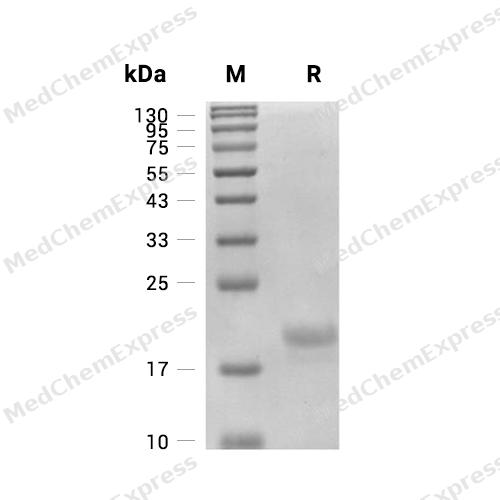
Purity - SDS-PAGE


Technical Parameters
-
Species Human
-
Source E. coli
-
Tag N-8*His
-
Accession
P56856-2 (D28-L76)
-
Molecular Construction
-
N-term
-
8*His
-
CLDN18 (D28-L76)
Accession # P56856-2 -
C-term
-
-
Protein Length
Extracellular Domain
-
Synonyms
CLDN18; Surfactant, Pulmonary Associated Protein J; Prev. SFTPJ; Claudin; Surfactant Associated Protein J; SFTA5; Claudin-18; Claudin 18; Surfactant Associated 5
-
AA Sequence
DQWSTQDLYNNPVTAVFNYQGLWRSCVRESSGFTECRGYFTLLGLPAML
-
Predicted Molecular Mass
19.7 kDa
-
Molecular Weight
Approximately 18 kDa, based on SDS-PAGE under reducing conditions.
-
Purity
≥ 95%, as determined by reducing SDS-PAGE.


Product Properties
Solution
1.Supplied as a 0.22 μm filtered solution of 25 mM Tris-HCl, 25 mM NaCl, 0.1% Triton X-100, 10% glycerol, pH 8.0.
2.Supplied as a 0.22 μm filtered solution of 25 mM Tris-HCl, 25 mM NaCl, 0.1% Triton X-100, 10% glycerol, 0.1 mM GSH, 0.01 mM GSSG, pH 8.0.
Please refer to the lot-specific COA for specific buffer information.
Note: For SPR assay, please replace the buffer. Primary amine components (e.g., Tris, imidazole) can affect protein-coupled chips.
<1 EU/μg, determined by LAL method.
Stored at -80°C for 1 year from date of receipt. It is stable at -20°C for 3 months after opening. It is recommended to freeze aliquots at -80°C for extended storage. Avoid repeated freeze-thaw cycles.
Shipping with dry ice.


Documentation
-
Data Sheet (235 KB)
-
SDS (252 KB)
- English - EN (252 KB)
- Français - FR (252 KB)
- Deutsch - DE (252 KB)
- Norwegian - NO (252 KB)
- Español - ES (252 KB)
- Swedish - SV (252 KB)
- Italian - IT (252 KB)
- Korean - KR (252 KB)
- Portuguese - PT (252 KB)
-
Handling Instructions (2659 KB)

Calculators
Concentration (start) × Volume (start) = Concentration (final) × Volume (final)


 Powered by Bioz

