



CLIC1 Protein, Human (N-His)

Based on 1 Customer Validation
The CLIC1 protein exhibits specific lysophospholipase activity and plays a critical role in mediating cellular responses to oxidative stress. As a member of the chloride intracellular channel family, CLIC1 is involved in a variety of physiological processes, including cell volume regulation, membrane potential regulation, and regulation of cell cycle progression. CLIC1 Protein, Human (N-His) is the recombinant human-derived CLIC1 protein, expressed by E. coli , with N-6*His labeled tag.
- Species: Human
- Source: E. coli
-
Storage:Stored at -20°C for 2 years from date of receipt. After reconstitution, it is stable at 4°C for 1 week or -20°C for longer (with carrier protein). It is recommended to freeze aliquots at -20°C or -80°C for extended storage.


To place orders, for customer services and technical support, please contact: MedChemExpress USA
Tel: 609-228-6898 E-mail: [email protected] [email protected]


-
 Biological Activity
-
Technical Parameters
-
Product Properties
- Documentation
- Help & FAQs




Biological Activity
Description
The CLIC1 protein exhibits specific lysophospholipase activity and plays a critical role in mediating cellular responses to oxidative stress. As a member of the chloride intracellular channel family, CLIC1 is involved in a variety of physiological processes, including cell volume regulation, membrane potential regulation, and regulation of cell cycle progression. CLIC1 Protein, Human (N-His) is the recombinant human-derived CLIC1 protein, expressed by E. coli , with N-6*His labeled tag.
Background
CLIC1 protein can insert into membranes and form chloride ion channels, while CLIC1 channel activity depends on the pH. Membrane insertion seems to be redox-regulated and may occur only under oxydizing conditions. CLIC1 is involved in regulation of the cell cycle. CLIC1 seems to have very low affinity for glutathione, even though glutathione binding was observed in protein crystals.
MCE Validation Data
-
Purity - SDS-PAGE
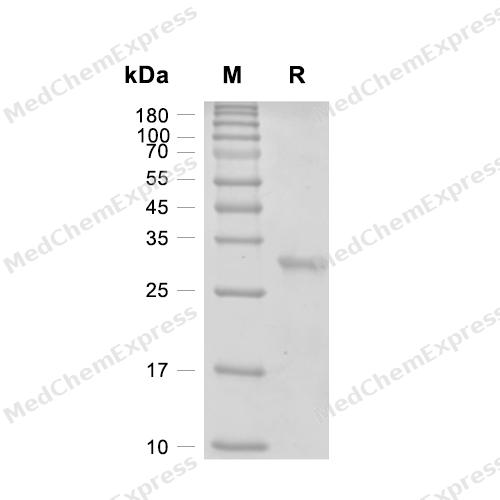
Purity - SDS-PAGE


Technical Parameters
-
Species Human
-
Source E. coli
-
Tag N-6*His
-
Accession
O00299 (A2-K241)
-
Molecular Construction
-
N-term
-
6*His
-
CLIC1 (A2-K241)
Accession # O00299 -
C-term
-
-
Protein Length
Full Length
-
Synonyms
CLIC1; Glutaredoxin-Like Oxidoreductase CLIC1; Chloride Intracellular Channel 1; Nuclear Chloride Ion Channel 27; NCC27; Chloride Channel ABP; G6; HRNCC; P64CLCP; Chloride Intracellular Channel Protein; CLCNL1; Nuclear Chloride Ion Channel Protein; Glutat
-
AA Sequence
AEEQPQVELFVKAGSDGAKIGNCPFSQRLFMVLWLKGVTFNVTTVDTKRRTETVQKLCPGGQLPFLLYGTEVHTDTNKIEEFLEAVLCPPRYPKLAALNPESNTAGLDIFAKFSAYIKNSNPALNDNLEKGLLKALKVLDNYLTSPLPEEVDETSAEDEGVSQRKFLDGNELTLADCNLLPKLHIVQVVCKKYRGFTIPEAFRGVHRYLSNAYAREEFASTCPDDEEIELAYEQVAKALK
-
Predicted Molecular Mass
27 kDa
-
Molecular Weight
Approximately 29 kDa, based on SDS-PAGE under reducing conditions.
-
Purity
≥ 90%, as determined by reducing SDS-PAGE.


Product Properties
Lyophilized powder.
Lyophilized from a 0.22 μm filtered solution of 50 mM Tris-HCl, 300 mM NaCl, pH 7.4, 5% trehalose, 5% mannitol and 0.01% Tween 80.
Note: For SPR assay, please replace the buffer. Primary amine components (e.g., Tris, imidazole) can affect protein-coupled chips.
<1 EU/μg, determined by LAL method.
It is not recommended to reconstitute to a concentration less than 100 μg/mL in ddH2O.
Stored at -20°C for 2 years from date of receipt. After reconstitution, it is stable at 4°C for 1 week or -20°C for longer (with carrier protein). It is recommended to freeze aliquots at -20°C or -80°C for extended storage.
Room temperature in continental US; may vary elsewhere.


Documentation
-
Data Sheet (236 KB)
-
SDS (251 KB)
- English - EN (251 KB)
- Français - FR (251 KB)
- Deutsch - DE (251 KB)
- Norwegian - NO (251 KB)
- Español - ES (251 KB)
- Swedish - SV (251 KB)
- Italian - IT (251 KB)
- Korean - KR (251 KB)
- Portuguese - PT (251 KB)
-
Handling Instructions (2659 KB)

Calculators
Concentration (start) × Volume (start) = Concentration (final) × Volume (final)


 Powered by Bioz

