



E-selectin/CD62E Protein, Cynomolgus (HEK293, His)

Based on 1 Customer Validation
The E-selectin/CD62E protein belongs to the selectin/LECAM family and plays a crucial role in mediating cell adhesion processes, particularly the interaction between leukocytes and endothelial cells. As a member of this family, E-selectin may have conserved characteristics, underscoring its importance in cell adhesion. E-selectin/CD62E Protein, Cynomolgus (HEK293, His) is the recombinant cynomolgus-derived E-selectin/CD62E protein, expressed by HEK293 , with C-His labeled tag.
- Species: Cynomolgus
- Source: HEK293
-
Storage:Stored at -20°C for 2 years from date of receipt. After reconstitution, it is stable at 4°C for 1 week or -20°C for longer (with carrier protein). It is recommended to freeze aliquots at -20°C or -80°C for extended storage.


To place orders, for customer services and technical support, please contact: MedChemExpress USA
Tel: 609-228-6898 E-mail: [email protected] [email protected]


-
 Biological Activity
-
Technical Parameters
-
Product Properties
- Documentation
- Help & FAQs




Biological Activity
Description
The E-selectin/CD62E protein belongs to the selectin/LECAM family and plays a crucial role in mediating cell adhesion processes, particularly the interaction between leukocytes and endothelial cells. As a member of this family, E-selectin may have conserved characteristics, underscoring its importance in cell adhesion. E-selectin/CD62E Protein, Cynomolgus (HEK293, His) is the recombinant cynomolgus-derived E-selectin/CD62E protein, expressed by HEK293 , with C-His labeled tag.
Background
The E-selectin/CD62E Protein is a vital member of the selectin/LECAM family, signifying its significant role in cell adhesion processes. As part of this family, E-selectin likely shares conserved structural and functional features with related proteins, indicating its involvement in mediating interactions between leukocytes and endothelial cells. The classification within the selectin/LECAM family underscores its specific designation within the broader context of cell adhesion molecules, providing insights into its unique contributions to cellular adhesion. The study of E-selectin/CD62E contributes to our understanding of its role in inflammatory responses and immune cell trafficking, offering potential applications in therapeutic interventions and a deeper comprehension of its broader impact on cellular processes involved in immune surveillance and inflammation. Further exploration of E-selectin/CD62E's role holds promise for enhancing our knowledge of its contributions to normal physiology and pathological conditions.
Verified Bioactivity
Measured by the ability of the immobilized protein to support the adhesion of U937 human histiocytic lymphoma cells. The ED50 for this effect is 29.560 ng/mL, corresponding to a specific activity is 3.392×10⁴ units/mg.
MCE Validation Data
-
Purity - SDS-PAGE
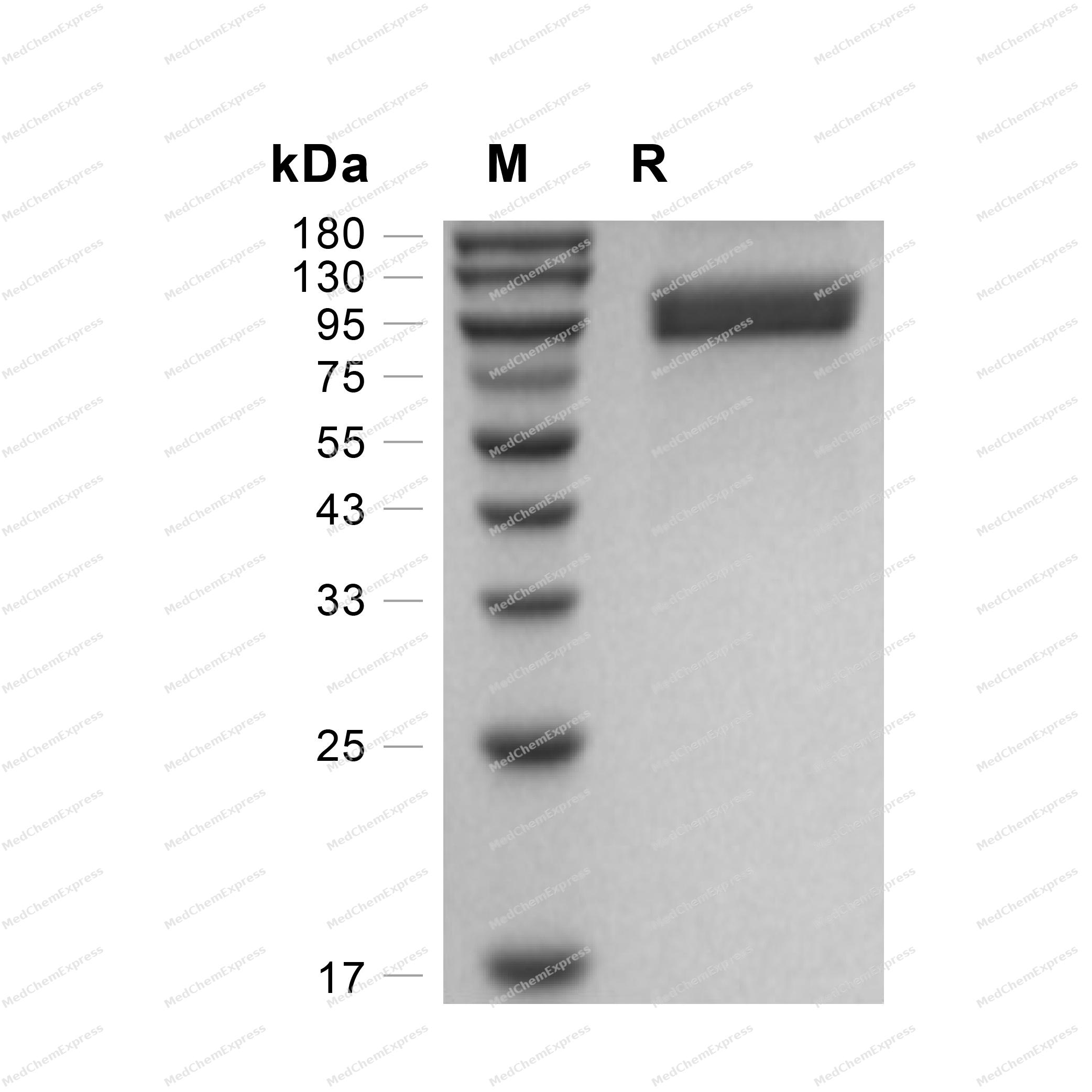
Purity - SDS-PAGE
-
Bioactivity - Cell-Based Assay
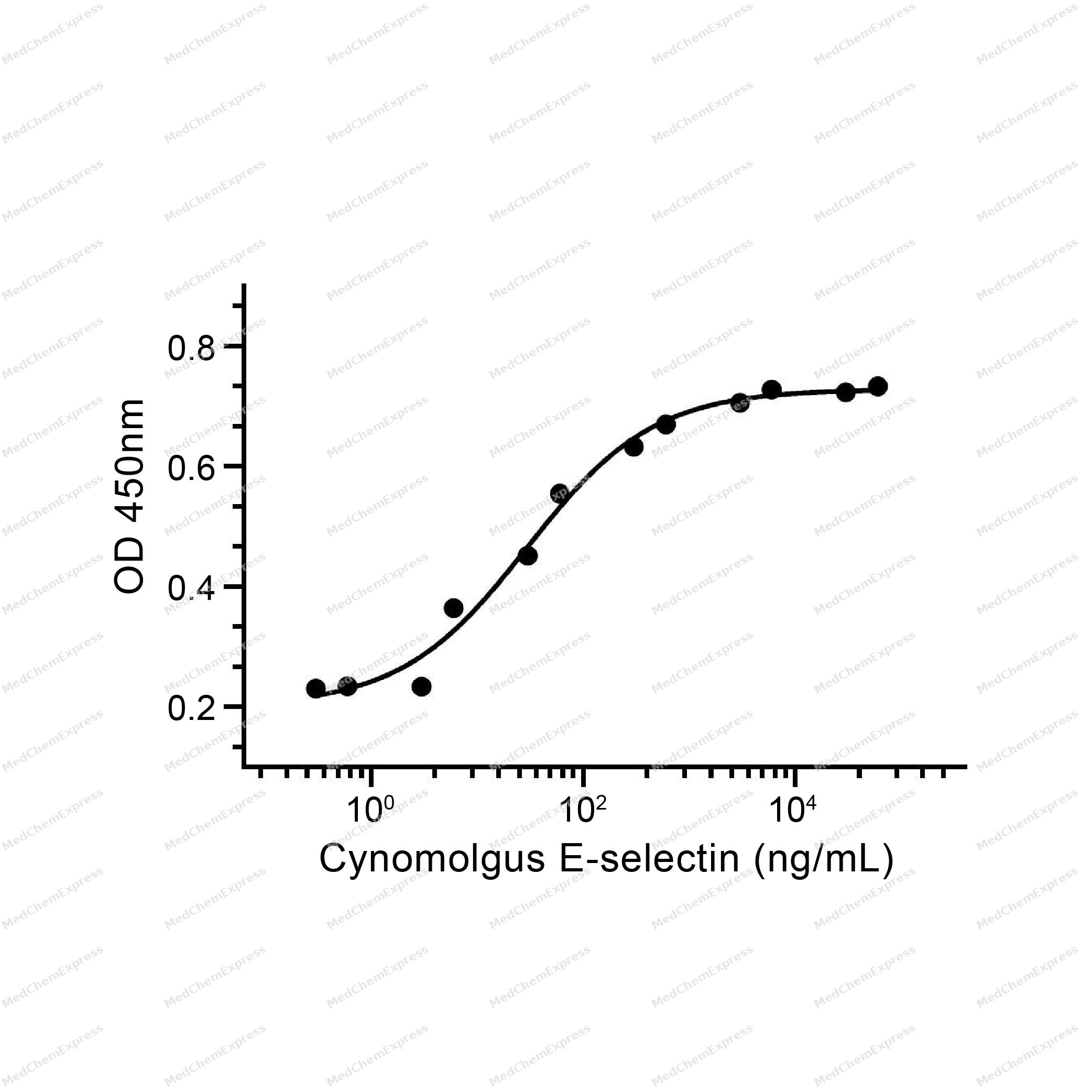
Bioactivity - Cell-Based Assay


Technical Parameters
-
Species Cynomolgus
-
Source HEK293
-
Tag C-His
-
Accession
G8F370 (W22-P556)
-
Gene ID/
-
Molecular Construction
-
N-term
-
CD62E (W22-P556)
Accession # G8F370 -
His
-
C-term
-
-
Protein Length
Partial
-
Synonyms
SELE; ESEL; Prev. ELAM1; Endothelial Adhesion Molecule 1; Prev. ELAM; ELAM-1; Endothelial Leukocyte Adhesion Molecule 1; LECAM2; CD62 Antigen-Like Family Member E; Leukocyte Endothelial Cell Adhesion Molecule 2; E-Selectin; CD62E Antigen; CD62E; Selectin-
-
AA Sequence
WSYNTSTEAMTYDEASAYCQQRYTHLVAIQNKEEIEYLNSILSYSPSYYWIGIRKVNNVWVWVGTQKPLTEEAKNWAPGEPNNRQKDEDCVEIYIKRDKDVGMWNDERCSKKKLALCYTAACTNTSCSGHGECVETINNYTCKCDPGFSGLECEQIVNCTALESPEHGSLVCSHPLGNFSYSSSCSVSCDRGYLPSSVETTQCMSSGEWSVPIPACKVVECDAVTNPANGFVECFQNPGSFPWNTTCTFDCEEGFELMGAQSLQCTSSGNWDNEKPTCKAVTCRAIRQPQNGSVRCSHSPAGEFTFKSSCNFTCEEGFMLQGAAQVECTTQGQWTQQVPVCEAFQCTALSNPERGYMNCLPSASGSFRNGSSCEFSCEQGFVLKGSKRLQCGPTGEWDNEKPTCEAVRCDAVHQPQRGLVRCAHSPIGEFTYKSSCAFSCEEGFELHGSTQLECTSQGQWTEEVPSCQVVKCSSLAVLEKINMSCSGEPVFGTVCNFACPEGWRLNGSAAMTCGATGHWSGMLPTCEAPTESNTP
-
Molecular Weight
Approximately 90-100 kDa, based on SDS-PAGE under reducing conditions.
-
Purity
≥ 95%, as determined by reducing SDS-PAGE.


Product Properties
Lyophilized powder
Lyophilized from a 0.2 μm filtered solution of PBS, pH 7.4. Normally 5 % - 8 % trehalose, mannitol and 0.01% Tween 80 are added as protectants before lyophilization.
<1 EU/μg, determined by LAL method.
It is not recommended to reconstitute to a concentration less than 100 μg/mL in ddH2O.
Stored at -20°C for 2 years from date of receipt. After reconstitution, it is stable at 4°C for 1 week or -20°C for longer (with carrier protein). It is recommended to freeze aliquots at -20°C or -80°C for extended storage.
Room temperature in continental US; may vary elsewhere.


Documentation
-
Data Sheet (239 KB)
-
SDS (251 KB)
- English - EN (251 KB)
- Français - FR (251 KB)
- Deutsch - DE (251 KB)
- Norwegian - NO (251 KB)
- Español - ES (251 KB)
- Swedish - SV (251 KB)
- Italian - IT (251 KB)
- Korean - KR (251 KB)
- Portuguese - PT (251 KB)
-
Handling Instructions (2659 KB)

Calculators
Concentration (start) × Volume (start) = Concentration (final) × Volume (final)


 Powered by Bioz

