



Fetuin A/AHSG Protein, Macaca nemestrina (HEK293, His)

Based on 1 Customer Validation
Fetuin A/AHSG Protein is a heterodimeric plasma glycoprotein containing an A-chain of 282 amino acids and a B-chain of 27 amino acid residues linked by a single inter-disulfide bond. Fetuin A is a plasma carrier protein that helps to transport and make a wide range of substances available in the bloodstream. Fetuin A is a hepatokine which has the capacity to prevent vascular calcification. Fetuin A is a multifunctional protein that plays important roles in diabetes, kidney disease, and cancer, as well as in inhibition of ectopic calcification. Fetuin A/AHSG Protein, Macaca nemestrina (HEK293, His) is the recombinant Fetuin A/AHSG protein, expressed by HEK293 , with C-10*His labeled tag.
- Species: Others
- Source: HEK293
-
Storage:Stored at -20°C for 2 years from date of receipt. After reconstitution, it is stable at 4°C for 1 week or -20°C for longer (with carrier protein). It is recommended to freeze aliquots at -20°C or -80°C for extended storage.


To place orders, for customer services and technical support, please contact: MedChemExpress USA
Tel: 609-228-6898 E-mail: [email protected] [email protected]


-
 Biological Activity
-
Technical Parameters
-
Product Properties
- Documentation
- Help & FAQs




Biological Activity
Description
Fetuin A/AHSG Protein is a heterodimeric plasma glycoprotein containing an A-chain of 282 amino acids and a B-chain of 27 amino acid residues linked by a single inter-disulfide bond. Fetuin A is a plasma carrier protein that helps to transport and make a wide range of substances available in the bloodstream. Fetuin A is a hepatokine which has the capacity to prevent vascular calcification. Fetuin A is a multifunctional protein that plays important roles in diabetes, kidney disease, and cancer, as well as in inhibition of ectopic calcification[1][2][3]. Fetuin A/AHSG Protein, Macaca nemestrina (HEK293, His) is the recombinant Fetuin A/AHSG protein, expressed by HEK293 , with C-10*His labeled tag.
Background
The molecular weight of Fetuin A ranges from 51 to 67 kDa, depending on the degree of glycosylation. It is a negatively charged glycoprotein circulating in the blood and extracellular fluid with several days of half-life[1].
Fetuin A is a hepatic secretory glycoprotein that promotes insulin resistance by inhibiting the insulin receptor tyrosine kinase in skeletal muscle and hepatocytes, serving as an adaptor protein for saturated fatty acids and allowing them to activate Toll-like receptor 4 (TLR4), thereby inducing inflammatory signaling and insulin resistance. Fetuin A inhibits soft tissue calcification through binding of small clusters of calcium and phosphate. Fetuin A enhances phagocytosis of extracellular vesicles and apoptotic cells by vascular smooth muscle cells and macrophages, reducing both apoptosis and calcification in cells subjected to elevated extracellular concentrations of mineral ions[1].
Fetuin A binds with a plethora of receptors and exhibits multifaceted physiological and pathological functions. It is involved in the regulation of calcium metabolism, osteogenesis, and the insulin signaling pathway. It also acts as an ectopic calcification inhibitor, protease inhibitor, inflammatory mediator, anti-inflammatory partner, atherogenic factor, and adipogenic factor, among other several moonlighting functions[2].
MCE Validation Data
-
Purity - SDS-PAGE
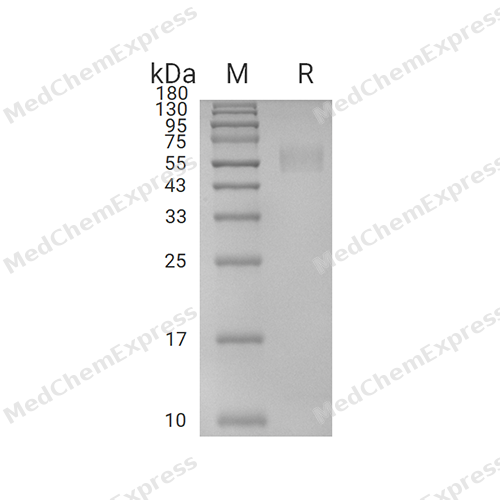
Purity - SDS-PAGE


Technical Parameters
-
Species Others
-
Source HEK293
-
Tag C-10*His
-
Accession
A0A2K6AQI2 (A19-V367)
-
Gene ID105480162 [NCBI]
-
Molecular Construction
-
N-term
-
AHSG (A19-V367)
Accession # A0A2K6AQI2 -
10*His
-
C-term
-
-
Protein Length
Full Length of Mature Protein
-
Synonyms
AHSG; HSGA; Alpha 2-HS Glycoprotein; Ba-Alpha-2-Glycoprotein; FETUA; Alpha-2-Z-Globulin; Alpha-2-HS-Glycoprotein; Fetuin A; Fetuin-A; APMR1; A2HS; AHS
-
AA Sequence
APHGPGLIYRQPNCDDPETEEAALVAVDYINQNLPWGYKHTLNQIDEVKVWPQQPFGEMFEIEIDTLETTCHVLDPTPVAGCRVRQLKEHAVEGDCDFQLLKVNGKFSVEYAKCDSSPDSAEDVRKVCRDCPLLAPLNDTRVVHAAEAAVTAFNAQNNGSNFQLEEISRAQLVPLPPSTYVEFTISGTDCVAKEATEAANCNLLAKKQYGFCKATLNEKLGGEEVAVTCTVFQTQPATSQPQPEGANEAVPTPVVDADAPASYPVGASGPLPTGSPIYAHVLAAAPPVVPIHSSHYDLRHLFMGVVSLRSPSGEALHPRKTRSVVQPSVGAAAGPVVPPCPGRVRHFKV
-
Predicted Molecular Mass
38.9 kDa
-
Molecular Weight
Approximately 45-70 kDa, based on SDS-PAGE under reducing conditions.
-
Purity
≥ 95%, as determined by reducing SDS-PAGE.


Product Properties
Lyophilized powder.
Lyophilized from a 0.22 μm filtered solution of PBS, pH 7.4.
<1 EU/μg, determined by LAL method.
It is not recommended to reconstitute to a concentration less than 100 μg/mL in ddH2O. For long term storage it is recommended to add a carrier protein (0.1% BSA, 5% HSA, 10% FBS or 5% Trehalose).
Stored at -20°C for 2 years from date of receipt. After reconstitution, it is stable at 4°C for 1 week or -20°C for longer (with carrier protein). It is recommended to freeze aliquots at -20°C or -80°C for extended storage.
Room temperature in continental US; may vary elsewhere.


Documentation
-
Data Sheet (238 KB)
-
SDS (252 KB)
- English - EN (252 KB)
- Français - FR (252 KB)
- Deutsch - DE (252 KB)
- Norwegian - NO (252 KB)
- Español - ES (252 KB)
- Swedish - SV (252 KB)
- Italian - IT (252 KB)
- Korean - KR (252 KB)
- Portuguese - PT (252 KB)
-
Handling Instructions (2659 KB)

Calculators
Concentration (start) × Volume (start) = Concentration (final) × Volume (final)


 Powered by Bioz

