



Fetuin B Protein, Mouse (HEK293, His)

Based on 1 Customer Validation
Fetub Protein, a glycoprotein, plays a significant role in regulating insulin sensitivity and lipid metabolism. Dysregulation of Fetub Protein has been associated with several diseases, including obesity and type 2 diabetes. Fetuin B Protein, Mouse (HEK293, His) is the recombinant mouse-derived Fetuin B protein, expressed by HEK293 , with C-His labeled tag.
- Species: Mouse
- Source: HEK293
-
Storage:Stored at -20°C for 2 years from date of receipt. After reconstitution, it is stable at 4°C for 1 week or -20°C for longer (with carrier protein). It is recommended to freeze aliquots at -20°C or -80°C for extended storage.


To place orders, for customer services and technical support, please contact: MedChemExpress USA
Tel: 609-228-6898 E-mail: [email protected] [email protected]


-
 Biological Activity
-
Technical Parameters
-
Product Properties
- Documentation
- Help & FAQs




Biological Activity
Description
Fetub Protein, a glycoprotein, plays a significant role in regulating insulin sensitivity and lipid metabolism. Dysregulation of Fetub Protein has been associated with several diseases, including obesity and type 2 diabetes. Fetuin B Protein, Mouse (HEK293, His) is the recombinant mouse-derived Fetuin B protein, expressed by HEK293 , with C-His labeled tag.
Background
Fetub protein is an essential protease inhibitor involved in the process of egg fertilization. Its primary role is to prevent the premature hardening of the zona pellucida before fertilization can take place. This is likely achieved through the inhibition of ASTL, a protease responsible for cleaving ZP2 and initiating the hardening of the zona pellucida.
MCE Validation Data
-
Purity - SDS-PAGE
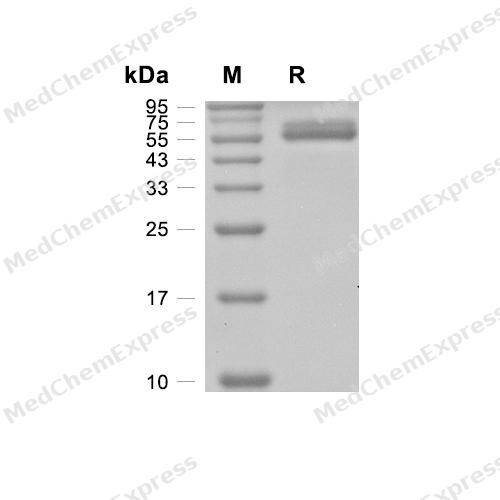
Purity - SDS-PAGE


Technical Parameters
-
Species Mouse
-
Source HEK293
-
Tag C-His
-
Accession
Q9QXC1 (R19-P388)
-
Molecular Construction
-
N-term
-
Fetuin B (R19-P388)
Accession # Q9QXC1 -
His
-
C-term
-
-
Protein Length
Full Length of Mature Protein
-
Synonyms
FETUB; 16G2; Fetuin B; Gugu; Fetuin-Like Protein IRL685; IRL685; Fetuin-B
-
AA Sequence
RSPPAPPLPQRPLSPLHPLGCNDSEVLAVAGFALQNINRDQKDGYMLSLNRVHDVREHYQEDMGSLFYLTLDVLETDCHVLSRKAQKDCKPRMFYESVYGQCKAMFHINKPRRVLYLPAYNCTLRPVSKRKTHTTCPDCPSPIDLSNPSALEAATESLAKFNSKSPSKKYELVKVTKAMNQWVSGPAYYVEYLIKEAPCTKSQASCSLQHSDSEPVGICQGSTVQSSLRHVPLIQPVEKSVTVTCEFFESQAQVPGDENPAVTQGPQKLPQKNTAPTSSPSVTAPRGSIQHLPELDDEKPEESKGGSPEEAFPVQLDLTTNPQGDTLDVSFLYLEPGDKKLVVLPFPGKEQRSAECPGPEKENNPLVLPP
-
Molecular Weight
Approximately 55-60 kDa, based on SDS-PAGE under reducing conditions, due to the glycosylation.
-
Glycosylation
Yes
-
Purity
≥ 95%, as determined by reducing SDS-PAGE.


Product Properties
Lyophilized powder.
Lyophilized from a 0.22 μm filtered solution of 20 mM Tris, 150 mM NaCl, pH 7.5.
Note: For SPR assay, please replace the buffer. Primary amine components (e.g., Tris, imidazole) can affect protein-coupled chips.
<1 EU/μg, determined by LAL method.
It is not recommended to reconstitute to a concentration less than 100 μg/mL in ddH2O. For long term storage it is recommended to add a carrier protein (0.1% BSA, 5% HSA, 10% FBS or 5% Trehalose).
Stored at -20°C for 2 years from date of receipt. After reconstitution, it is stable at 4°C for 1 week or -20°C for longer (with carrier protein). It is recommended to freeze aliquots at -20°C or -80°C for extended storage.
Room temperature in continental US; may vary elsewhere.


Documentation
-
Data Sheet (237 KB)
-
SDS (252 KB)
- English - EN (252 KB)
- Français - FR (252 KB)
- Deutsch - DE (252 KB)
- Norwegian - NO (252 KB)
- Español - ES (252 KB)
- Swedish - SV (252 KB)
- Italian - IT (252 KB)
- Korean - KR (252 KB)
- Portuguese - PT (252 KB)
-
Handling Instructions (2659 KB)

Calculators
Concentration (start) × Volume (start) = Concentration (final) × Volume (final)


 Powered by Bioz

