



FGF-12 Protein, Canine

Based on 1 Customer Validation
FGF-12 forms complexes with signaling proteins regulates the cytoskeletal system, binds to FGF receptors, activates signaling cascades to prevent apoptosis and interacts with ribosome biogenetic complexes. FGF-12 has been linked to neurological diseases, cancer and heart disease, making it a potential target and therapeutic agent for gene therapy. FGF-12 Protein, Canine is the recombinant canine-derived FGF-12 protein, expressed by E. coli , with tag free.
- Species: Canine
- Source: E. coli
-
Storage:Stored at -20°C for 2 years from date of receipt. After reconstitution, it is stable at 4°C for 1 week or -20°C for longer (with carrier protein). It is recommended to freeze aliquots at -20°C or -80°C for extended storage.


To place orders, for customer services and technical support, please contact: MedChemExpress USA
Tel: 609-228-6898 E-mail: [email protected] [email protected]


-
 Biological Activity
-
Technical Parameters
-
Product Properties
- Documentation
- Help & FAQs




Biological Activity
Description
FGF-12 forms complexes with signaling proteins regulates the cytoskeletal system, binds to FGF receptors, activates signaling cascades to prevent apoptosis and interacts with ribosome biogenetic complexes. FGF-12 has been linked to neurological diseases, cancer and heart disease, making it a potential target and therapeutic agent for gene therapy. FGF-12 Protein, Canine is the recombinant canine-derived FGF-12 protein, expressed by E. coli , with tag free.
Background
FGF family members have a wide range of mitotic and cell survival activities and are involved in a variety of biological processes, including embryonic development, cell growth, morphogenesis, tissue repair, tumor growth and invasion. Fibroblast growth factor 12 (FGF12) belongs to the fibroblast growth factor Homologous factor (FHF) subfamily, also known as the FGF11 subfamily. FGF12 is a key player in nervous system development and function, exerting its influence by positively regulating the activity of voltage-gated sodium channels. FGF12 forms complexes with signaling proteins regulates the cytoskeletal system, binds to FGF receptors, activates signaling cascades to prevent apoptosis and interacts with ribosome biogenetic complexes. FGF12 has been linked to neurological diseases, cancer and heart disease, making it a potential target and therapeutic agent for gene therapy[1][2].
Verified Bioactivity
Measured by its binding ability in a functional ELISA. Immobilized FGFR4 at 2 μg/mL (100 μL/well) can bind Biotinylated FGF-12. The ED50 for this effect is 1.505 µg/mL.
MCE Validation Data
-
Purity - SDS-PAGE
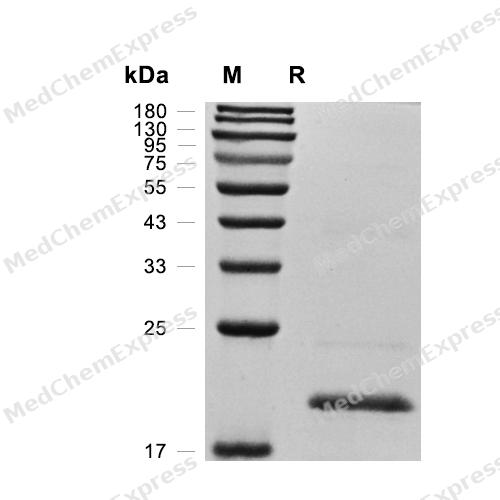
Purity - SDS-PAGE
-
Bioactivity - ELISA
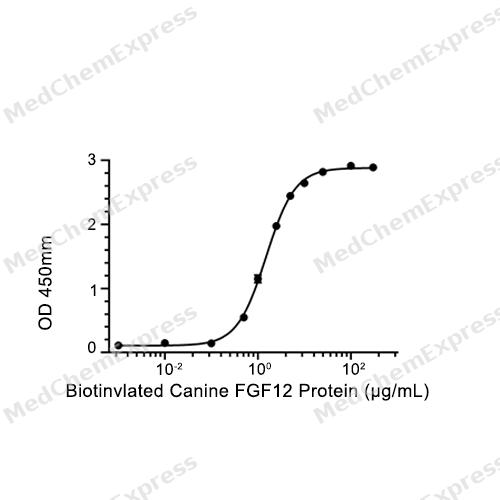
Bioactivity - ELISA


Technical Parameters
-
Species Canine
-
Source E. coli
-
Tag Tag Free
-
Accession
A0A5F4CAA4 (M1-T181)
-
Molecular Construction
-
N-term
-
FGF-12 (M1-T181)
Accession # A0A5F4CAA4 -
C-term
-
-
Protein Length
Full Length
-
Synonyms
FGF12; Fibroblast Growth Factor 12B; Prev. FGF12B; EIEE47; FHF1; FGF-12; Fibroblast Growth Factor Homologous Factor 1; DEE47; Myocyte-Activating Factor; FHF-1; Fibroblast Growth Factor FGF-12b; FGF; Fibroblast Growth Factor 12; Fibroblast Growth Factor
-
AA Sequence
MESKEPQLKGIVTRLFSQQGYFLQMHPDGTIDGTKDENSDYTLFNLIPVGLRVVAIQGVKASLYVAMNGEGYLYSSDVFTPECKFKESVFENYYVIYSSTLYRQQESGRAWFLGLNKEGQIMKGNRVKKTKPSSHFVPKPIEVCMYREPSLHEIGEKQGRSRKSSGTPTMNGGKVVNQDST
-
Predicted Molecular Mass
20.4 kDa
-
Molecular Weight
Approximately 20 kDa, based on SDS-PAGE under reducing conditions, due to the glycosylation.
-
Purity
≥ 95%, as determined by reducing SDS-PAGE.


Product Properties
Lyophilized powder.
Lyophilized from a 0.22 μm filtered solution of PBS, pH 7.4.
<1 EU/μg, determined by LAL method.
It is not recommended to reconstitute to a concentration less than 100 μg/mL in ddH2O. For long term storage it is recommended to add a carrier protein (0.1% BSA, 5% HSA, 10% FBS or 5% Trehalose).
Stored at -20°C for 2 years from date of receipt. After reconstitution, it is stable at 4°C for 1 week or -20°C for longer (with carrier protein). It is recommended to freeze aliquots at -20°C or -80°C for extended storage.
Room temperature in continental US; may vary elsewhere.


Documentation
-
Data Sheet (236 KB)
-
SDS (251 KB)
- English - EN (251 KB)
- Français - FR (251 KB)
- Deutsch - DE (251 KB)
- Norwegian - NO (251 KB)
- Español - ES (251 KB)
- Swedish - SV (251 KB)
- Italian - IT (251 KB)
- Korean - KR (251 KB)
- Portuguese - PT (251 KB)
-
Handling Instructions (2659 KB)

Calculators
Concentration (start) × Volume (start) = Concentration (final) × Volume (final)


 Powered by Bioz

