



FGFR-1 alpha (IIIb) Protein, Human (HEK293, His)

Based on 1 Customer Validation
FGFR-1 alpha, a conserved member of the FGFR family, binds acidic and basic fibroblast growth factors, influencing mitogenesis and differentiation. Mutations in FGFR1 cause syndromes and disorders. It exhibits ubiquitous expression, with notable levels in ovary (RPKM 21.8), fat (RPKM 21.4), and 25 other tissues. Alternatively spliced variants contribute to its functional diversity. FGFR-1 alpha (IIIb) Protein, Human (HEK293, His) is a recombinant protein dimer complex containing human-derived FGFR-1 alpha, expressed by HEK293 , with C-His, C-10*His labeled tag. FGFR-1 alpha (IIIb) Protein, Human (HEK293, His), has molecular weight of 60-90 kDa.
- Species: Human
- Source: HEK293
-
Storage:Stored at -20°C for 2 years from date of receipt. After reconstitution, it is stable at 4°C for 1 week or -20°C for longer (with carrier protein). It is recommended to freeze aliquots at -20°C or -80°C for extended storage.


To place orders, for customer services and technical support, please contact: MedChemExpress USA
Tel: 609-228-6898 E-mail: [email protected] [email protected]


-
 Biological Activity
-
Technical Parameters
-
Product Properties
- Documentation
- Help & FAQs




Biological Activity
Description
FGFR-1 alpha, a conserved member of the FGFR family, binds acidic and basic fibroblast growth factors, influencing mitogenesis and differentiation. Mutations in FGFR1 cause syndromes and disorders. It exhibits ubiquitous expression, with notable levels in ovary (RPKM 21.8), fat (RPKM 21.4), and 25 other tissues. Alternatively spliced variants contribute to its functional diversity. FGFR-1 alpha (IIIb) Protein, Human (HEK293, His) is a recombinant protein dimer complex containing human-derived FGFR-1 alpha, expressed by HEK293 , with C-His, C-10*His labeled tag. FGFR-1 alpha (IIIb) Protein, Human (HEK293, His), has molecular weight of 60-90 kDa.
Background
Fibroblast Growth Factor Receptor 1 alpha (FGFR1), a member of the FGFR family, shares a highly conserved amino acid sequence with other family members and exhibits varying ligand affinities and tissue distributions. Comprising three immunoglobulin-like domains in its extracellular region, a single membrane-spanning segment, and a cytoplasmic tyrosine kinase domain, FGFR1 plays a pivotal role in transducing signals initiated by fibroblast growth factors. It binds both acidic and basic fibroblast growth factors, influencing mitogenesis and differentiation, particularly in limb induction. Mutations in FGFR1 have been linked to several syndromes, including Pfeiffer syndrome, Jackson-Weiss syndrome, and Kallmann syndrome 2, as well as disorders like osteoglophonic dysplasia. Chromosomal aberrations involving this gene are associated with stem cell myeloproliferative disorder and stem cell leukemia lymphoma syndrome. Various alternatively spliced variants, encoding distinct protein isoforms, have been identified, contributing to the functional diversity of FGFR1. The gene exhibits ubiquitous expression across tissues, with notable expression levels in ovary (RPKM 21.8), fat (RPKM 21.4), and 25 other tissues.
Verified Bioactivity
1.This product does not contain protein kinase domain.
2.Measured by its ability to inhibit FGF acidic-dependent proliferation of NIH/3T3 mouse fibroblast cells. The ED50 for this effect is 4.134 ng/mL, corresponding to a specific activity is 2.42×10^5 units/mg.
MCE Validation Data
-
Bioactivity - Cell-Based Assay
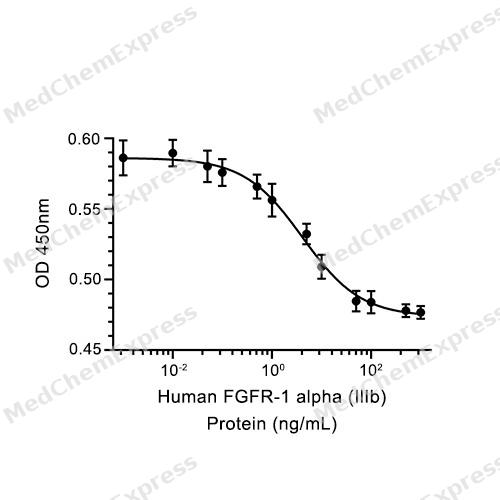
Bioactivity - Cell-Based Assay


Technical Parameters
-
Species Human
-
Source HEK293
-
Tag C-His
-
Accession
P11362-7/NP_056934.2 (R22-K310&A359-E374)&AAB19502 (H1-P47)
-
Synonyms
FGFR1; H3; Prev. FLT2; H5; Prev. KAL2; Heparin-Binding Growth Factor Receptor; BFGFR; Fibroblast Growth Factor Receptor; CEK; Receptor Protein-Tyrosine Kinase; FLG; FMS-Like Tyrosine Kinase 2; Basic Fibroblast Growth Factor Receptor 1; Hydroxyaryl-Protein
-
AA Sequence
A1:
RPSPTLPEQAQPWGAPVEVESFLVHPGDLLQLRCRLRDDVQSINWLRDGVQLAESNRTRITGEEVEVQDSVPADSGLYACVTSSPSGSDTTYFSVNVSDALPSSEDDDDDDDSSSEEKETDNTKPNPVAPYWTSPEKMEKKLHAVPAAKTVKFKCPSSGTPNPTLRWLKNGKEFKPDHRIGGYKVRYATWSIIMDSVVPSDKGNYTCIVENEYGSINHTYQLDVVERSPHRPILQAGLPANKTVALGSNVEFMCKVYSDPQPHIQWLKHIEVNGSKIGPDNLPYVQILK
A2:
ALEERPAVMTSPLYLE
A3:
HSGINSSDAEVLTLFNVTEAQSGEYVCKVSNYIGEANQSAWLTVTRP -
Molecular Weight
Approximately 60-90 kDa, based on SDS-PAGE under reducing conditions, due to the glycosylation.
-
Glycosylation
Yes
-
Purity
≥ 95%, as determined by reducing SDS-PAGE.


Product Properties
Lyophilized powder.
Lyophilized from a 0.22 μm filtered solution of PBS, pH 7.4.
<1 EU/μg, determined by LAL method.
It is not recommended to reconstitute to a concentration less than 100 μg/mL in ddH2O. For long term storage it is recommended to add a carrier protein (0.1% BSA, 5% HSA, 10% FBS or 5% Trehalose).
Stored at -20°C for 2 years from date of receipt. After reconstitution, it is stable at 4°C for 1 week or -20°C for longer (with carrier protein). It is recommended to freeze aliquots at -20°C or -80°C for extended storage.
Room temperature in continental US; may vary elsewhere.


Documentation
-
Data Sheet (238 KB)
-
SDS (251 KB)
- English - EN (251 KB)
- Français - FR (251 KB)
- Deutsch - DE (251 KB)
- Norwegian - NO (251 KB)
- Español - ES (251 KB)
- Swedish - SV (251 KB)
- Italian - IT (251 KB)
- Korean - KR (251 KB)
- Portuguese - PT (251 KB)
-
Handling Instructions (2659 KB)

Calculators
Concentration (start) × Volume (start) = Concentration (final) × Volume (final)


 Powered by Bioz

