



Fibrillin-1/Asprosin Protein, Mouse (HEK293, His)
Based on 3 publication(s) in Google Scholar
Fibrillin-1/Asprosin proteins play crucial roles in a variety of biological processes. They regulate osteoblast maturation by controlling the availability of TGF-β and regulating TGF-β and BMP levels. Fibrillin-1/Asprosin Protein, Mouse (HEK293, His) is the recombinant mouse-derived Fibrillin-1/Asprosin protein, expressed by HEK293 , with N-His labeled tag.
- Species: Mouse
- Source: HEK293
-
Storage:Stored at -20°C for 2 years from date of receipt. After reconstitution, it is stable at 4°C for 1 week or -20°C for longer (with carrier protein). It is recommended to freeze aliquots at -20°C or -80°C for extended storage.


To place orders, for customer services and technical support, please contact: MedChemExpress USA
Tel: 609-228-6898 E-mail: [email protected] [email protected]


-
 Biological Activity
-
Technical Parameters
-
Product Properties
- Documentation
- Help & FAQs




Biological Activity
Description
Fibrillin-1/Asprosin proteins play crucial roles in a variety of biological processes. They regulate osteoblast maturation by controlling the availability of TGF-β and regulating TGF-β and BMP levels. Fibrillin-1/Asprosin Protein, Mouse (HEK293, His) is the recombinant mouse-derived Fibrillin-1/Asprosin protein, expressed by HEK293 , with N-His labeled tag.
Background
The oglycan components are involved in various biological processes. They regulate osteoblast maturation by controlling the availability of TGF-beta and calibrating TGF-beta and BMP levels. They also negatively regulate osteoclastogenesis by binding and sequestering TNFSF11, a factor important for osteoclast differentiation and function. This disrupts TNFSF11-induced signaling and impairs the activation of transcription factor NFATC1, which is important for osteoclast differentiation.
Verified Bioactivity
Measured in a cell proliferation assay using human umbilical vein endothelial cells. The ED50 this effect is 15-25 ng/mL, corresponding to a specific activity is ≥ 4.919×10⁴ units/mg.
MCE Validation Data
-
Purity - SDS-PAGE
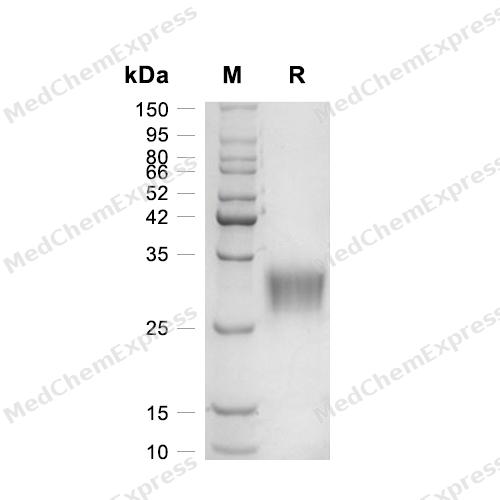
Purity - SDS-PAGE
-
Bioactivity - Cell-Based Assay
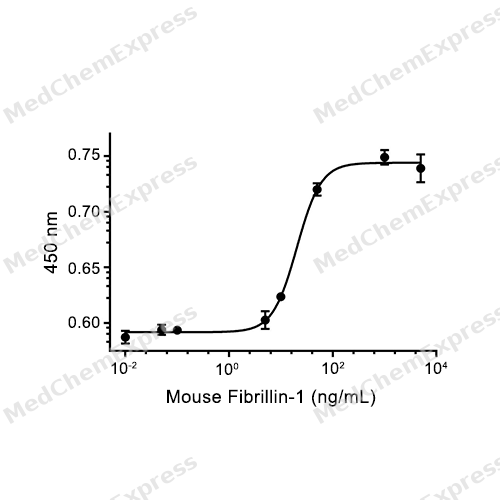
Bioactivity - Cell-Based Assay


Publications (3)
-
Journal Impact Factor
-
Most Recent
-
Free Radic Biol Med
2024 Dec 9:227:296-311. PMID: 39653130 -
Int J Mol Sci
Asprosin in the Paraventricular Nucleus Induces Sympathetic Activation and Pressor Responses via cAMP-Dependent ROS Production. [Abstract]2022 Oct 20;23(20):12595. PMID: 36293450 -
Heliyon
Asprosin promotes vascular inflammation via TLR4-NFκB-mediated NLRP3 inflammasome activation in hypertension. [Abstract]2024 May 23;10(11):e31659. PMID: 38841464


Technical Parameters
-
Species Mouse
-
Source HEK293
-
Tag N-His
-
Accession
Q61554 (S2734-H2873)
-
Molecular Construction
-
N-term
-
His
-
Asprosin (S2734-H2871)
Accession # AAA56840.1 -
C-term
-
-
Protein Length
Full Length of Asprosin Chain
-
Synonyms
FBN1; Epididymis Secretory Sperm Binding Protein; Prev. FBN; Alternative Protein FBN1; Prev. MFS1; Marfan Syndrome; Prev. WMS; Fibrillin 15; Fibrillin-1; GPHYSD2; MASS; ACMICD; OCTD; ECTOL1; SGS; MFLS; Fibrillin-1 Preproprotein; SSKS; Asprosin; WMS2; Fibr
-
AA Sequence
STNETDASDIQDGSEMEANVSLASWDVEKPASFAFNISHVNNKVRILELLPALTTLMNHNRYLIESGNEDGFFKINQKEGVSYLHFTKKKPVAGTYSLQISSTPLYKKKELNQLEDRYDKDYLSGELGDNLKMKIQILLH
-
Molecular Weight
Approximately 30 kDa, based on SDS-PAGE under reducing conditions.
-
Glycosylation
Yes
-
Purity
≥ 85%, as determined by reducing SDS-PAGE.


Product Properties
Lyophilized powder
Lyophilized from a 0.2 μm filtered solution of PBS.
<1 EU/μg, determined by LAL method.
It is not recommended to reconstitute to a concentration less than 100 μg/mL in ddH2O. For long term storage it is recommended to add a carrier protein (0.1% BSA, 5% HSA, 10% FBS or 5% Trehalose).
Stored at -20°C for 2 years from date of receipt. After reconstitution, it is stable at 4°C for 1 week or -20°C for longer (with carrier protein). It is recommended to freeze aliquots at -20°C or -80°C for extended storage.
Room temperature in continental US; may vary elsewhere.


Documentation
-
Data Sheet (236 KB)
-
SDS (252 KB)
- English - EN (252 KB)
- Français - FR (252 KB)
- Deutsch - DE (252 KB)
- Norwegian - NO (252 KB)
- Español - ES (252 KB)
- Swedish - SV (252 KB)
- Italian - IT (252 KB)
- Korean - KR (252 KB)
- Portuguese - PT (252 KB)
-
Handling Instructions (2659 KB)

Calculators
Concentration (start) × Volume (start) = Concentration (final) × Volume (final)


 Powered by Bioz

