



G-CSF Protein, Human (CHO)
Based on 1 Customer Validation
G-CSF Protein, Human (CHO) is a polypeptide growth factor that regulates the production of neutrophilic granulocytes.
- Species: Human
- Source: CHO
-
Storage:Stored at -20°C for 2 years from date of receipt. After reconstitution, it is stable at 4°C for 1 week or -20°C for longer (with carrier protein). It is recommended to freeze aliquots at -20°C or -80°C for extended storage.


To place orders, for customer services and technical support, please contact: MedChemExpress USA
Tel: 609-228-6898 E-mail: [email protected] [email protected]


-
 Biological Activity
-
Technical Parameters
-
Product Properties
- Documentation
- References
- Help & FAQs




Biological Activity
Description
G-CSF Protein, Human (CHO) is a polypeptide growth factor that regulates the production of neutrophilic granulocytes.
Background
Recombinant Human Granulocyte Colony-stimulating Factor (CHO-expressed) is a polypeptide growth factor that regulates the production of neutrophilic granulocytes. Granulocyte Colony Stimulating Factor (G-CSF) is a cytokine that normally acts in the bone marrow microenvironment to stimulate blood cell formation. It selectively promotes growth and maturation of neutrophil progenitor cells. Granulocyte Colony Stimulating Factor receptors are present on precursor cells in the bone marrow. By binding to these receptors, Granulocyte Colony Stimulating Factor initiates proliferation and differentiation into mature granulocytes, and also stimulates bone marrow cell release into the circulation. In addition to growth promotion, Granulocyte Colony Stimulating Factor also effects phagocytosis, motility, bactericidal activity and surface molecule expression of neutrophils and monocytes[1][2]. G-CSF production is induced by several inflammatory stimuli that become rapidly elevated during infection such as interleukin-1β (IL-1β), tumor necrosis factor-alpha (TNFα) and lipopolysaccaride (LPS). Therefore, pathogen-mediated activation of host pattern recognition receptors via LPS, and the host cytokine response to infection, serve to induce circulating levels of G-CSF[3].
Verified Bioactivity
Measured in a cell proliferation assay using M-NFS-60 mouse myelogenous leukemia lymphoblast cells. The ED50 for this effect is <100 pg/mL, corresponding to a specific activity is > 1×10⁷ units/mg.
MCE Validation Data
-
Purity - SDS-PAGE
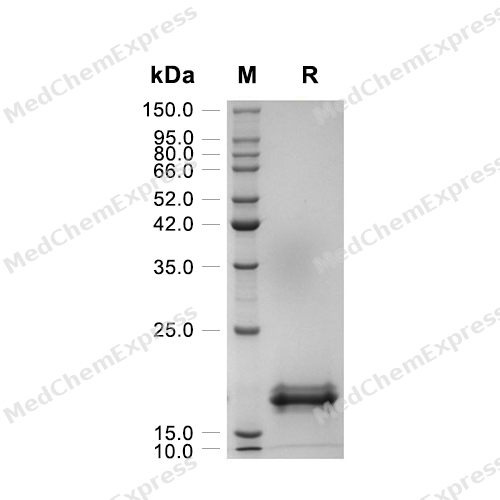
Purity - SDS-PAGE
-
Bioactivity - Cell-Based Assay
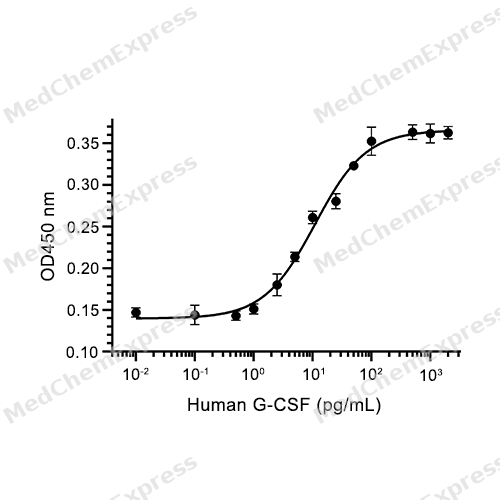
Bioactivity - Cell-Based Assay


Technical Parameters
-
Species Human
-
Source CHO
-
Tag Tag Free
-
Accession
Q8N4W3 (T27-P200)/P09919-2 (T31-P204)
-
Molecular Construction
-
N-term
-
G-CSF (T27-P200)
Accession # Q8N4W3 -
C-term
-
-
Protein Length
Full Length of Mature Protein
-
Synonyms
CSF3; Filgrastim; Prev. C17orf33; MGC45931; Prev. GCSF; Colony Stimulating Factor 3 Nirs Variant 1; Prev. G-CSF; Granulocyte Colony Stimulating Factor; Granulocyte Colony-Stimulating Factor; Granulocyte-Colony Stimulating Factor; Pluripoietin; Chromosome
-
AA Sequence
TPLGPASSLPQSFLLKCLEQVRKIQGDGAALQEKLCATYKLCHPEELVLLGHSLGIPWAPLSSCPSQALQLAGCLSQLHSGLFLYQGLLQALEGISPELGPTLDTLQLDVADFATTIWQQMEELGMAPALQPTQGAMPAFASAFQRRAGGVLVASHLQSFLEVSYRVLRHLAQP
-
Predicted Molecular Mass
18.7 kDa
-
Molecular Weight
Approximately 19 kDa, based on SDS-PAGE under reducing conditions.
-
Purity
≥ 95%, as determined by reducing SDS-PAGE.


Product Properties
Lyophilized powder
1.Lyophilized from a 0.22 μm filtered solution of PBS.
2.Lyophilized from a 0.22 μm filtered solution of 20 mM PB, 150 mM NaCl, pH 7.4.
3.Lyophilized from a 0.22 μm filtered solution of PBS, pH 7.4, 5% trehalose, 5% mannitol, 0.01% Tween 80.
Please refer to the lot-specific COA for specific buffer information.
<1 EU/μg, determined by LAL method.
It is not recommended to reconstitute to a concentration less than 100 μg/mL in ddH2O. For long term storage it is recommended to add a carrier protein (0.1% BSA, 5% HSA, 10% FBS or 5% Trehalose).
Stored at -20°C for 2 years from date of receipt. After reconstitution, it is stable at 4°C for 1 week or -20°C for longer (with carrier protein). It is recommended to freeze aliquots at -20°C or -80°C for extended storage.
Room temperature in continental US; may vary elsewhere.


Documentation
-
Data Sheet (263 KB)
-
SDS (252 KB)
- English - EN (252 KB)
- Français - FR (252 KB)
- Deutsch - DE (252 KB)
- Norwegian - NO (252 KB)
- Español - ES (252 KB)
- Swedish - SV (252 KB)
- Italian - IT (252 KB)
- Korean - KR (252 KB)
- Portuguese - PT (252 KB)
-
Handling Instructions (2659 KB)


References
[1]. Demetri GD, et al. Granulocyte Colony Stimulating Factor and its receptor. Blood. 1991 Dec 1;78(11):2791-808. [Content Brief]
[2]. Shah J, et al. The clinical use of granulocyte-colony stimulating factor. Br J Hosp Med (Lond). 2014 Feb;75(2):C29-32. [Content Brief]
[3]. Panopoulos AD, et al. Granulocyte colony-stimulating factor: molecular mechanisms of action during steady state and 'emergency' hematopoiesis. Cytokine. 2008 Jun;42(3):277-88. [Content Brief]

Calculators
Concentration (start) × Volume (start) = Concentration (final) × Volume (final)


 Powered by Bioz

