



Galectin-3/LGALS3 Protein, Human (HEK293, His)

Based on 1 Customer Validation
The Galectin-3/LGALS3 protein is a galactose-specific lectin known for its diverse roles in cellular processes. It binds IgE and synergizes with α-3 and β-1 integrins to promote CSPG4-induced endothelial cell migration. Galectin-3/LGALS3 Protein, Human (HEK293, His) is the recombinant human-derived Galectin-3/LGALS3 protein, expressed by HEK293 , with C-6*His labeled tag.
- Species: Human
- Source: HEK293
-
Storage:Stored at -20°C for 2 years from date of receipt. After reconstitution, it is stable at 4°C for 1 week or -20°C for longer (with carrier protein). It is recommended to freeze aliquots at -20°C or -80°C for extended storage.


To place orders, for customer services and technical support, please contact: MedChemExpress USA
Tel: 609-228-6898 E-mail: [email protected] [email protected]


-
 Biological Activity
-
Technical Parameters
-
Product Properties
- Documentation
- Help & FAQs




Biological Activity
Description
The Galectin-3/LGALS3 protein is a galactose-specific lectin known for its diverse roles in cellular processes. It binds IgE and synergizes with α-3 and β-1 integrins to promote CSPG4-induced endothelial cell migration. Galectin-3/LGALS3 Protein, Human (HEK293, His) is the recombinant human-derived Galectin-3/LGALS3 protein, expressed by HEK293 , with C-6*His labeled tag.
Background
The Galectin-3/LGALS3 Protein is a galactose-specific lectin known for its versatile roles in cellular processes. It binds IgE and, in collaboration with the alpha-3, beta-1 integrin, facilitates CSPG4-induced migration of endothelial cells. Together with DMBT1, it is crucial for the terminal differentiation of columnar epithelial cells during early embryogenesis. In the nucleus, the protein serves as a pre-mRNA splicing factor and is actively involved in acute inflammatory responses, influencing neutrophil activation, adhesion, chemoattraction of monocytes and macrophages, opsonization of apoptotic neutrophils, and mast cell activation. Its partnership with TRIM16 allows for the coordinated recognition of membrane damage, triggering the mobilization of core autophagy regulators ATG16L1 and BECN1 in response to damaged endomembranes. The protein likely forms homo- or heterodimers and engages with various partners, including DMBT1, CD6, ALCAM, ITGA3, ITGB1, CSPG4, LGALS3BP, LYPD3, ZFTRAF1, UACA, TRIM16, and TMED10, facilitating diverse cellular interactions, including autophagy and secretion.
Verified Bioactivity
1.Measured by the ability of the immobilized protein to support the adhesion of TF-1 Human blood leukemia cells. The ED50 this effect is ≤6.301 μg/ml, corresponding to a specific activity is ≥158.705 units/mg.
2.Measured by the ability of the immobilized protein to support the adhesion of MOLT-4. The ED50 for this effect is 2.117 μg/mL, corresponding to a specific activity is 472.367 units/mg.
3. Loaded Oloctinebart (HY-P990081) on AHC2 biosensor, can bind Galectin-3/LGALS3 Protein, Human (HEK293, His) with an affinity constant of 5.984E-08 M as determined in BLI assay.
MCE Validation Data
-
Purity - SDS-PAGE
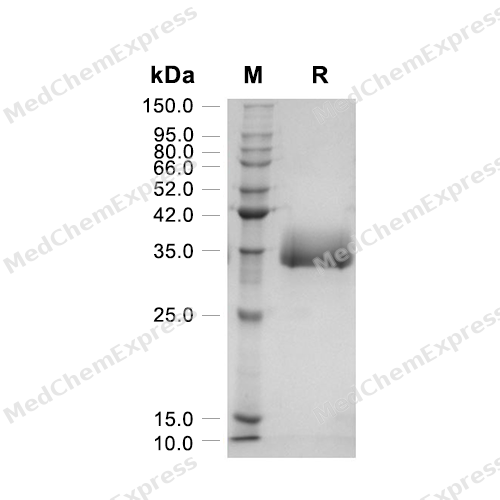
Purity - SDS-PAGE
-
Bioactivity - Cell-Based Assay
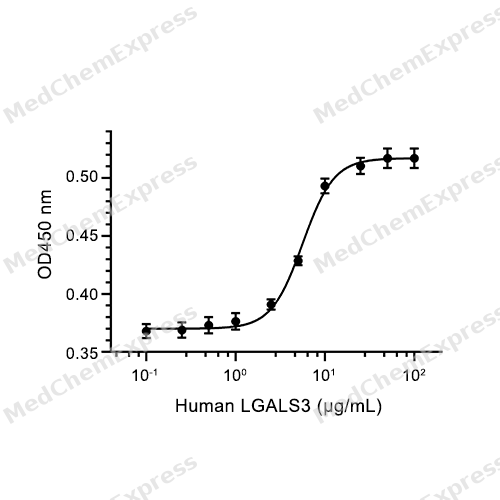
Bioactivity - Cell-Based Assay
-
Bioactivity - BLI
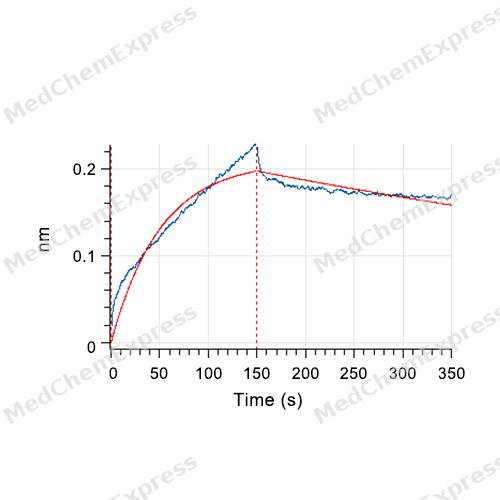
Bioactivity - BLI


Technical Parameters
-
Species Human
-
Source HEK293
-
Tag C-6*His
-
Accession
AAH53667.1 (A2-I250)
-
Molecular Construction
-
N-term
-
LGALS3 (A2-I250)
Accession # AAH53667.1 -
6*His
-
C-term
-
-
Protein Length
Full Length
-
Synonyms
LGALS3; MAC-2; Prev. LGALS2; MAC2; GALIG; Galactoside-Binding Protein; Epididymis Secretory Sperm Binding Protein; MAC-2 Antigen; Advanced Glycation End-Product Receptor 3; Mac-2 Antigen; Lectin, Galactoside-Binding, Soluble, 3; Galectin; Carbohydrate-Bin
-
AA Sequence
ADNFSLHDALSGSGNPNPQGWPGAWGNQPAGAGGYPGASYPGAYPGQAPPGAYPGQAPPGAYHGAPGAYPGAPAPGVYPGPPSGPGAYPSSGQPSAPGAYPATGPYGAPAGPLIVPYNLPLPGGVVPRMLITILGTVKPNANRIALDFQRGNDVAFHFNPRFNENNRRVIVCNTKLDNNWGREERQSVFPFESGKPFKIQVLVEPDHFKVAVNDAHLLQYNHRVKKLNEISKLGISGDIDLTSASYTMI
-
Molecular Weight
Approximately 35 kDa, based on SDS-PAGE under reducing conditions.
-
Glycosylation
Yes
-
Purity
≥ 95%, as determined by reducing SDS-PAGE.


Product Properties
Lyophilized powder
1.Lyophilized from a 0.22 μm filtered solution of 20 mM Citrare, 8% trehalose, 4% mannitol, 0.02% Tween 80, pH 4.5.
2.Lyophilized from a 0.22 μm filtered solution of 20 mM PB, 150 mM NaCl, 3 mM DTT, pH 7.4.
3.Lyophilized from a 0.22 μm filtered solution of PBS, pH 7.4, 3 mM DTT, 5% trehalose, 5% mannitol and 0.01% Tween 80.
4.Lyophilized from a 0.22 μm filtered solution of PBS, pH 7.4, 3 mM DTT, 8% trehalose.
Please refer to the lot-specific COA for specific buffer information.
<1 EU/μg, determined by LAL method.
It is not recommended to reconstitute to a concentration less than 100 μg/mL in ddH2O. For long term storage it is recommended to add a carrier protein (0.1% BSA, 5% HSA, 10% FBS or 5% Trehalose).
Stored at -20°C for 2 years from date of receipt. After reconstitution, it is stable at 4°C for 1 week or -20°C for longer (with carrier protein). It is recommended to freeze aliquots at -20°C or -80°C for extended storage.
Room temperature in continental US; may vary elsewhere.


Documentation
-
Data Sheet (238 KB)
-
SDS (252 KB)
- English - EN (252 KB)
- Français - FR (252 KB)
- Deutsch - DE (252 KB)
- Norwegian - NO (252 KB)
- Español - ES (252 KB)
- Swedish - SV (252 KB)
- Italian - IT (252 KB)
- Korean - KR (252 KB)
- Portuguese - PT (252 KB)
-
Handling Instructions (2659 KB)

Calculators
Concentration (start) × Volume (start) = Concentration (final) × Volume (final)


 Powered by Bioz

