



IgG1 Protein, Human (Biotinylated, HEK293, Avi)
Based on 1 Customer Validation
The IgG1 protein is the constant region of the immunoglobulin heavy chain and serves as a receptor during the recognition phase of humoral immunity. It triggers clonal expansion and differentiation of B lymphocytes into immunoglobulin-secreting plasma cells. IgG1 Protein, Human (Biotinylated, HEK293, Avi) is the recombinant human-derived IgG1 protein, expressed by HEK293 , with C-Avi labeled tag.
- Species: Human
- Source: HEK293
-
Storage:Stored at -20°C for 2 years from date of receipt. After reconstitution, it is stable at 4°C for 1 week or -20°C for longer (with carrier protein). It is recommended to freeze aliquots at -20°C or -80°C for extended storage.


To place orders, for customer services and technical support, please contact: MedChemExpress USA
Tel: 609-228-6898 E-mail: [email protected] [email protected]


-
 Biological Activity
-
Technical Parameters
-
Product Properties
- Documentation
- Help & FAQs




Biological Activity
Description
The IgG1 protein is the constant region of the immunoglobulin heavy chain and serves as a receptor during the recognition phase of humoral immunity. It triggers clonal expansion and differentiation of B lymphocytes into immunoglobulin-secreting plasma cells. IgG1 Protein, Human (Biotinylated, HEK293, Avi) is the recombinant human-derived IgG1 protein, expressed by HEK293 , with C-Avi labeled tag.
Background
The constant region of immunoglobulin heavy chains, known as antibodies, represents membrane-bound or secreted glycoproteins produced by B lymphocytes. In the recognition phase of humoral immunity, these membrane-bound immunoglobulins act as receptors, initiating the clonal expansion and differentiation of B lymphocytes into immunoglobulin-secreting plasma cells upon binding specific antigens. Secreted immunoglobulins play a crucial role in the effector phase of humoral immunity, leading to the elimination of bound antigens. The antigen binding site is shaped by the variable domain of one heavy chain, along with that of its associated light chain, resulting in each immunoglobulin having two antigen binding sites with remarkable affinity for a particular antigen. Variable domains undergo V-(D)-J rearrangement and subsequent somatic hypermutations, enabling affinity maturation for a specific antigen following exposure and selection. IgG1 protein mediates effector functions on monocytes, triggering antibody-dependent cellular cytotoxicity (ADCC) of virus-infected cells. Immunoglobulins are composed of two identical heavy chains and two identical light chains, interconnected by disulfide linkages, and interact with FCGR1A, FCGR2A, and FCGR3A to mediate various effector functions.
Verified Bioactivity
Immobilized Human CD64 at 1 μg/mL (100 μL/well) can bind biotinylated Human IgG1. The ED50 for this effect is 25.141 ng/mL.
MCE Validation Data
-
Bioactivity - ELISA
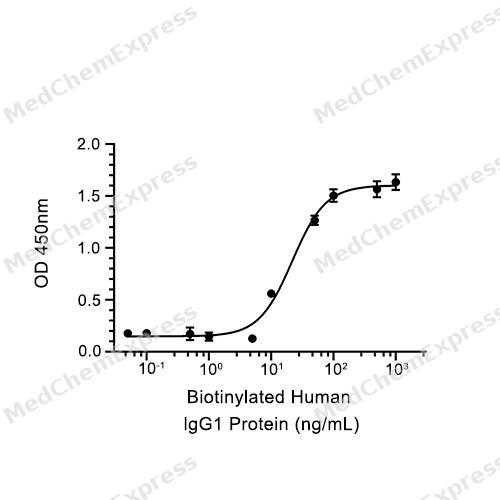
Bioactivity - ELISA


Technical Parameters
-
Species Human
-
Source HEK293
-
Tag C-Avi
-
Accession
P01857-1 (D104-K330, D239E, L241M)
-
Molecular Construction
-
N-term
-
IgG1 (D104-K330, D239E, L241M)
Accession # P01857-1 -
Avi
-
C-term
-
-
Protein Length
Partial
-
Conjugation
Biotin
-
Synonyms
IGHG1; Ig Gamma-1 Chain C Region NIE; Immunoglobulin Heavy Constant Gamma 1 (G1m Marker); Ig Gamma-1 Chain C Region KOL; Constant Region Of Heavy Chain Of IgG1; Ig Gamma-1 Chain C Region EU; Immunoglobulin Heavy Constant Gamma 1; Ig Gamma-1 Chain C Region
-
AA Sequence
DKTHTCPPCPAPELLGGPSVFLFPPKPKDTLMISRTPEVTCVVVDVSHEDPEVKFNWYVDGVEVHNAKTKPREEQYNSTYRVVSVLTVLHQDWLNGKEYKCKVSNKALPAPIEKTISKAKGQPREPQVYTLPPSREEMTKNQVSLTCLVKGFYPSDIAVEWESNGQPENNYKTTPPVLDSDGSFFLYSKLTVDKSRWQQGNVFSCSVMHEALHNHYTQKSLSLSPGKGLNDIFEAQKIEWHE
-
Predicted Molecular Mass
27.7 kDa
-
Molecular Weight
Approximately 33 kDa, based on SDS-PAGE under reducing conditions.
-
Glycosylation
Yes
-
Purity
≥ 95%, as determined by reducing SDS-PAGE.


Product Properties
Lyophilized powder.
Lyophilized from a 0.22 μm filtered solution of PBS, pH 7.4.
<1 EU/μg, determined by LAL method.
It is not recommended to reconstitute to a concentration less than 100 μg/mL in ddH2O. For long term storage it is recommended to add a carrier protein (0.1% BSA, 5% HSA, 10% FBS or 5% Trehalose).
Stored at -20°C for 2 years from date of receipt. After reconstitution, it is stable at 4°C for 1 week or -20°C for longer (with carrier protein). It is recommended to freeze aliquots at -20°C or -80°C for extended storage.
Room temperature in continental US; may vary elsewhere.


Documentation
-
Data Sheet (261 KB)
-
SDS (251 KB)
- English - EN (251 KB)
- Français - FR (251 KB)
- Deutsch - DE (251 KB)
- Norwegian - NO (251 KB)
- Español - ES (251 KB)
- Swedish - SV (251 KB)
- Italian - IT (251 KB)
- Korean - KR (251 KB)
- Portuguese - PT (251 KB)
-
Handling Instructions (2659 KB)

Calculators
Concentration (start) × Volume (start) = Concentration (final) × Volume (final)


 Powered by Bioz

