



IL-1RN Protein, Horse (His)

Based on 1 Customer Validation
IL-1RN protein, an anti-inflammatory antagonist, safeguards against immune dysregulation and systemic inflammation triggered by IL1. It acts on proinflammatory cytokines, including IL1B and IL1A, countering the effects of IL1. Particularly responsive to innate stimulatory agents like pathogens, IL-1RN helps mitigate the inflammatory response, ensuring immune homeostasis. IL-1RN Protein, Horse (His) is the recombinant equine-derived IL-1RN protein, expressed by E. coli , with N-6*His labeled tag.
- Species: Equine
- Source: E. coli
-
Storage:Stored at -20°C for 2 years from date of receipt. After reconstitution, it is stable at 4°C for 1 week or -20°C for longer (with carrier protein). It is recommended to freeze aliquots at -20°C or -80°C for extended storage.


To place orders, for customer services and technical support, please contact: MedChemExpress USA
Tel: 609-228-6898 E-mail: [email protected] [email protected]


-
 Biological Activity
-
Technical Parameters
-
Product Properties
- Documentation
- Help & FAQs




Biological Activity
Description
IL-1RN protein, an anti-inflammatory antagonist, safeguards against immune dysregulation and systemic inflammation triggered by IL1. It acts on proinflammatory cytokines, including IL1B and IL1A, countering the effects of IL1. Particularly responsive to innate stimulatory agents like pathogens, IL-1RN helps mitigate the inflammatory response, ensuring immune homeostasis. IL-1RN Protein, Horse (His) is the recombinant equine-derived IL-1RN protein, expressed by E. coli , with N-6*His labeled tag.
Background
IL-1RN protein is an anti-inflammatory antagonist that acts on the interleukin-1 family of proinflammatory cytokines, including interleukin-1beta/IL1B and interleukin-1alpha/IL1A. It serves as a protective agent against immune dysregulation and uncontrolled systemic inflammation induced by IL1, particularly in response to various innate stimulatory agents like pathogens. IL-1RN helps mitigate the inflammatory response and maintain immune homeostasis by counteracting the effects of IL1.
Verified Bioactivity
Measured by its ability to inhibit proliferation of CTLL-2 mouse cytotoxic T cells in the presence of 50 pg/mL of rhIL-1 alpha. The ED50 for this effect is 3.666 μg/mL, corresponding to a specific activity is 272.78 units/mg.
MCE Validation Data
-
Purity - SDS-PAGE
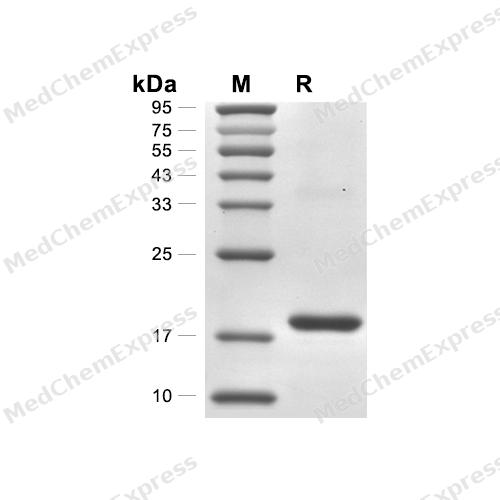
Purity - SDS-PAGE
-
Bioactivity - Cell-Based Assay
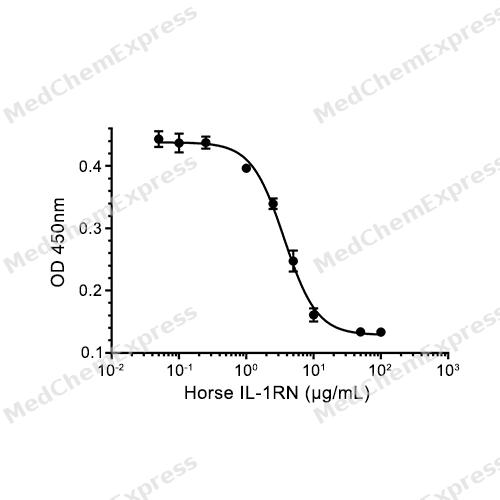
Bioactivity - Cell-Based Assay


Technical Parameters
-
Species Equine
-
Source E. coli
-
Tag N-6*His
-
Accession
O18999 (H26-Q177)
-
Gene ID100034236 [NCBI]
-
Molecular Construction
-
N-term
-
6*His
-
IL-1RN (H26-Q177)
Accession # O18999 -
C-term
-
-
Protein Length
Full Length of Mature Protein
-
Synonyms
IL1RN; IL-1ra; Interleukin 1 Receptor Antagonist; Intracellular Interleukin-1 Receptor Antagonist (IcIL-1ra); ICIL-1RA; Intracellular Interleukin-1 Receptor Antagonist; IL-1RN; Intracellular IL-1 Receptor Antagonist Type II; IL1RA; Type II Interleukin-1 R
-
AA Sequence
HPLGKRPCKMQAFRIWDVNQKTFYMRNNQLVAGYLQESNTKLQEKIDVVPIEPDALFLGLHGRKLCLACVKSGDEIRFQLEAVNITDLSKNKEENKRFTFIRSNSGPTTSFESAACPGWFLCTAQEADRPVSLTNKPKESFMVTKFYLQEDQ
-
Predicted Molecular Mass
17.2 kDa
-
Molecular Weight
Approximately 18 kDa, based on SDS-PAGE under reducing conditions.
-
Purity
≥ 95%, as determined by reducing SDS-PAGE.


Product Properties
Lyophilized powder.
Lyophilized from a 0.22 μm filtered solution of 50 mM Tris-HCl, 300 mM NaCl, pH 7.4.
Note: For SPR assay, please replace the buffer. Primary amine components (e.g., Tris, imidazole) can affect protein-coupled chips.
<1 EU/μg, determined by LAL method.
It is not recommended to reconstitute to a concentration less than 100 μg/mL in ddH2O. For long term storage it is recommended to add a carrier protein (0.1% BSA, 5% HSA, 10% FBS or 5% Trehalose).
Stored at -20°C for 2 years from date of receipt. After reconstitution, it is stable at 4°C for 1 week or -20°C for longer (with carrier protein). It is recommended to freeze aliquots at -20°C or -80°C for extended storage.
Room temperature in continental US; may vary elsewhere.


Documentation
-
Data Sheet (236 KB)
-
SDS (251 KB)
- English - EN (251 KB)
- Français - FR (251 KB)
- Deutsch - DE (251 KB)
- Norwegian - NO (251 KB)
- Español - ES (251 KB)
- Swedish - SV (251 KB)
- Italian - IT (251 KB)
- Korean - KR (251 KB)
- Portuguese - PT (251 KB)
-
Handling Instructions (2659 KB)

Calculators
Concentration (start) × Volume (start) = Concentration (final) × Volume (final)


 Powered by Bioz

