



LALBA Protein, Human (HEK293, His)

Based on 1 Customer Validation
LALBA proteins are regulatory subunits of lactose synthase and play a key role in altering the substrate specificity of mammary galactosyltransferase. This modification allows galactosyltransferase to utilize glucose, promoting the synthesis of lactose - the main milk carbohydrate. LALBA Protein, Human (HEK293, His) is the recombinant human-derived LALBA protein, expressed by HEK293 , with C-6*His labeled tag.
- Species: Human
- Source: HEK293
-
Storage:Stored at -80°C for 1 year from date of receipt. It is stable at -20°C for 3 months after opening. It is recommended to freeze aliquots at -80°C for extended storage. Avoid repeated freeze-thaw cycles.


To place orders, for customer services and technical support, please contact: MedChemExpress USA
Tel: 609-228-6898 E-mail: [email protected] [email protected]


-
 Biological Activity
-
Technical Parameters
-
Product Properties
- Documentation
- Help & FAQs




Biological Activity
Description
LALBA proteins are regulatory subunits of lactose synthase and play a key role in altering the substrate specificity of mammary galactosyltransferase. This modification allows galactosyltransferase to utilize glucose, promoting the synthesis of lactose - the main milk carbohydrate. LALBA Protein, Human (HEK293, His) is the recombinant human-derived LALBA protein, expressed by HEK293 , with C-6*His labeled tag.
Background
LALBA protein serves as the regulatory subunit of lactose synthase, exerting a pivotal role in altering the substrate specificity of galactosyltransferase within the mammary gland. This modification enables galactosyltransferase to utilize glucose as a proficient acceptor substrate, facilitating the synthesis of lactose—the predominant carbohydrate constituent of milk. Beyond its involvement in lactose synthesis, in various tissues, galactosyltransferase transfers galactose onto the N-acetylglucosamine of oligosaccharide chains in glycoproteins. Functioning as part of lactose synthase (LS), LALBA collaborates with the catalytic component, beta1,4-galactosyltransferase (beta4Gal-T1), to form a heterodimeric complex that orchestrates the intricate processes of lactose production, contributing to the essential composition of milk.
MCE Validation Data
-
Purity - SDS-PAGE
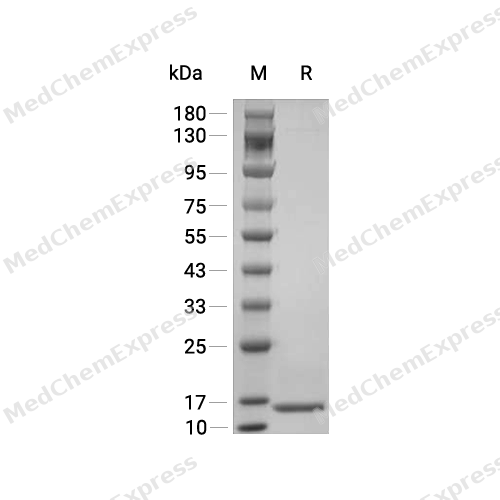
Purity - SDS-PAGE


Technical Parameters
-
Species Human
-
Source HEK293
-
Tag C-6*His
-
Accession
P00709 (K20-L142)
-
Molecular Construction
-
N-term
-
LALBA (K20-L142)
Accession # P00709 -
6*His
-
C-term
-
-
Protein Length
Full Length of Mature Protein
-
Synonyms
LALBA; LYZG; Lactalbumin Alpha; Lysozyme-Like Protein 7; Lactose Synthase B Protein; Lysozyme G; Alpha-Lactalbumin; Lactalbumin, Alpha-; HAMLET; Lactose Synthase B; LYZL7
-
AA Sequence
KQFTKCELSQLLKDIDGYGGIALPELICTMFHTSGYDTQAIVENNESTEYGLFQISNKLWCKSSQVPQSRNICDISCDKFLDDDITDDIMCAKKILDIKGIDYWLAHKALCTEKLEQWLCEKL
-
Predicted Molecular Mass
15.1 kDa
-
Molecular Weight
Approximately 14-16 kDa, based on SDS-PAGE under reducing conditions.
-
Glycosylation
Yes
-
Purity
≥ 95%, as determined by reducing SDS-PAGE.


Product Properties
Solution
Supplied as a 0.22 μm filtered solution of 20 mM Tris-HCl, 150 mM NaCl, pH 8.0.
Note: For SPR assay, please replace the buffer. Primary amine components (e.g., Tris, imidazole) can affect protein-coupled chips.
<1 EU/μg, determined by LAL method.
Stored at -80°C for 1 year from date of receipt. It is stable at -20°C for 3 months after opening. It is recommended to freeze aliquots at -80°C for extended storage. Avoid repeated freeze-thaw cycles.
Shipping with dry ice.


Documentation
-
Data Sheet (235 KB)
-
SDS (252 KB)
- English - EN (252 KB)
- Français - FR (252 KB)
- Deutsch - DE (252 KB)
- Norwegian - NO (252 KB)
- Español - ES (252 KB)
- Swedish - SV (252 KB)
- Italian - IT (252 KB)
- Korean - KR (252 KB)
- Portuguese - PT (252 KB)
-
Handling Instructions (2659 KB)

Calculators
Concentration (start) × Volume (start) = Concentration (final) × Volume (final)


 Powered by Bioz

