



Leptin Protein, Mouse (His)
Based on 1 publication(s) in Google Scholar
Leptin is a key regulator of energy balance and body weight and binds to LEPR receptors in multiple tissues.It controls appetite in the hypothalamus and affects bone mass, hormone regulation, and reproductive function.Leptin Protein, Mouse (His) is the recombinant mouse-derived Leptin protein, expressed by E.coli , with N-6*His labeled tag.
- Species: Mouse
- Source: E. coli
-
Storage:Stored at -20°C for 2 years from date of receipt. After reconstitution, it is stable at 4°C for 1 week or -20°C for longer (with carrier protein). It is recommended to freeze aliquots at -20°C or -80°C for extended storage.


To place orders, for customer services and technical support, please contact: MedChemExpress USA
Tel: 609-228-6898 E-mail: [email protected] [email protected]


-
 Biological Activity
-
Technical Parameters
-
Product Properties
- Documentation
- Help & FAQs




Biological Activity
Description
Leptin is a key regulator of energy balance and body weight and binds to LEPR receptors in multiple tissues.It controls appetite in the hypothalamus and affects bone mass, hormone regulation, and reproductive function.Leptin Protein, Mouse (His) is the recombinant mouse-derived Leptin protein, expressed by E.coli , with N-6*His labeled tag.
Background
Leptin, a key regulator in the orchestration of energy balance and body weight, exerts comprehensive effects once released into circulation by binding to its receptor, LEPR, present in diverse tissues. In the hypothalamus, it acts as an appetite-regulating factor, inducing a decrease in food intake and an increase in energy consumption through the modulation of anorexinogenic and orexigenic neuropeptides. Leptin further extends its influence beyond appetite control, regulating bone mass, hypothalamo-pituitary-adrenal hormones, and impacting reproductive function. In peripheral tissues, it enhances basal metabolism, influences pancreatic beta-cell function, and exhibits pro-angiogenic properties. Within the arcuate nucleus of the hypothalamus, leptin activates POMC neurons and inhibits NPY neurons, orchestrating the release of anorexigenic and orexigenic peptides, respectively. Additionally, leptin plays a modulatory role in nutrient absorption, reducing glucose uptake in the intestine. It functions as a growth factor, activating various signaling pathways to regulate gene expression involved in cell cycle control, apoptosis, and angiogenesis. In innate immunity, leptin modulates neutrophil activity, enhances macrophage function, and promotes a pro-inflammatory response. In adaptive immunity, it influences T-cell responses, promoting T helper-1 cell immune responses and regulating CD4(+)CD25(-) T-cell proliferation through MTOR signaling pathway activation.
Verified Bioactivity
1.Fully biologically active determined by the dose dependent proliferation of MCF-7 cells. The ED50 for this effect is ≤1.680 ng/mL, corresponding to a specific activity is ≥5.95×10⁵ units/mg. 2.Measured in a cell proliferation assay using BaF3 mouse pro-B cells transfected with human Leptin R. The ED50 for this effect is 0.4384 ng/mL.
MCE Validation Data
-
Purity - SDS-PAGE
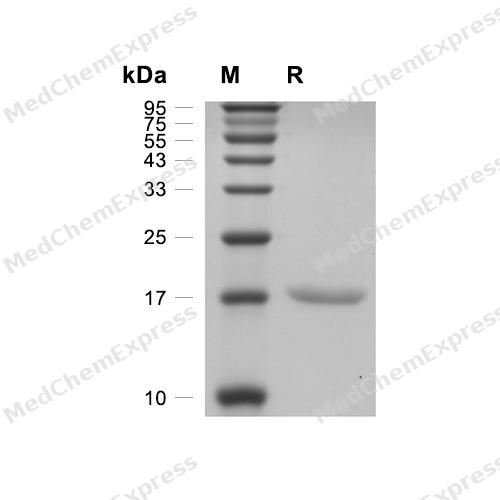
Purity - SDS-PAGE
-
Bioactivity - Cell-Based Assay
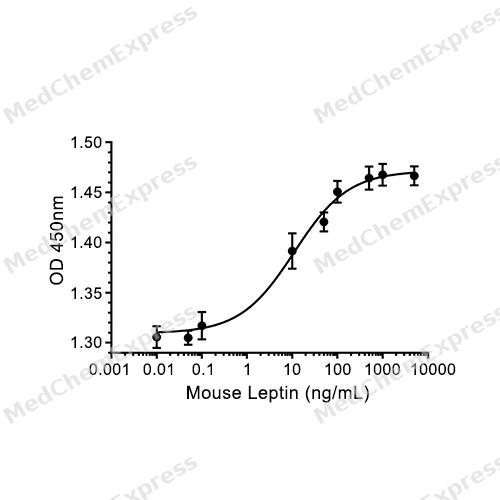
Bioactivity - Cell-Based Assay


Publications (1)
-
Journal Impact Factor
-
Most Recent
-
J Adv Res
Tirzepatide retention in iWAT with mesoporous polydopamine encapsulation enhances weight loss through leptin receptor signaling. [Abstract]2025 Sep 11:S2090-1232(25)00692-7. PMID: 40945849


Technical Parameters
-
Species Mouse
-
Source E. coli
-
Tag N-6*His
-
Accession
Q544U0 (V22-C167)
-
Molecular Construction
-
N-term
-
6*His
-
Leptin (V22-C167)
Accession # Q544U0 -
C-term
-
-
Protein Length
Full Length of Mature Protein
-
Synonyms
LEP; Leptin (Murine Obesity Homolog); Prev. OBS; Obese Protein; Prev. OB; Obese, Mouse, Homolog Of; Obesity Factor; LEPD; Leptin; Leptin (Obesity Homolog, Mouse)
-
AA Sequence
VPIQKVQDDTKTLIKTIVTRINDISHTQSVSAKQRVTGLDFIPGLHPILSLSKMDQTLAVYQQVLTSLPSQNVLQIANDLENLRDLLHLLAFSKSCSLPQTSGLQKPESLDGVLEASLYSTEVVALSRLQGSLQDILQQLDVSPEC
-
Predicted Molecular Mass
16 kDa
-
Molecular Weight
Approximately 17 kDa, based on SDS-PAGE under reducing conditions.
-
Purity
≥ 95%, as determined by reducing SDS-PAGE.


Product Properties
Lyophilized powder.
Lyophilized from a 0.22 μm filtered solution of 50 mM Tris-HCl, 300 mM NaCl, 200 mM arginine, pH 8.0.
Note: For SPR assay, please replace the buffer. Primary amine components (e.g., Tris, imidazole) can affect protein-coupled chips.
<1 EU/μg, determined by LAL method.
It is not recommended to reconstitute to a concentration less than 100 μg/mL in ddH2O. For long term storage it is recommended to add a carrier protein (0.1% BSA, 5% HSA, 10% FBS or 5% Trehalose).
Stored at -20°C for 2 years from date of receipt. After reconstitution, it is stable at 4°C for 1 week or -20°C for longer (with carrier protein). It is recommended to freeze aliquots at -20°C or -80°C for extended storage.
Room temperature in continental US; may vary elsewhere.


Documentation
-
Data Sheet (237 KB)
-
SDS (252 KB)
- English - EN (252 KB)
- Français - FR (252 KB)
- Deutsch - DE (252 KB)
- Norwegian - NO (252 KB)
- Español - ES (252 KB)
- Swedish - SV (252 KB)
- Italian - IT (252 KB)
- Korean - KR (252 KB)
- Portuguese - PT (252 KB)
-
Handling Instructions (2659 KB)

Calculators
Concentration (start) × Volume (start) = Concentration (final) × Volume (final)


 Powered by Bioz

