



MGMT Protein, Human (His)

Based on 1 Customer Validation
MGMT Protein crucially defends against O6-methylguanine (O6-MeG) and O4-methylthymine (O4-MeT) in DNA, using a suicide reaction to repair methylated nucleobases. It stoichiometrically transfers the methyl group to a cysteine residue, but this process irreversibly inactivates MGMT. The sacrificial nature of MGMT's function emphasizes its commitment to safeguarding cellular DNA integrity at the expense of its own activity. MGMT Protein, Human (His) is the recombinant human-derived MGMT protein, expressed by E. coli , with N-6*His labeled tag.
- Species: Human
- Source: E. coli
-
Storage:Stored at -80°C for 1 year from date of receipt. It is stable at -20°C for 3 months after opening. It is recommended to freeze aliquots at -80°C for extended storage. Avoid repeated freeze-thaw cycles.


To place orders, for customer services and technical support, please contact: MedChemExpress USA
Tel: 609-228-6898 E-mail: [email protected] [email protected]


-
 Biological Activity
-
Technical Parameters
-
Product Properties
- Documentation
- Help & FAQs




Biological Activity
Description
MGMT Protein crucially defends against O6-methylguanine (O6-MeG) and O4-methylthymine (O4-MeT) in DNA, using a suicide reaction to repair methylated nucleobases. It stoichiometrically transfers the methyl group to a cysteine residue, but this process irreversibly inactivates MGMT. The sacrificial nature of MGMT's function emphasizes its commitment to safeguarding cellular DNA integrity at the expense of its own activity. MGMT Protein, Human (His) is the recombinant human-derived MGMT protein, expressed by E. coli , with N-6*His labeled tag.
Background
The MGMT Protein plays a crucial role in the cellular defense against the biological effects of O6-methylguanine (O6-MeG) and O4-methylthymine (O4-MeT) in DNA. Operating through a suicide reaction, MGMT repairs the methylated nucleobases in DNA by stoichiometrically transferring the methyl group to a cysteine residue within the enzyme. However, this repair process results in the irreversible inactivation of the MGMT Protein. This unique mechanism underscores the sacrificial nature of MGMT's function, emphasizing its commitment to safeguarding cellular DNA integrity at the expense of its own activity.
Verified Bioactivity
Human MGMT immobilized on CM5 Chip can bind O6-Benzylguanine with an affinity constant of 953.8 μM as determined in a SPR assay.
MCE Validation Data
-
Purity - SDS-PAGE
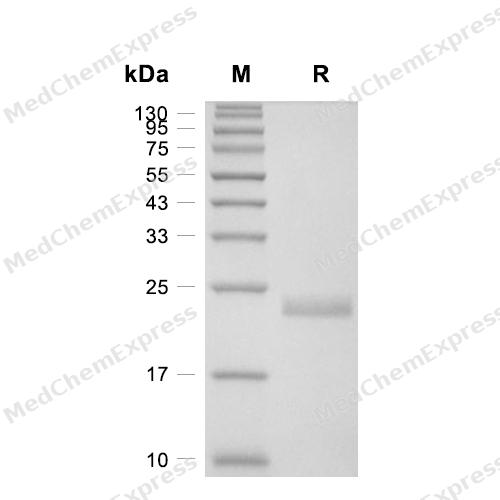
Purity - SDS-PAGE
-
Bioactivity - SPR
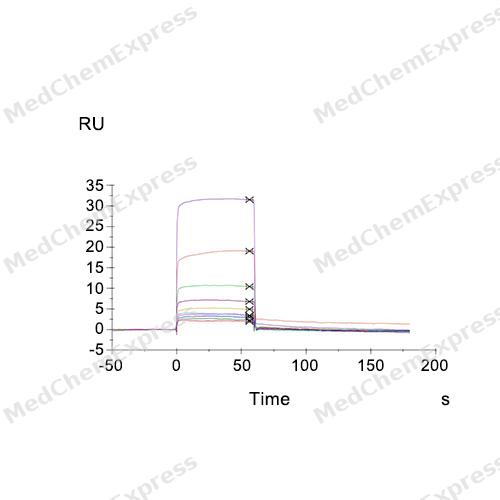
Bioactivity - SPR


Technical Parameters
-
Species Human
-
Source E. coli
-
Tag N-6*His
-
Accession
P16455 (M1-N207)
-
Molecular Construction
-
N-term
-
6*His
-
MGMT (M1-N207)
Accession # P16455 -
C-term
-
-
Protein Length
Full Length
-
Synonyms
MGMT; O-6-Methylguanine-DNA-Alkyltransferase; O-6-Methylguanine-DNA Methyltransferase; O6-Methylguanine-DNA Methyltransferase; Methylated-DNA--Protein-Cysteine Methyltransferase; Methylguanine-DNA Methyltransferase; 6-O-Methylguanine-DNA Methyltransferase
-
AA Sequence
MDKDCEMKRTTLDSPLGKLELSGCEQGLHEIKLLGKGTSAADAVEVPAPAAVLGGPEPLMQCTAWLNAYFHQPEAIEEFPVPALHHPVFQQESFTRQVLWKLLKVVKFGEVISYQQLAALAGNPKAARAVGGAMRGNPVPILIPCHRVVCSSGAVGNYSGGLAVKEWLLAHEGHRLGKPGLGGSSGLAGAWLKGAGATSGSPPAGRN
-
Molecular Weight
Approximately 25 kDa, based on SDS-PAGE under reducing conditions.
-
Purity
≥ 95%, as determined by reducing SDS-PAGE.


Product Properties
Solution
Supplied as a 0.22 μm filtered solution of 20 mM Tris-HCl,1 mM DTT,1 mM EDTA,500 mM NaCl,0.1% Trition X-100, pH 8.0.
Note: For SPR assay, please replace the buffer. Primary amine components (e.g., Tris, imidazole) can affect protein-coupled chips.
<1 EU/μg, determined by LAL method.
Stored at -80°C for 1 year from date of receipt. It is stable at -20°C for 3 months after opening. It is recommended to freeze aliquots at -80°C for extended storage. Avoid repeated freeze-thaw cycles.
Shipping with dry ice.


Documentation
-
Data Sheet (260 KB)
-
SDS (252 KB)
- English - EN (252 KB)
- Français - FR (252 KB)
- Deutsch - DE (252 KB)
- Norwegian - NO (252 KB)
- Español - ES (252 KB)
- Swedish - SV (252 KB)
- Italian - IT (252 KB)
- Korean - KR (252 KB)
- Portuguese - PT (252 KB)
-
Handling Instructions (2659 KB)

Calculators
Concentration (start) × Volume (start) = Concentration (final) × Volume (final)


 Powered by Bioz

