



Noggin Protein, Mouse (HEK293)
Based on 1 publication(s) in Google Scholar
Noggin is an indispensable factor in cartilage morphogenesis and joint formation, a potent inhibitor of bone morphogenetic protein (BMP) signaling, and plays a crucial role in the growth and patterning of the neural tube and somites.By forming homodimers, Noggin acts as a key regulator to inhibit chondrocyte differentiation by interacting with growth and differentiation factors, particularly GDF5 and possibly GDF6.Noggin Protein, Mouse (HEK293) is the recombinant mouse-derived Noggin protein, expressed by HEK293 , with tag free.
- Species: Mouse
- Source: HEK293
-
Storage:Stored at -20°C for 2 years from date of receipt. After reconstitution, it is stable at 4°C for 1 week or -20°C for longer (with carrier protein). It is recommended to freeze aliquots at -20°C or -80°C for extended storage.


To place orders, for customer services and technical support, please contact: MedChemExpress USA
Tel: 609-228-6898 E-mail: [email protected] [email protected]


-
 Biological Activity
-
Technical Parameters
-
Product Properties
- Documentation
- Help & FAQs


-
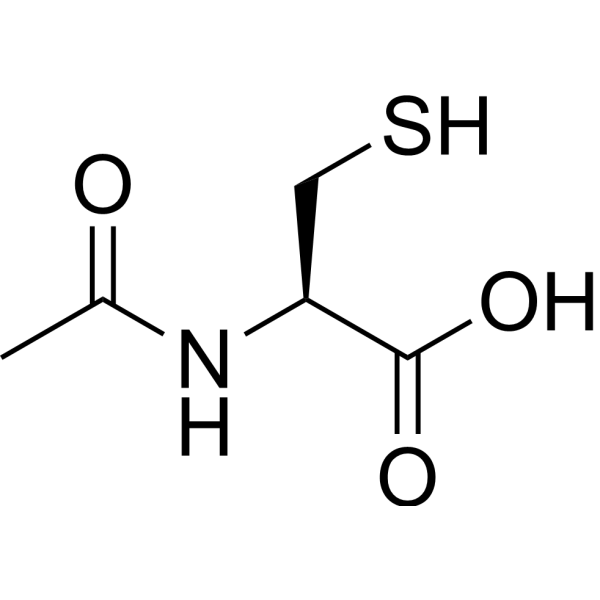
HY-B0215
Acetylcysteine -
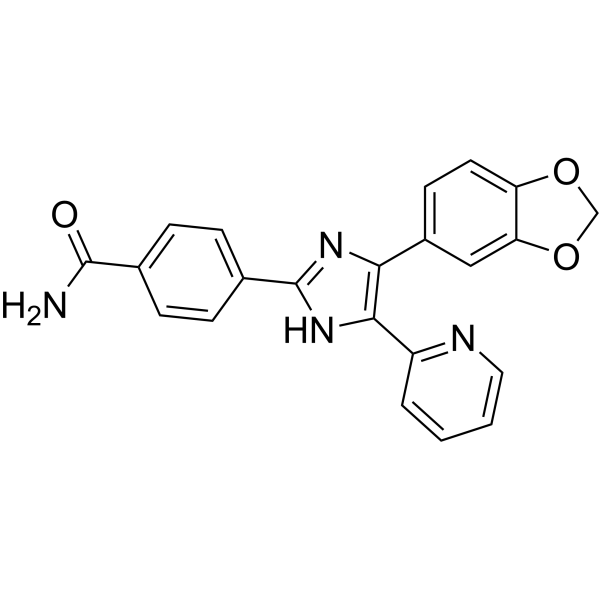
HY-10431
SB-431542 -

HY-P78344
RSPO1/R-spondin-1 Protein, Mouse (HEK293, His) -
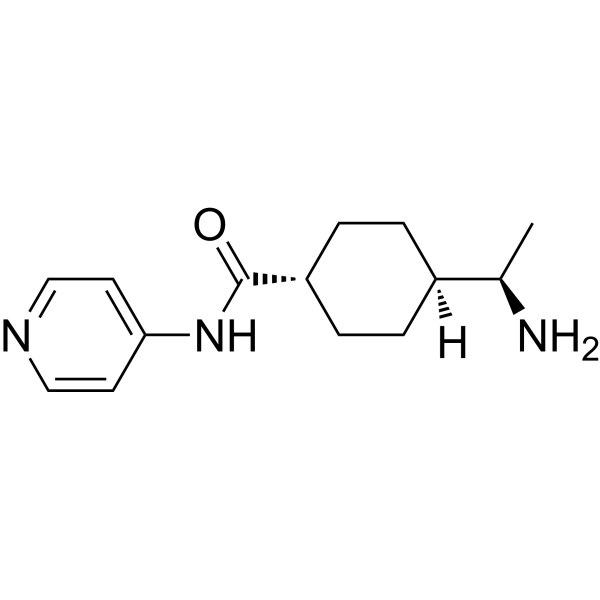
HY-10071
Y-27632 -
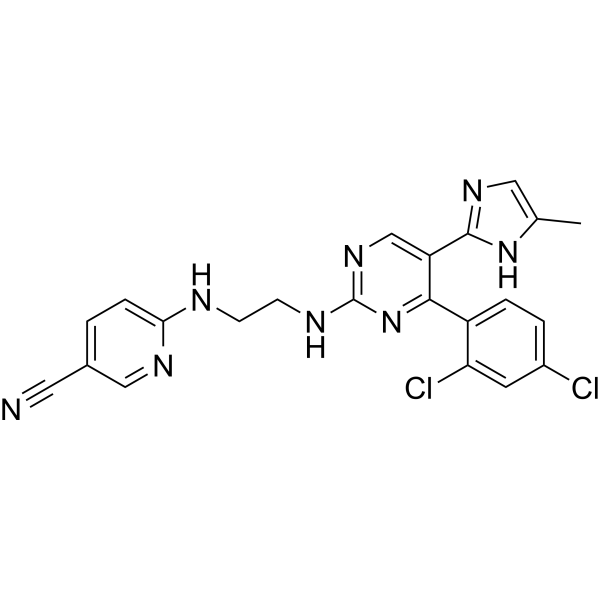
HY-10182
Laduviglusib -
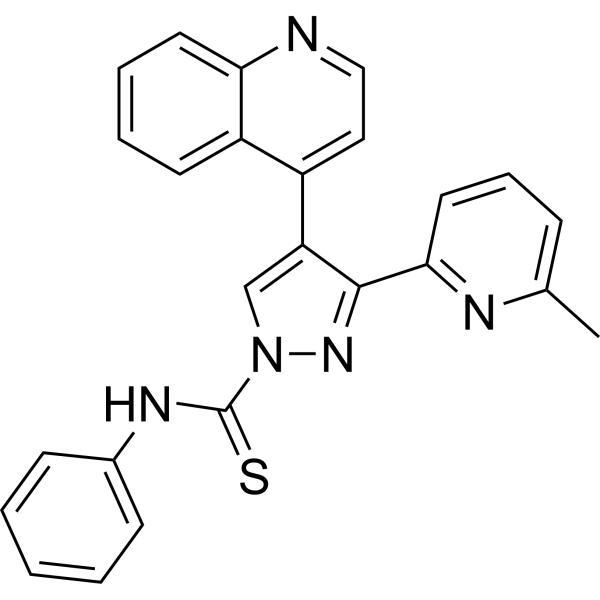
HY-10432
A 83-01 -
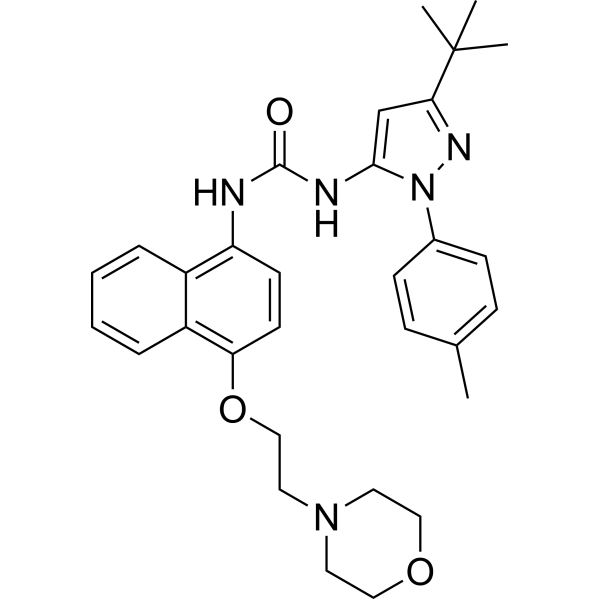
HY-10320
Doramapimod -
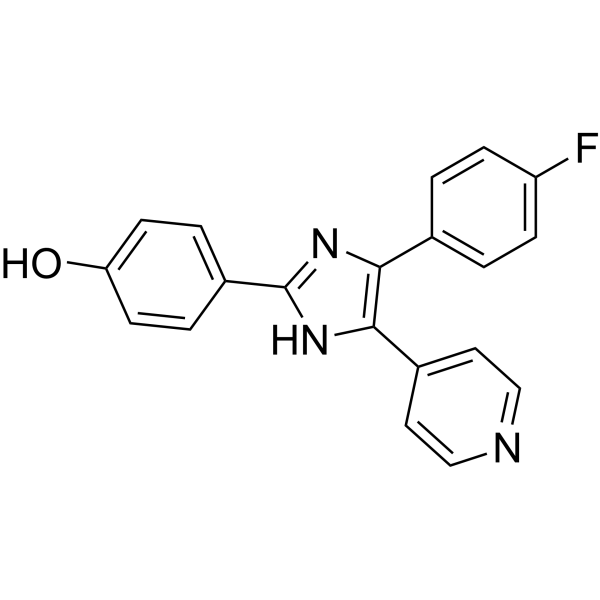
HY-10295
SB 202190 -
HY-P70452
Wnt3a Protein, Mouse (His) -
HY-P7109
EGF Protein, Human -
HY-P7114
RSPO1/R-spondin-1 Protein, Human (CHO, His) -
HY-P7067
EGF Protein, Mouse


Biological Activity
Description
Noggin is an indispensable factor in cartilage morphogenesis and joint formation, a potent inhibitor of bone morphogenetic protein (BMP) signaling, and plays a crucial role in the growth and patterning of the neural tube and somites.By forming homodimers, Noggin acts as a key regulator to inhibit chondrocyte differentiation by interacting with growth and differentiation factors, particularly GDF5 and possibly GDF6.Noggin Protein, Mouse (HEK293) is the recombinant mouse-derived Noggin protein, expressed by HEK293 , with tag free.
Background
Noggin is a vital protein involved in cartilage morphogenesis and joint formation, playing a crucial role in inhibiting bone morphogenetic proteins (BMP) signaling essential for the growth and patterning of the neural tube and somite. Acting as an inhibitor of BMP, Noggin is implicated in the regulation of chondrocyte differentiation through its interaction with growth and differentiation factor 5 (GDF5) and likely GDF6. Existing as a homodimer, Noggin directly interacts with GDF5, leading to the inhibition of chondrocyte differentiation. These multifaceted functions underscore the importance of Noggin in embryonic development, particularly in the intricate processes of skeletal and neural tissue formation, and highlight its role as a key modulator of BMP signaling pathways (
Verified Bioactivity
Measured by its ability to inhibit BMP-4-induced alkaline phosphatase production by ATDC5 mouse chondrogenic cells.The EC50 is 0.004-0.015 μg/mL.
MCE Validation Data
-
Purity - SDS-PAGE
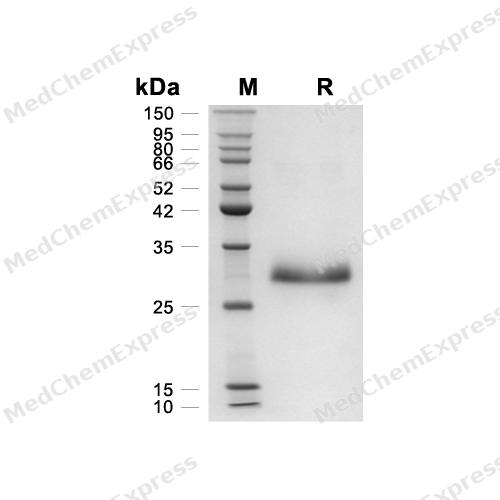
Purity - SDS-PAGE
-
Bioactivity - Cell-Based Assay
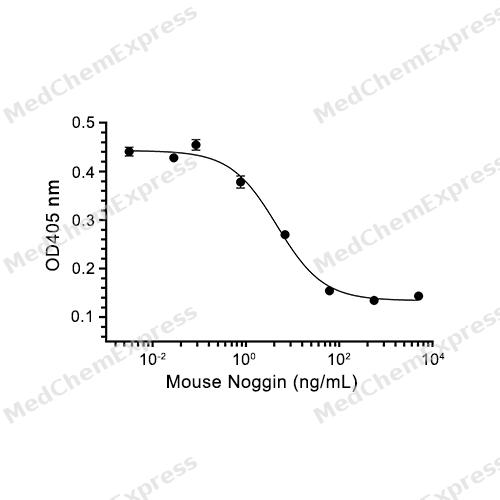
Bioactivity - Cell-Based Assay


Publications (1)
-
Journal Impact Factor
-
Most Recent


Technical Parameters
-
Species Mouse
-
Source HEK293
-
Tag Tag Free
-
Accession
P97466 (Q28-C232)
-
Molecular Construction
-
N-term
-
Noggin (Q28-C232)
Accession # P97466 -
C-term
-
-
Protein Length
Full Length of Mature Protein
-
Synonyms
NOG; Symphalangism 1 (Proximal); Prev. SYNS1; SYNS1A; Prev. SYM1; Noggin; Synostoses (Multiple) Syndrome 1
-
AA Sequence
QHYLHIRPAPSDNLPLVDLIEHPDPIFDPKEKDLNETLLRSLLGGHYDPGFMATSPPEDRPGGGGGPAGGAEDLAELDQLLRQRPSGAMPSEIKGLEFSEGLAQGKKQRLSKKLRRKLQMWLWSQTFCPVLYAWNDLGSRFWPRYVKVGSCFSKRSCSVPEGMVCKPSKSVHLTVLRWRCQRRGGQRCGWIPIQYPIISECKCSC
-
Predicted Molecular Mass
23.1 kDa
-
Molecular Weight
Approximately 30 kDa, based on SDS-PAGE under reducing conditions.
-
Glycosylation
Yes
-
Purity
≥ 95%, as determined by reducing SDS-PAGE.


Product Properties
Lyophilized powder.
Lyophilized from a 0.22 μm filtered solution of 20 mM PB, 150 mM NaCl, pH 7.4.
<1 EU/μg, determined by LAL method.
It is not recommended to reconstitute to a concentration less than 100 μg/mL in ddH2O. For long term storage it is recommended to add a carrier protein (0.1% BSA, 5% HSA, 10% FBS or 5% Trehalose).
Stored at -20°C for 2 years from date of receipt. After reconstitution, it is stable at 4°C for 1 week or -20°C for longer (with carrier protein). It is recommended to freeze aliquots at -20°C or -80°C for extended storage.
Room temperature in continental US; may vary elsewhere.


Documentation
-
Data Sheet (236 KB)
-
SDS (252 KB)
- English - EN (252 KB)
- Français - FR (252 KB)
- Deutsch - DE (252 KB)
- Norwegian - NO (252 KB)
- Español - ES (252 KB)
- Swedish - SV (252 KB)
- Italian - IT (252 KB)
- Korean - KR (252 KB)
- Portuguese - PT (252 KB)
-
Handling Instructions (2659 KB)

Calculators
Concentration (start) × Volume (start) = Concentration (final) × Volume (final)


 Powered by Bioz

