



Prolactin Protein, Mouse (His)
Based on 5 publication(s) in Google Scholar
Prolactin Protein, acting on the mammary gland, plays a pivotal role in promoting lactation through interaction with its receptor, PRLR, facilitating the lactation process.Prolactin Protein, Mouse (His) is the recombinant mouse-derived Prolactin protein, expressed by E.coli , with N-6*His labeled tag.
- Species: Mouse
- Source: E. coli
-
Storage:Stored at -20°C for 2 years from date of receipt. After reconstitution, it is stable at 4°C for 1 week or -20°C for longer (with carrier protein). It is recommended to freeze aliquots at -20°C or -80°C for extended storage.


To place orders, for customer services and technical support, please contact: MedChemExpress USA
Tel: 609-228-6898 E-mail: [email protected] [email protected]


-
 Biological Activity
-
Technical Parameters
-
Product Properties
- Documentation
- Help & FAQs




Biological Activity
Description
Prolactin Protein, acting on the mammary gland, plays a pivotal role in promoting lactation through interaction with its receptor, PRLR, facilitating the lactation process.Prolactin Protein, Mouse (His) is the recombinant mouse-derived Prolactin protein, expressed by E.coli , with N-6*His labeled tag.
Background
Prolactin is a protein that plays a pivotal role in promoting lactation by primarily acting on the mammary gland. It achieves this by interacting with its specific receptor, PRLR, which facilitates the lactation process.
Verified Bioactivity
1.Measured in a cell proliferation assay using Nb2-11 rat lymphoma cells.The ED50 for this effect is 0.3921-4.279 ng/mL.
2.Mouse Prolactin Receptor captured on CM5 Chip can bind Mouse Prolactin with an affinity constant of 10-20 nM as determined in SPR assay.
MCE Validation Data
-
Purity - SDS-PAGE
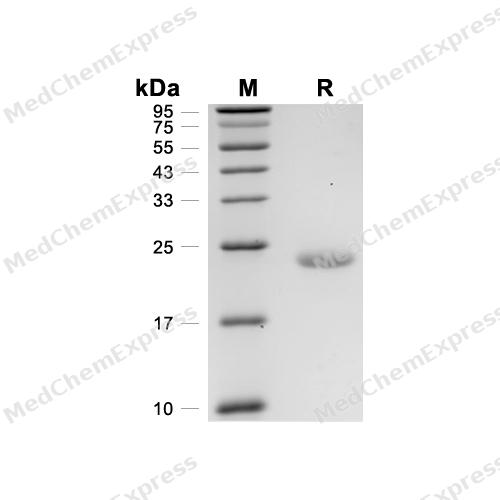
Purity - SDS-PAGE
-
Bioactivity - Cell-Based Assay
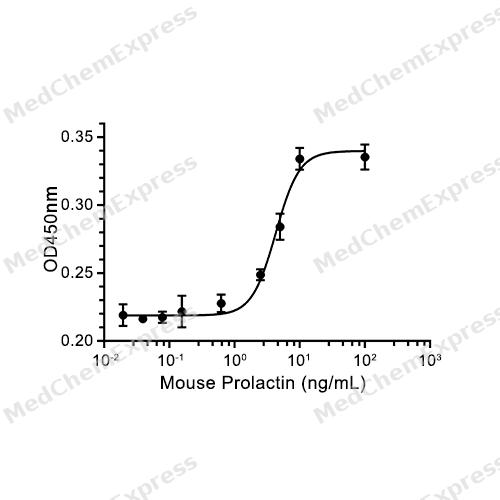
Bioactivity - Cell-Based Assay


Publications (5)
-
Journal Impact Factor
-
Most Recent
-
Adv Sci (Weinh)
Granulosa Cell-Layer Stiffening Prevents Escape of Mural Granulosa Cells from the Post-Ovulatory Follicle. [Abstract]2024 Sep;11(33):e2403640. PMID: 38946588 -
Free Radic Biol Med
Prolactin drives the pathogenic amplification of atopic dermatitis by promoting CCL17 secretion through activation of the PI3K/AKT pathway. [Abstract]2026 Aug 1:251:199-211. PMID: 42009143 -
Cell Rep
CD36-mediated arachidonic acid influx from decidual stromal cells increases inflammatory macrophages in miscarriage. [Abstract]2024 Oct 19;43(11):114881. PMID: 39427314 -
-


Technical Parameters
-
Species Mouse
-
Source E. coli
-
Tag N-6*His
-
Accession
P06879 (L30-C226)
-
Molecular Construction
-
N-term
-
6*His
-
Prolactin (L30-C226)
Accession # P06879 -
C-term
-
-
Protein Length
Full Length of Mature Protein
-
Synonyms
PRL; PPRL; Prolactin; GHA1; Luteotropic Hormone; Decidual Prolactin; Prolactin Peptide; Growth Hormone A1; Luteotropin
-
AA Sequence
LPICSAGDCQTSLRELFDRVVILSHYIHTLYTDMFIEFDKQYVQDREFMVKVINDCPTSSLATPEDKEQALKVPPEVLLNLILSLVQSSSDPLFQLITGVGGIQEAPEYILSRAKEIEEQNKQLLEGVEKIISQAYPEAKGNGIYFVWSQLPSLQGVDEESKILSLRNTIRCLRRDSHKVDNFLKVLRCQIAHQNNC
-
Predicted Molecular Mass
23.2 kDa
-
Molecular Weight
Approximately 24 kDa, based on SDS-PAGE under reducing conditions.
-
Purity
≥ 95%, as determined by reducing SDS-PAGE.


Product Properties
Lyophilized powder
1.Lyophilized from a 0.22 μm filtered solution of 50 mM Tris-HCl, 300 mM NaCl, 200 mM arginine, pH 8.0.
2.Lyophilized from a 0.22 μm filtered solution of PBS, pH 7.4, 8% trehalose.
Please refer to the lot-specific COA for specific buffer information.
Note: For SPR assay, please replace the buffer. Primary amine components (e.g., Tris, imidazole) can affect protein-coupled chips.
<1 EU/μg, determined by LAL method.
It is not recommended to reconstitute to a concentration less than 100 μg/mL in ddH2O. For long term storage it is recommended to add a carrier protein (0.1% BSA, 5% HSA, 10% FBS or 5% Trehalose).
Stored at -20°C for 2 years from date of receipt. After reconstitution, it is stable at 4°C for 1 week or -20°C for longer (with carrier protein). It is recommended to freeze aliquots at -20°C or -80°C for extended storage.
Room temperature in continental US; may vary elsewhere.


Documentation
-
Data Sheet (236 KB)
-
SDS (251 KB)
- English - EN (251 KB)
- Français - FR (251 KB)
- Deutsch - DE (251 KB)
- Norwegian - NO (251 KB)
- Español - ES (251 KB)
- Swedish - SV (251 KB)
- Italian - IT (251 KB)
- Korean - KR (251 KB)
- Portuguese - PT (251 KB)
-
Handling Instructions (2659 KB)

Calculators
Concentration (start) × Volume (start) = Concentration (final) × Volume (final)


 Powered by Bioz

