



S100B Protein, Human (His)

Based on 1 Customer Validation
The S100B protein binds calcium and zinc ions, each with a different site on the monomer. Physiological levels of potassium ions disrupt the binding of calcium and zinc, affecting high-affinity sites. S100B Protein, Human (His) is the recombinant human-derived S100B protein, expressed by E. coli , with N-6*His labeled tag.
- Species: Human
- Source: E. coli
-
Storage:Stored at -20°C for 2 years from date of receipt. After reconstitution, it is stable at 4°C for 1 week or -20°C for longer (with carrier protein). It is recommended to freeze aliquots at -20°C or -80°C for extended storage.


To place orders, for customer services and technical support, please contact: MedChemExpress USA
Tel: 609-228-6898 E-mail: [email protected] [email protected]


-
 Biological Activity
-
Technical Parameters
-
Product Properties
- Documentation
- Help & FAQs




Biological Activity
Description
The S100B protein binds calcium and zinc ions, each with a different site on the monomer. Physiological levels of potassium ions disrupt the binding of calcium and zinc, affecting high-affinity sites. S100B Protein, Human (His) is the recombinant human-derived S100B protein, expressed by E. coli , with N-6*His labeled tag.
Background
S100B is a protein that plays a role in binding calcium and zinc ions. It has distinct binding sites for each ion on each monomer. Physiological concentrations of potassium ions can interfere with the binding of both calcium and zinc, particularly affecting the high-affinity calcium-binding sites. S100B functions as a neurotrophic factor, promoting astrocytosis and axonal proliferation. It is also involved in the innervation of thermogenic adipose tissue, promoting sympathetic innervation. S100B can activate the STK38 kinase by releasing inhibitory interactions within the kinase. After a myocardial infarction, it interacts with AGER, potentially contributing to myocyte apoptosis through ERK1/2 and p53/TP53 signaling. S100B may assist in the cytoplasmic processing of ATAD3A, preventing aggregation and facilitating mitochondrial localization. It can also modulate the activity of other proteins, such as TPR-containing proteins, through calcium-dependent interactions. S100B forms dimers of either two alpha chains, two beta chains, or one alpha and one beta chain. It interacts with various proteins, including CACYBP, ATAD3A, S100A6, CAPZA1, AGER, PPP5C, TPPP, and isoform CLSTN3beta of CLSTN3, with different functional consequences.
Verified Bioactivity
1. Measured in a cell proliferation assay using THP-1 cells. The ED50 for this effect is 0.09308 μg/mL, corresponding to a specific activity is 1.07×10⁴ units/mg.
2. Measured by its binding ability in a functional ELISA. Immobilized Human AGER at 4 μg/mL can bind Biotinylated Human S100B. The ED50 for this effect is 0.5-2 μg/mL.
MCE Validation Data
-
Purity - SDS-PAGE
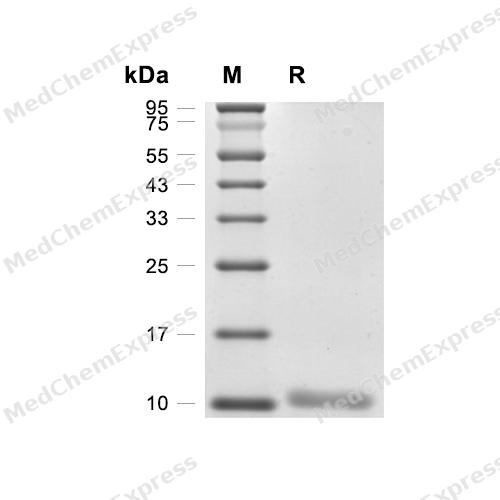
Purity - SDS-PAGE
-
Bioactivity - Cell-Based Assay
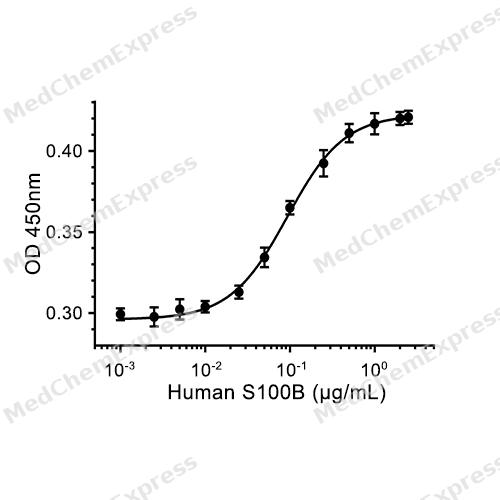
Bioactivity - Cell-Based Assay


Technical Parameters
-
Species Human
-
Source E. coli
-
Tag N-6*His
-
Accession
P04271 (M1-E92)
-
Molecular Construction
-
N-term
-
6*His
-
S100B (M1-E92)
Accession # P04271 -
C-term
-
-
Protein Length
Full Length
-
Synonyms
S100B; S100 Calcium-Binding Protein B; S100 Calcium Binding Protein B; S100 Calcium-Binding Protein; S100beta; S-100 Protein Beta Chain; S-100 Protein Subunit Beta; Protein S100; Protein S100-B; S100-B; S100 Calcium Binding Protein, Beta (Neural); S100; S
-
AA Sequence
MSELEKAMVALIDVFHQYSGREGDKHKLKKSELKELINNELSHFLEEIKEQEVVDKVMETLDNDGDGECDFQEFMAFVAMVTTACHEFFEHE
-
Molecular Weight
Approximately 12 kDa, based on SDS-PAGE under reducing conditions.
-
Purity
≥ 95%, as determined by reducing SDS-PAGE.


Product Properties
Lyophilized powder
1.Lyophilized from a 0.22 μm filtered solution of 20 mM PB, 150 mM NaCl, pH 7.4.
2.Lyophilized from a 0.22 μm filtered solution of PBS, 300 mM NaCl, pH 7.4.
Please refer to the lot-specific COA for specific buffer information.
<1 EU/μg, determined by LAL method.
It is not recommended to reconstitute to a concentration less than 100 μg/mL in ddH2O. For long term storage it is recommended to add a carrier protein (0.1% BSA, 5% HSA, 10% FBS or 5% Trehalose).
Stored at -20°C for 2 years from date of receipt. After reconstitution, it is stable at 4°C for 1 week or -20°C for longer (with carrier protein). It is recommended to freeze aliquots at -20°C or -80°C for extended storage.
Room temperature in continental US; may vary elsewhere.


Documentation
-
Data Sheet (236 KB)
-
SDS (252 KB)
- English - EN (252 KB)
- Français - FR (252 KB)
- Deutsch - DE (252 KB)
- Norwegian - NO (252 KB)
- Español - ES (252 KB)
- Swedish - SV (252 KB)
- Italian - IT (252 KB)
- Korean - KR (252 KB)
- Portuguese - PT (252 KB)
-
Handling Instructions (2659 KB)

Calculators
Concentration (start) × Volume (start) = Concentration (final) × Volume (final)


 Powered by Bioz

