



SAA1 Protein, Human (His)
Based on 1 publication(s) in Google Scholar
SAA1 Protein, a major acute phase protein, forms a homohexamer comprising dimers of trimers. While the native form doesn't spontaneously form amyloid fibrils, partial proteolysis can induce amyloid fibril generation. SAA1 also serves as an apolipoprotein in the HDL complex and shows affinity for heparin. SAA1 Protein, Human (His) is the recombinant human-derived SAA1 protein, expressed by E. coli , with N-6*His labeled tag.
- Species: Human
- Source: E. coli
-
Storage:Stored at -20°C for 2 years from date of receipt. After reconstitution, it is stable at 4°C for 1 week or -20°C for longer (with carrier protein). It is recommended to freeze aliquots at -20°C or -80°C for extended storage.


To place orders, for customer services and technical support, please contact: MedChemExpress USA
Tel: 609-228-6898 E-mail: [email protected] [email protected]


-
 Biological Activity
-
Technical Parameters
-
Product Properties
- Documentation
- Help & FAQs




Biological Activity
Description
SAA1 Protein, a major acute phase protein, forms a homohexamer comprising dimers of trimers. While the native form doesn't spontaneously form amyloid fibrils, partial proteolysis can induce amyloid fibril generation. SAA1 also serves as an apolipoprotein in the HDL complex and shows affinity for heparin. SAA1 Protein, Human (His) is the recombinant human-derived SAA1 protein, expressed by E. coli , with N-6*His labeled tag.
Background
SAA1 protein, a major acute phase protein, exists as a homohexamer composed of dimers of trimers. While the native, undenatured form does not spontaneously form amyloid fibrils, partial proteolysis can lead to the generation of amyloid fibrils. Additionally, SAA1 functions as an apolipoprotein within the HDL complex and exhibits an affinity for heparin.
Verified Bioactivity
Measured by its ability to chemoattract THP-1 cells. The ED50 for this effect is <100 ng/mL.
MCE Validation Data
-
Purity - SDS-PAGE
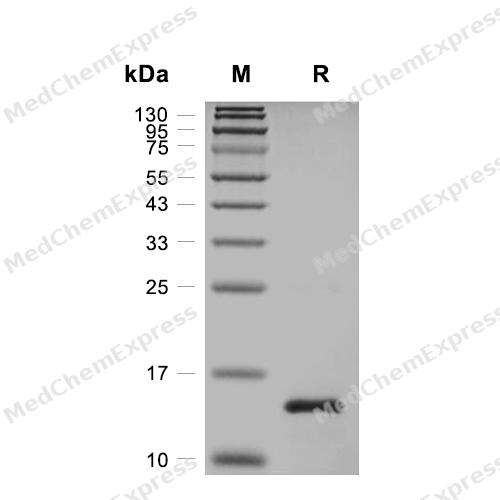
Purity - SDS-PAGE
-
Bioactivity - Cell-Based Assay
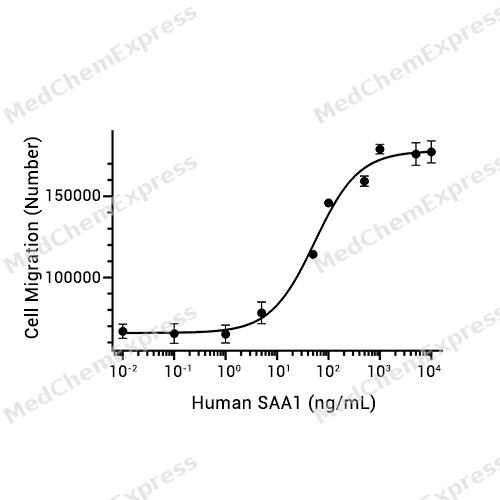
Bioactivity - Cell-Based Assay


Publications (1)
-
Journal Impact Factor
-
Most Recent
-
J Exp Clin Cancer Res
Tumor cells promote immunosuppression in ovarian cancer via a positive feedback loop with MDSCs through the SAA1-IL-1β axis. [Abstract]2025 Sep 30;44(1):277. PMID: 41029721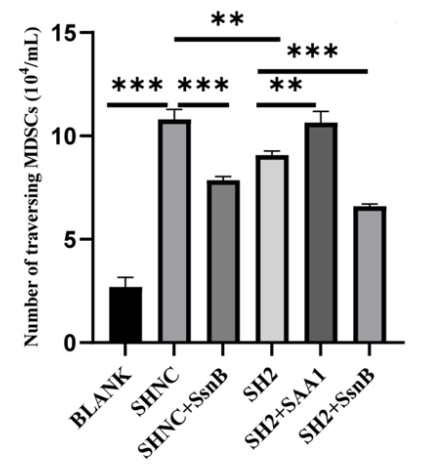
SAA1 Protein, Human (His) purchased from MedChemExpress. Usage Cited in: J Exp Clin Cancer Res. 2025 Sep 30;44(1):277. [Abstract]
Rescue experiments assessing the effect of adding recombinant SAA1 protein (HY-P70510; 200 ng/ml; ; 20–24 h) or the TLR2/4 inhibitor SsnB (Sparstolonin B; HY-116213; 20 µM; 20–24 h) on the ability of A2780 cell supernatants to recruit MDSCs.

SAA1 Protein, Human (His) purchased from MedChemExpress. Usage Cited in: J Exp Clin Cancer Res. 2025 Sep 30;44(1):277. [Abstract]
Rescue experiments assessing the effect of adding recombinant SAA1 protein (HY-P70510; 200 ng/ml; ; 20–24 h) or the TLR2/4 inhibitor SsnB (Sparstolonin B; HY-116213; 20 µM; 20–24 h) on the ability of A2780 cell supernatants to recruit MDSCs.
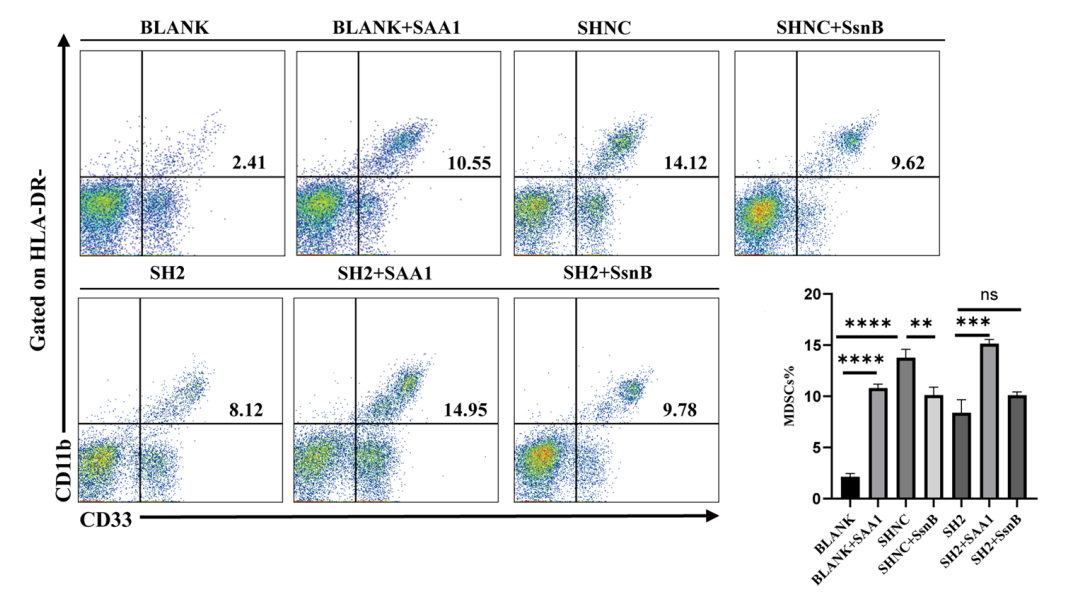
SAA1 Protein, Human (His) purchased from MedChemExpress. Usage Cited in: J Exp Clin Cancer Res. 2025 Sep 30;44(1):277. [Abstract]
Rescue experiments assessing the effect of adding recombinant SAA1 protein (HY-P70510; 200 ng/ml; ; 20–24 h) or the TLR2/4 inhibitor SsnB (Sparstolonin B; HY-116213; 20 µM; 20–24 h) on the ability of A2780 cell supernatants to induce GMP differentiation into MDSCs. Data are presented as mean ± SEM from three independent experiments; one-way ANOVA followed by Tukey’s multiple comparisons test.
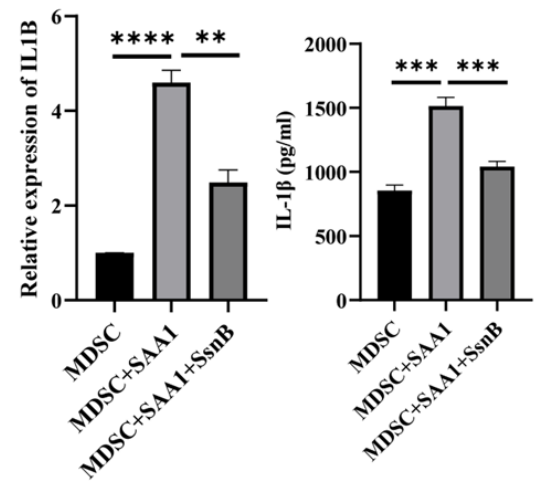
SAA1 Protein, Human (His) purchased from MedChemExpress. Usage Cited in: J Exp Clin Cancer Res. 2025 Sep 30;44(1):277. [Abstract]
IL-1β expression and secretion in MDSCs after adding the TLR2/4 inhibitor SsnB (Sparstolonin B; HY-116213; 20 µM; 20–24 h) to SAA1 (HY-P70510; 200 ng/ml; ; 20–24 h) treatment, detected by qRT-PCR (left) and ELISA (right). Data are presented as mean ± SEM from three independent experiments; one-way ANOVA followed by Dunnett’s multiple comparisons test.


Technical Parameters
-
Species Human
-
Source E. coli
-
Tag N-6*His
-
Accession
AAH07022.1 (R19-Y122)
-
Molecular Construction
-
N-term
-
6*His
-
SAA1 (R19-Y122)
Accession # AAH07022.1 -
C-term
-
-
Protein Length
Full Length of Serum amyloid A-1 protein Chain
-
Synonyms
SAA1; PIG4; Prev. SAA; Serum Amyloid A Protein; TP53I4; Tumor Protein P53 Inducible Protein 4; Serum Amyloid A1; Serum Amyloid A-1 Protein
-
AA Sequence
RSFFSFLGEAFDGARDMWRAYSDMREANYIGSDKYFHARGNYDAAKRGPGGVWAAEAISDARENIQRFFGHGAEDSLADQAADEWGRSGKDPNHFRPAGLPEKY
-
Molecular Weight
Approximately 14 kDa, based on SDS-PAGE under reducing conditions.
-
Purity
≥ 95%, as determined by reducing SDS-PAGE.


Product Properties
Lyophilized powder
1.Lyophilized from a 0.22 μm filtered solution of 20 mM Tris-HCl, 150 mM NaCl,1 mM EDTA, pH 8.0.
2.Lyophilized from a 0.22 μm filtered solution of PBS, 8% trehalose, pH 7.4.
Note: For SPR assay, please replace the buffer. Primary amine components (e.g., Tris, imidazole) can affect protein-coupled chips.
<1 EU/μg, determined by LAL method.
It is not recommended to reconstitute to a concentration less than 100 μg/mL in ddH2O. For long term storage it is recommended to add a carrier protein (0.1% BSA, 5% HSA, 10% FBS or 5% Trehalose).
Stored at -20°C for 2 years from date of receipt. After reconstitution, it is stable at 4°C for 1 week or -20°C for longer (with carrier protein). It is recommended to freeze aliquots at -20°C or -80°C for extended storage.
Room temperature in continental US; may vary elsewhere.


Documentation
-
Data Sheet (235 KB)
-
SDS (251 KB)
- English - EN (251 KB)
- Français - FR (251 KB)
- Deutsch - DE (251 KB)
- Norwegian - NO (251 KB)
- Español - ES (251 KB)
- Swedish - SV (251 KB)
- Italian - IT (251 KB)
- Korean - KR (251 KB)
- Portuguese - PT (251 KB)
-
Handling Instructions (2659 KB)

Calculators
Concentration (start) × Volume (start) = Concentration (final) × Volume (final)


 Powered by Bioz

