



SCF Protein, Human
Based on 5 publication(s) in Google Scholar
SCF proteins are ligands for the KIT receptor-type protein tyrosine kinase and regulate a variety of cellular processes, including survival, proliferation, hematopoiesis, stem cell maintenance, gametogenesis, mast cell development, migration, and melanogenesis. Binding to KIT activates signaling pathways involving PIK3R1, AKT1, GRB2, RAS, RAF1, MAP kinase, STAT family members, and PLCG1, producing diacylglycerol and inositol 1,4,5-trisphosphate. SCF Protein, Human is the recombinant human-derived SCF protein, expressed in E. coli.
- Species: Human
- Source: E. coli
-
Storage:Stored at -20°C for 2 years from date of receipt. After reconstitution, it is stable at 4°C for 1 week or -20°C for longer (with carrier protein). It is recommended to freeze aliquots at -20°C or -80°C for extended storage.


To place orders, for customer services and technical support, please contact: MedChemExpress USA
Tel: 609-228-6898 E-mail: [email protected] [email protected]


-
 Biological Activity
-
Technical Parameters
-
Product Properties
- Documentation
- References
- Help & FAQs


-

HY-P7007
BMP-4 Protein, Human -
HY-P7044
IL-6 Protein, Human -
HY-P7110A
VEGF165 Protein, Human (HEK293) -
HY-P7040
IL-3 Protein, Human -
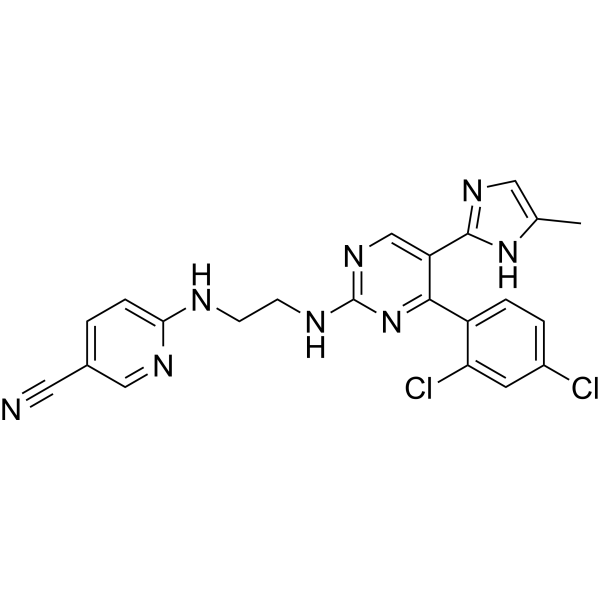
HY-10182
Laduviglusib -
HY-P70576
IL-3 Protein, Human (His) -
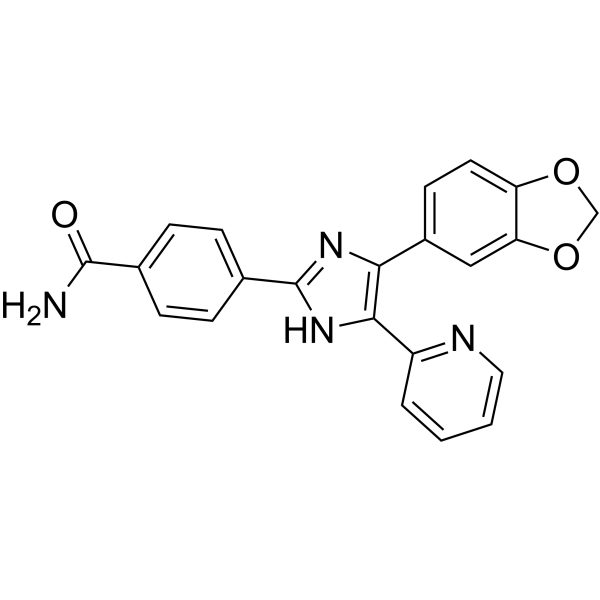
HY-10431
SB-431542 -
HY-P7111
FLT3LG Protein, Human (CHO) -
HY-P7050
M-CSF Protein, Human -
HY-P7004
FGF basic/bFGF Protein, Human (146a.a) -
HY-P7016A
GM-CSF Protein, Human -
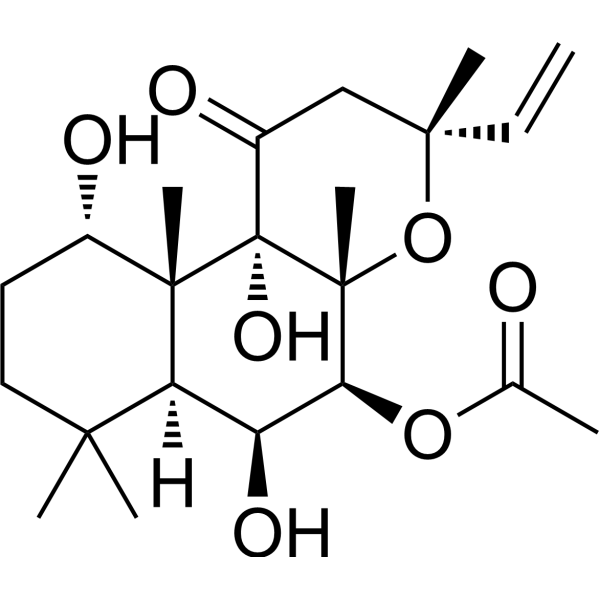
HY-15371
Forskolin


Biological Activity
Description
SCF proteins are ligands for the KIT receptor-type protein tyrosine kinase and regulate a variety of cellular processes, including survival, proliferation, hematopoiesis, stem cell maintenance, gametogenesis, mast cell development, migration, and melanogenesis. Binding to KIT activates signaling pathways involving PIK3R1, AKT1, GRB2, RAS, RAF1, MAP kinase, STAT family members, and PLCG1, producing diacylglycerol and inositol 1,4,5-trisphosphate. SCF Protein, Human is the recombinant human-derived SCF protein, expressed in E. coli.
Background
Stem cell factor (SCF) also known as mast cell growth factor (MGF) and steel-factor (SLF), plays essential roles in gametogenesis, melanogenesis and early stages of hematopoiesis. SCF is a dimeric molecule that exerts its biological functions by binding to and activating the receptor tyrosine kinase c-Kit[1][2].
In Vitro
SCF Protein, Human (0-110 ng/mL, 7-42 days) is the ligand for c-kit proto-oncogene that can promote the proliferation and differentiation of early hematopoietic progenitor cells, as well as the growth and differentiation of various cell types. SCF Protein, Human promotes the differentiation of human fetal liver cells into mast cells[3].
SCF Protein, Human (0-100 ng/mL, 72 h) increases the viability of human erythroleukemia cell TF-1 and prevents cell death[4].
Verified Bioactivity
Measured in a cell proliferation assay using TF-1 human erythroleukemic cells. The ED50 for this effect is 1-5 ng/mL, corresponding to a specific activity is > 2×10⁵ units/mg.
MCE Validation Data
-
Purity - SDS-PAGE
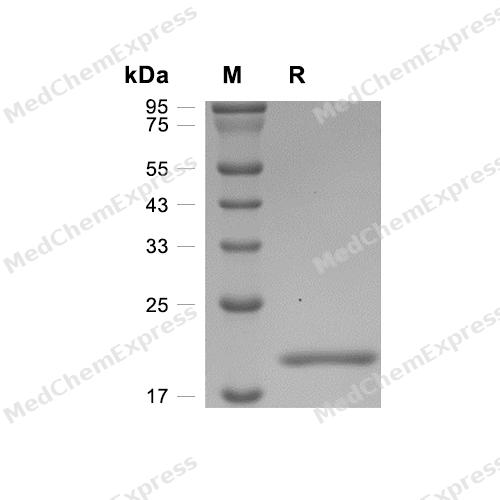
Purity - SDS-PAGE
-
Bioactivity - Cell-Based Assay
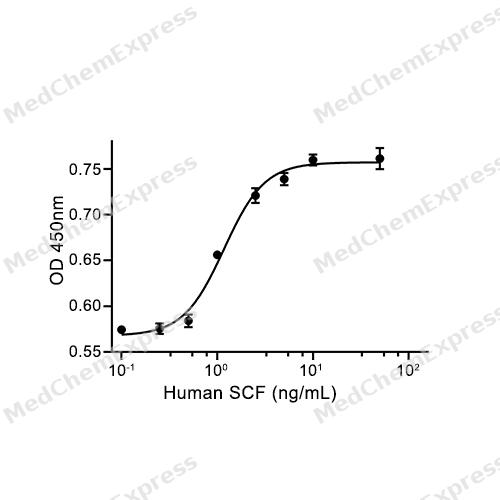
Bioactivity - Cell-Based Assay


Publications (5)
-
Journal Impact Factor
-
Most Recent
-
Nat Commun
Selective targeting of genome amplifications and repeat elements by CRISPR-Cas9 nickases to promote cancer cell death. [Abstract]2025 Jun 2;16(1):5126. PMID: 40456709 -
Biochem Pharmacol
The new mitochondrial uncoupler BAM15 induces ROS production for treatment of acute myeloid leukemia. [Abstract]2022 Apr:198:114948. PMID: 35192847 -
Int Forum Allergy Rhinol
2025 Aug;15(8):837-850. PMID: 40131162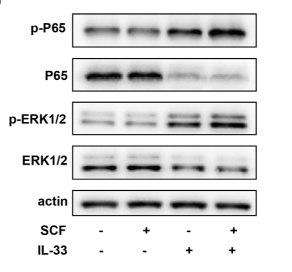
SCF Protein, Human purchased from MedChemExpress. Usage Cited in: Int Forum Allergy Rhinol. 2025 Aug;15(8):837-850. [Abstract]
SCF (100 ng/mL; 1 h). P65 and ERK activation in mast cells under the same conditions was determined via western blotting.
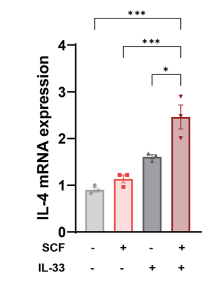
SCF Protein, Human purchased from MedChemExpress. Usage Cited in: Int Forum Allergy Rhinol. 2025 Aug;15(8):837-850. [Abstract]
The mRNA expression levels of IL‐4 was quantified via a real‐time quantitative polymerase chain reaction (qPCR) assay in mast cells that were stimulated with IL‐33 (10 ng/mL, 6 h) following pretreatment with stem cell factor (SCF; 100 ng/mL, 1 h).
-
Stem Cell Res
Generation of a human induced pluripotent stem cell line (SJTUXHi002-A) from an individual with autism spectrum disorder carrying a heterozygous mutation in GRIA2. [Abstract]2022 Apr;60:102676. PMID: 35134694 -
Stem Cell Res
Generation of induced pluripotent stem cell, BCHSCTi001-A, derived from a Hemophilia A patient with F8 (p. R391C) mutation. [Abstract]2021 Oct:56:102491. PMID: 34496342


Technical Parameters
-
Species Human
-
Source E. coli
-
Tag Tag Free
-
Accession
P21583-1 (E26-A189)
-
Molecular Construction
-
N-term
-
SCF (E26-A189)
Accession # P21583-1 -
C-term
-
-
Protein Length
Full Length of Soluble KIT ligand Chain
-
Synonyms
KITLG; SLF; Prev. MGF; Familial Progressive Hyperpigmentation 2; SCF; Steel Factor; Mast Cell Growth Factor; C-Kit Ligand; Stem Cell Factor; Kit Ligand; DFNA69; SHEP7; Kitl; DCUA; KL-1; FPHH; FPH2; WS2F; KIT Ligand; SF
-
AA Sequence
EGICRNRVTNNVKDVTKLVANLPKDYMITLKYVPGMDVLPSHCWISEMVVQLSDSLTDLLDKFSNISEGLSNYSIIDKLVNIVDDLVECVKENSSKDLKKSFKSPEPRLFTPEEFFRIFNRSIDAFKDFVVASETSDCVVSSTLSPEKDSRVSVTKPFMLPPVA
-
Predicted Molecular Mass
18.6 kDa
-
Molecular Weight
Approximately 16 kDa, based on SDS-PAGE under reducing conditions.
-
Purity
≥ 95%, as determined by reducing SDS-PAGE.


Product Properties
Lyophilized powder
1.Lyophilized from a 0.22 μm filtered solution of PBS, pH 7.4, 8% trehalose.
2.Lyophilized from a 0.22 μm filtered solution of 20 mM PB, 150 mM NaCl, pH 7.0.
Please refer to the lot-specific COA for specific buffer information.
<1 EU/μg, determined by LAL method.
It is not recommended to reconstitute to a concentration less than 100 μg/mL in ddH2O. For long term storage it is recommended to add a carrier protein (0.1% BSA, 5% HSA, 10% FBS or 5% Trehalose).
Stored at -20°C for 2 years from date of receipt. After reconstitution, it is stable at 4°C for 1 week or -20°C for longer (with carrier protein). It is recommended to freeze aliquots at -20°C or -80°C for extended storage.
Room temperature in continental US; may vary elsewhere.


Documentation
-
Data Sheet (262 KB)
-
SDS (252 KB)
- English - EN (252 KB)
- Français - FR (252 KB)
- Deutsch - DE (252 KB)
- Norwegian - NO (252 KB)
- Español - ES (252 KB)
- Swedish - SV (252 KB)
- Italian - IT (252 KB)
- Korean - KR (252 KB)
- Portuguese - PT (252 KB)
-
Handling Instructions (2659 KB)


References
[1]. Dehbashi M, Kamali E, Vallian S. Comparative genomics of human stem cell factor (SCF). Mol Biol Res Commun. 2017;6(1):1-11. [Content Brief]
[2]. Lennartsson J, Rönnstrand L. Stem cell factor receptor/c-Kit: from basic science to clinical implications. Physiol Rev. 2012;92(4):1619-1649. [Content Brief]
[4]. Akuta T, et al., Expression of bioactive soluble human stem cell factor (SCF) from recombinant Escherichia coli by coproduction of thioredoxin and efficient purification using arginine in affinity chromatography. Protein Expr Purif. 2015 Jan;105:1-7. [Content Brief]

Calculators
Concentration (start) × Volume (start) = Concentration (final) × Volume (final)


 Powered by Bioz

