



SLAMF2/CD48 Protein, Human (HEK293, hFc)
Based on 1 Customer Validation
SLAMF2/CD48 protein is a GPI-anchored glycoprotein that regulates immune cell function by interacting with CD2 and CD244. SLAMF2/CD48 Protein, Human (HEK293, hFc) is the recombinant human-derived SLAMF2/CD48 protein, expressed by HEK293 , with C-hFc labeled tag.
- Species: Human
- Source: HEK293
-
Storage:Stored at -20°C for 2 years from date of receipt. After reconstitution, it is stable at 4°C for 1 week or -20°C for longer (with carrier protein). It is recommended to freeze aliquots at -20°C or -80°C for extended storage.


To place orders, for customer services and technical support, please contact: MedChemExpress USA
Tel: 609-228-6898 E-mail: [email protected] [email protected]


-
 Biological Activity
-
Technical Parameters
-
Product Properties
- Documentation
- Help & FAQs




Biological Activity
Description
SLAMF2/CD48 protein is a GPI-anchored glycoprotein that regulates immune cell function by interacting with CD2 and CD244. SLAMF2/CD48 Protein, Human (HEK293, hFc) is the recombinant human-derived SLAMF2/CD48 protein, expressed by HEK293 , with C-hFc labeled tag.
Background
The SLAMF2/CD48 Protein, a glycosylphosphatidylinositol (GPI)-anchored cell surface glycoprotein, plays a pivotal role in immune cell regulation and activation by interacting through its N-terminal immunoglobulin domain with cell surface receptors, such as 2B4/CD244 or CD2. In T-cell signaling transduction, SLAMF2 associates with CD2, facilitating the efficient recruitment of the Src family protein kinase LCK and LAT to the TCR/CD3 complex, thereby promoting LCK phosphorylation and subsequent activation. Furthermore, SLAMF2 induces the phosphorylation of the cytoplasmic immunoreceptor tyrosine switch motifs (ITSMs) of CD244, initiating a cascade of signaling events that culminate in the formation of the immunological synapse and the directed release of cytolytic granules containing perforin and granzymes by T-lymphocytes and NK-cells. Notably, SLAMF2 interacts directly with CD2, CD244, and LCK, highlighting its intricate involvement in immune cell function and signaling pathways.
Verified Bioactivity
Measured by its binding ability in a functional ELISA. Immobilized CD48 at 2 μg/mL can bind Anti-CD48 rabbit monoclonal antibody, the EC50 of human CD48 protein is 0.7847-1.107 ng/mL.
MCE Validation Data
-
Purity - SDS-PAGE
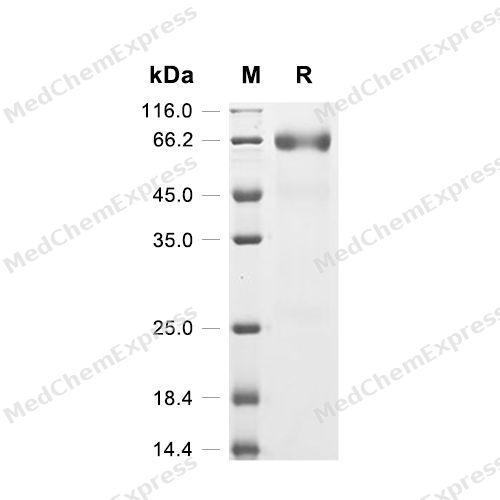
Purity - SDS-PAGE


Technical Parameters
-
Species Human
-
Source HEK293
-
Tag C-hFc
-
Accession
P09326 (Q27-S220)
-
Molecular Construction
-
N-term
-
CD48 (Q27-S220)
Accession # P09326 -
hFc
-
C-term
-
-
Protein Length
Full Length of Mature Protein
-
Synonyms
CD48; MCD48; Prev. BCM1; CD48 Antigen (B-Cell Membrane Protein); SLAMF2; B-Lymphocyte Activation Marker BLAST-1; Signaling Lymphocytic Activation Molecule 2; Leukocyte Antigen MEM-102; BCM1 Surface Antigen; BLAST1; SLAM Family Member 2; TCT.1; CD48 Antige
-
AA Sequence
QGHLVHMTVVSGSNVTLNISESLPENYKQLTWFYTFDQKIVEWDSRKSKYFESKFKGRVRLDPQSGALYISKVQKEDNSTYIMRVLKKTGNEQEWKIKLQVLDPVPKPVIKIEKIEDMDDNCYLKLSCVIPGESVNYTWYGDKRPFPKELQNSVLETTLMPHNYSRCYTCQVSNSVSSKNGTVCLSPPCTLARS
-
Predicted Molecular Mass
51.3 kDa
-
Molecular Weight
Approximately 65-80 kDa, based on SDS-PAGE under reducing conditions, due to the glycosylation.
-
Glycosylation
Yes
-
Purity
≥ 90%, as determined by reducing SDS-PAGE.


Product Properties
Lyophilized powder.
Lyophilized from a 0.22 μm filtered solution of PBS, 6% trehalose, pH 7.4.
<1 EU/μg, determined by LAL method.
It is not recommended to reconstitute to a concentration less than 100 μg/mL in ddH2O.
Stored at -20°C for 2 years from date of receipt. After reconstitution, it is stable at 4°C for 1 week or -20°C for longer (with carrier protein). It is recommended to freeze aliquots at -20°C or -80°C for extended storage.
Room temperature in continental US;may vary elsewhere.


Documentation
-
Data Sheet (237 KB)
-
SDS (251 KB)
- English - EN (251 KB)
- Français - FR (251 KB)
- Deutsch - DE (251 KB)
- Norwegian - NO (251 KB)
- Español - ES (251 KB)
- Swedish - SV (251 KB)
- Italian - IT (251 KB)
- Korean - KR (251 KB)
- Portuguese - PT (251 KB)
-
Handling Instructions (2659 KB)

Calculators
Concentration (start) × Volume (start) = Concentration (final) × Volume (final)


 Powered by Bioz

