



SPINK4 Protein, Human (HEK293, His)

Based on 1 Customer Validation
SPINK4 Protein is a member of the serine protease inhibitors family named Kazal type (SPINK) in humans. SPINK4 is known as a gastrointestinal peptide in the gastrointestinal tract and is abundantly expressed in human goblet cells. SPINK4 can serve as a prognostic marker for colorectal cancer (CRC), bladder cancer (BCa) and Barrett's esophagus. The reduced expression of SPINK4 relates to poor survival in colorectal cancer (CRC). SPINK4 Protein, Human (HEK293, His) is the recombinant human-derived SPINK4 protein, expressed by HEK293 , with C-6*His labeled tag.
- Species: Human
- Source: HEK293
-
Storage:Stored at -20°C for 2 years from date of receipt. After reconstitution, it is stable at 4°C for 1 week or -20°C for longer (with carrier protein). It is recommended to freeze aliquots at -20°C or -80°C for extended storage.


To place orders, for customer services and technical support, please contact: MedChemExpress USA
Tel: 609-228-6898 E-mail: [email protected] [email protected]


-
 Biological Activity
-
Technical Parameters
-
Product Properties
- Documentation
- Help & FAQs




Biological Activity
Description
SPINK4 Protein is a member of the serine protease inhibitors family named Kazal type (SPINK) in humans. SPINK4 is known as a gastrointestinal peptide in the gastrointestinal tract and is abundantly expressed in human goblet cells. SPINK4 can serve as a prognostic marker for colorectal cancer (CRC), bladder cancer (BCa) and Barrett's esophagus. The reduced expression of SPINK4 relates to poor survival in colorectal cancer (CRC)[1][2]. SPINK4 Protein, Human (HEK293, His) is the recombinant human-derived SPINK4 protein, expressed by HEK293 , with C-6*His labeled tag.
Background
The SPINK4 gene of human chromosome 9p13.3 encodes a precursor protein consisting of 86 amino acids. The precursor protein consists of 26 amino acids, which are characterized by a C-terminal cysteine, an N-terminal glutamate and a cell secretion mark. A total of 60 residues of, are believed to be involved in the defense against degradation of mucosal and epithelial tissue proteins[1].
One branch of the family of serine protease inhibitors is named Kazal type (SPINK) and originally consisted of four members in humans (SPINK1, SPINK2, SPINK4, and SPINK5). Although the major site of expression of all four SPINK members may differ, all are thought to be involved in protection against proteolytic degradation of epithelial and mucosal tissues[2].
MCE Validation Data
-
Purity - SDS-PAGE
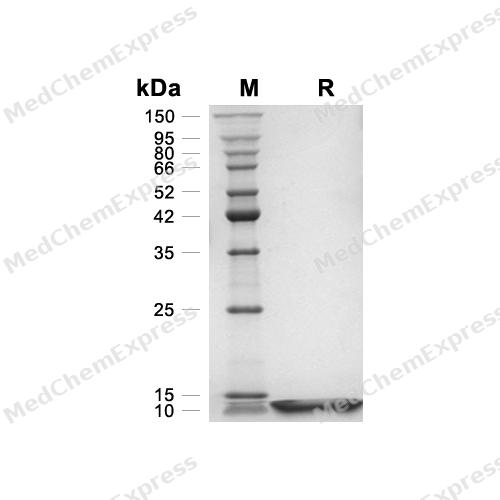
Purity - SDS-PAGE


Technical Parameters
-
Species Human
-
Source HEK293
-
Tag C-6*His
-
Accession
O60575 (G27-C86)
-
Molecular Construction
-
N-term
-
SPINK4 (G27-C86)
Accession # O60575 -
6*His
-
C-term
-
-
Protein Length
Full Length of Mature Protein
-
Synonyms
SPINK4; MGC133107; Serine Peptidase Inhibitor Kazal Type 4; Serine Peptidase Inhibitor, Kazal Type 4; PEC-60; Serine Protease Inhibitor, Kazal Type 4; Serine Protease Inhibitor Kazal-Type 4; Gastrointestinal Peptide; Epididymis Luminal Protein 136; HEL136
-
AA Sequence
GKLPFSRMPICEHMVESPTCSQMSNLVCGTDGLTYTNECQLCLARIKTKQDIQIMKDGKC
-
Predicted Molecular Mass
8 kDa
-
Molecular Weight
Approximately 10-13 kDa, based on SDS-PAGE under reducing conditions, due to the glycosylation.
-
Purity
≥ 95%, as determined by reducing SDS-PAGE.


Product Properties
Lyophilized powder
1.Lyophilized from a 0.22 μm filtered solution of PBS, 1 mM EDTA, 5% trehalose, pH 7.4.
2.Lyophilized from a 0.22 μm filtered solution of 20 mM PB, 150 mM NaCl, pH 7.4.
Please refer to the lot-specific COA for specific buffer information.
<1 EU/μg, determined by LAL method.
It is not recommended to reconstitute to a concentration less than 100 μg/mL in ddH2O.
Stored at -20°C for 2 years from date of receipt. After reconstitution, it is stable at 4°C for 1 week or -20°C for longer (with carrier protein). It is recommended to freeze aliquots at -20°C or -80°C for extended storage.
Room temperature in continental US; may vary elsewhere.


Documentation
-
Data Sheet (235 KB)
-
SDS (251 KB)
- English - EN (251 KB)
- Français - FR (251 KB)
- Deutsch - DE (251 KB)
- Norwegian - NO (251 KB)
- Español - ES (251 KB)
- Swedish - SV (251 KB)
- Italian - IT (251 KB)
- Korean - KR (251 KB)
- Portuguese - PT (251 KB)
-
Handling Instructions (2659 KB)

Calculators
Concentration (start) × Volume (start) = Concentration (final) × Volume (final)


 Powered by Bioz

