



Syntenin-1 Protein, Human (C-His)

Based on 1 Customer Validation
Syntenin-1 is a multifunctional adapter protein that coordinates multiple cellular processes, including transmembrane protein trafficking, neural and immune regulation, exosome biogenesis, and tumorigenesis. It actively regulates TGFB1 signaling and enhances SMAD2/3 activation, TGFB1-induced epithelial-mesenchymal transition (EMT), and cell migration. Syntenin-1 Protein, Human (C-His) is the recombinant human-derived Syntenin-1 protein, expressed by E. coli , with C-6*His labeled tag.
- Species: Human
- Source: E. coli
-
Storage:Stored at -80°C for 1 year from date of receipt. It is stable at -20°C for 3 months after opening. It is recommended to freeze aliquots at -80°C for extended storage. Avoid repeated freeze-thaw cycles.


To place orders, for customer services and technical support, please contact: MedChemExpress USA
Tel: 609-228-6898 E-mail: [email protected] [email protected]


-
 Biological Activity
-
Technical Parameters
-
Product Properties
- Documentation
- Help & FAQs




Biological Activity
Description
Syntenin-1 is a multifunctional adapter protein that coordinates multiple cellular processes, including transmembrane protein trafficking, neural and immune regulation, exosome biogenesis, and tumorigenesis. It actively regulates TGFB1 signaling and enhances SMAD2/3 activation, TGFB1-induced epithelial-mesenchymal transition (EMT), and cell migration. Syntenin-1 Protein, Human (C-His) is the recombinant human-derived Syntenin-1 protein, expressed by E. coli , with C-6*His labeled tag.
Background
Syntenin-1, a multifunctional adapter protein, is intricately involved in a diverse array of cellular processes, encompassing the trafficking of transmembrane proteins, neuro and immunomodulation, exosome biogenesis, and tumorigenesis. In various cell types, it exerts a positive regulatory influence on TGFB1-mediated SMAD2/3 activation, TGFB1-induced epithelial-to-mesenchymal transition (EMT), and cell migration. This multifaceted protein enhances TGFB1 signaling by augmenting cell-surface expression of TGFR1, preventing its interaction with CAV1 and subsequent CAV1-dependent internalization and degradation of TGFR1. Syntenin-1, in collaboration with SDC1/4 and PDCD6IP, plays a pivotal role in exosome biogenesis. Its regulatory impact extends to cancer biology, where it modulates migration, growth, proliferation, and cell cycle progression across various cancer types. In adherens junctions, Syntenin-1 may function to couple syndecans to cytoskeletal proteins or signaling components and is implicated in linking the transcription factor SOX4 to the IL-5 receptor (IL5RA). Furthermore, it appears to be crucial for the targeting of TGFA to the cell surface in the early secretory pathway. Syntenin-1 exists both as a monomer and homodimer, interacting with a spectrum of proteins, including SDC1-4, NRXN2, EPHA7, EPHB1, NF2 isoform 1, TGFA, IL5RA, NFASC, PTPRJ, SDCBP2, and TGFBR1, forming complexes that contribute to its versatile functional repertoire. Additionally, its interaction with FZD7 is modulated by inositol trisphosphate (IP3), and it forms an interaction with SMO, further highlighting its intricate involvement in various cellular pathways.
MCE Validation Data
-
Purity - SDS-PAGE
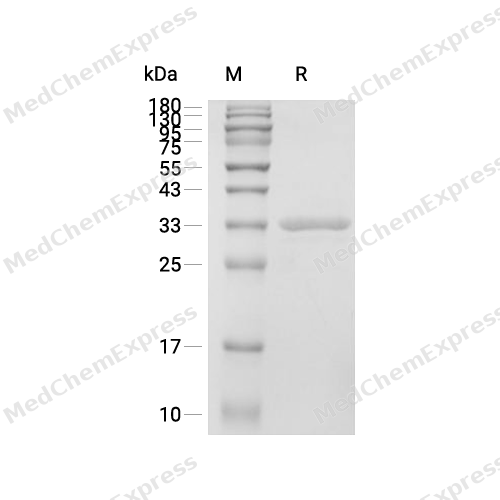
Purity - SDS-PAGE


Technical Parameters
-
Species Human
-
Source E. coli
-
Tag C-6*His
-
Accession
O00560 (S2-V298)
-
Molecular Construction
-
N-term
-
Syntenin-1 (S2-V298)
Accession # O00560 -
6*His
-
C-term
-
-
Protein Length
Full Length
-
Synonyms
SDCBP; TACIP18; Syndecan Binding Protein; MDA9; MDA-9; CDNA FLJ55055, Moderately Similar To Syntenin-1; SYCL; Melanoma Differentiation Associated Protein-9; Syntenin-1; Melanoma Differentiation-Associated Protein 9; SDCBP1; Syndecan Binding Protein (Synte
-
AA Sequence
SLYPSLEDLKVDKVIQAQTAFSANPANPAILSEASAPIPHDGNLYPRLYPELSQYMGLSLNEEEIRANVAVVSGAPLQGQLVARPSSINYMVAPVTGNDVGIRRAEIKQGIREVILCKDQDGKIGLRLKSIDNGIFVQLVQANSPASLVGLRFGDQVLQINGENCAGWSSDKAHKVLKQAFGEKITMTIRDRPFERTITMHKDSTGHVGFIFKNGKITSIVKDSSAARNGLLTEHNICEINGQNVIGLKDSQIADILSTSGTVVTITIMPAFIFEHIIKRMAPSIMKSLMDHTIPEV
-
Molecular Weight
Approximately 32 kDa, based on SDS-PAGE under reducing conditions.
-
Purity
≥ 95%, as determined by reducing SDS-PAGE.


Product Properties
Solution
Supplied as a 0.22 μm filtered solution of 20 mM Acetate, 250 mM mannitol, 0.05% Tween 80, pH 4.0.
<1 EU/μg, determined by LAL method.
Stored at -80°C for 1 year from date of receipt. It is stable at -20°C for 3 months after opening. It is recommended to freeze aliquots at -80°C for extended storage. Avoid repeated freeze-thaw cycles.
Shipping with dry ice.


Documentation
-
Data Sheet (237 KB)
-
SDS (252 KB)
- English - EN (252 KB)
- Français - FR (252 KB)
- Deutsch - DE (252 KB)
- Norwegian - NO (252 KB)
- Español - ES (252 KB)
- Swedish - SV (252 KB)
- Italian - IT (252 KB)
- Korean - KR (252 KB)
- Portuguese - PT (252 KB)
-
Handling Instructions (2659 KB)

Calculators
Concentration (start) × Volume (start) = Concentration (final) × Volume (final)


 Powered by Bioz

