



Tenascin/Tnc Protein, Mouse (HEK293, His-Myc, solution)
Based on 1 publication(s) in Google Scholar
Tenascin/Tnc proteins guide neuronal and axonal migration and contribute to development, synaptic plasticity, and neuronal regeneration. Tenascin/Tnc Protein, Mouse (HEK293, His-Myc, solution) is the recombinant mouse-derived Tenascin/Tnc protein, expressed by HEK293 , with N-10*His, C-Myc labeled tag.
- Species: Mouse
- Source: HEK293
-
Storage:Stored at -80°C for 1 year from date of receipt. It is stable at -20°C for 3 months after opening. It is recommended to freeze aliquots at -80°C for extended storage. Avoid repeated freeze-thaw cycles.


To place orders, for customer services and technical support, please contact: MedChemExpress USA
Tel: 609-228-6898 E-mail: [email protected] [email protected]


-
 Biological Activity
-
Technical Parameters
-
Product Properties
- Documentation
- Help & FAQs




Biological Activity
Description
Tenascin/Tnc proteins guide neuronal and axonal migration and contribute to development, synaptic plasticity, and neuronal regeneration. Tenascin/Tnc Protein, Mouse (HEK293, His-Myc, solution) is the recombinant mouse-derived Tenascin/Tnc protein, expressed by HEK293 , with N-10*His, C-Myc labeled tag.
Background
The Tenascin/Tnc protein, an extracellular matrix protein, assumes a critical role in guiding migrating neurons and axons during development, as well as contributing to synaptic plasticity and neuronal regeneration. It not only promotes neurite outgrowth in cultured neurons but also may play a role in supporting the growth of epithelial tumors, underscoring its diverse functional implications. Serving as a ligand for integrins ITGA8:ITGB1, ITGA9:ITGB1, ITGAV:ITGB3, and ITGAV:ITGB6, Tenascin/Tnc establishes molecular interactions essential for cellular communication and signaling. In the context of tumors, it stimulates angiogenesis by facilitating the elongation, migration, and sprouting of endothelial cells. Structurally, Tenascin/Tnc exists as a homohexamer with a potential homotrimer formation in the triple coiled-coil region, further stabilized by disulfide rings at both ends. The interaction with CSPG4 suggests its involvement in intricate cellular and molecular processes across diverse biological contexts.
Verified Bioactivity
Measured by the ability of the immobilized protein to block Fibronectin-mediated adhesion of NIH-3T3 mouse embryonic fibroblast cells. Tenascin immobilized at 0.8 μg/mL, in the presence of 0.1 μg/mL human Fibronectin, will block approximately 54.01% NIH-3T3 cell adhesion (5×10⁴ cells/well, 100 μL/well).
MCE Validation Data
-
Purity - SDS-PAGE
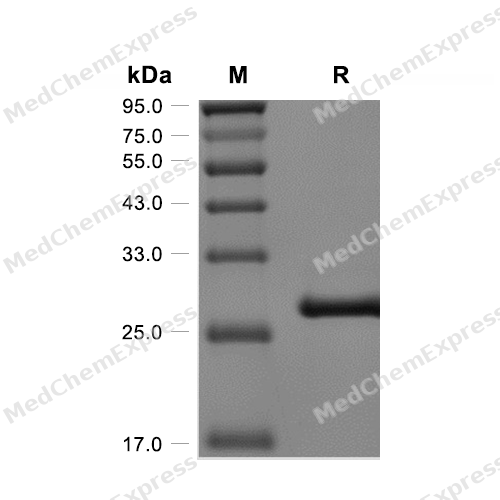
Purity - SDS-PAGE


Publications (1)
-
Journal Impact Factor
-
Most Recent


Technical Parameters
-
Species Mouse
-
Source HEK293
-
Tag N-10*His;C-Myc
-
Accession
Q80YX1-1 (G1884-N2099)
-
Molecular Construction
-
N-term
-
10*His
-
Tenascin (G1884-N2099)
Accession # Q80YX1-1 -
Myc
-
C-term
-
-
Protein Length
Full Length of Fibrinogen C-terminal Domain
-
Synonyms
TNC; Neuronectin; Prev. HXB; Cytotactin; Prev. DFNA56; Tenascin-C; TN; MGC167029; Tenascin; GMEM; Glioma-Associated-Extracellular Matrix Antigen; TN-C; Deafness, Autosomal Dominant 56; JI; Tenascin-C Additional Domain 1; Hexabrachion (Tenascin C, Cytotact
-
AA Sequence
GLLYPFPRDCSQAMLNGDTTSGLYTIYINGDKTQALEVYCDMTSDGGGWIVFLRRKNGREDFYRNWKAYAAGFGDRREEFWLGLDNLSKITAQGQYELRVDLQDHGESAYAVYDRFSVGDAKSRYKLKVEGYSGTAGDSMNYHNGRSFSTYDKDTDSAITNCALSYKGAFWYKNCHRVNLMGRYGDNNHSQGVNWFHWKGHEYSIQFAEMKLRPSN
-
Predicted Molecular Mass
25.9 kDa
-
Molecular Weight
Approximately 27 kDa, based on SDS-PAGE under reducing conditions.
-
Glycosylation
Yes
-
Purity
≥ 95%, as determined by reducing SDS-PAGE.


Product Properties
Solution
Supplied as a 0.22 μm filtered solution of 50 mM Tris-HCl, 300 mM NaCl, pH 7.4, 20% glycerol.
Note: For SPR assay, please replace the buffer. Primary amine components (e.g., Tris, imidazole) can affect protein-coupled chips.
<1 EU/μg, determined by LAL method.
Stored at -80°C for 1 year from date of receipt. It is stable at -20°C for 3 months after opening. It is recommended to freeze aliquots at -80°C for extended storage. Avoid repeated freeze-thaw cycles.
Shipping with dry ice.


Documentation
-
Data Sheet (237 KB)
-
SDS (252 KB)
- English - EN (252 KB)
- Français - FR (252 KB)
- Deutsch - DE (252 KB)
- Norwegian - NO (252 KB)
- Español - ES (252 KB)
- Swedish - SV (252 KB)
- Italian - IT (252 KB)
- Korean - KR (252 KB)
- Portuguese - PT (252 KB)
-
Handling Instructions (2659 KB)

Calculators
Concentration (start) × Volume (start) = Concentration (final) × Volume (final)


 Powered by Bioz

