



TrkA Protein, Human (HEK293, His)
Based on 1 Customer Validation
Pentraxin 3/TSG-14 protein is a multifunctional protein that plays a role in immune response and inflammation. It is involved in the recognition and clearance of pathogens, as well as regulation of inflammatory processes. Dysregulation of Pentraxin 3/TSG-14 protein has been associated with various diseases, including cardiovascular disorders and infections. Targeting Pentraxin 3/TSG-14 protein may hold therapeutic potential in these conditions. TrkA Protein, Human (HEK293, His) is the recombinant human-derived TrkA protein, expressed by HEK293 , with N-His labeled tag.
- Species: Human
- Source: HEK293
-
Storage:Stored at -20°C for 2 years from date of receipt. After reconstitution, it is stable at 4°C for 1 week or -20°C for longer (with carrier protein). It is recommended to freeze aliquots at -20°C or -80°C for extended storage.


To place orders, for customer services and technical support, please contact: MedChemExpress USA
Tel: 609-228-6898 E-mail: [email protected] [email protected]


-
 Biological Activity
-
Technical Parameters
-
Product Properties
- Documentation
- Help & FAQs




Biological Activity
Description
Pentraxin 3/TSG-14 protein is a multifunctional protein that plays a role in immune response and inflammation. It is involved in the recognition and clearance of pathogens, as well as regulation of inflammatory processes. Dysregulation of Pentraxin 3/TSG-14 protein has been associated with various diseases, including cardiovascular disorders and infections. Targeting Pentraxin 3/TSG-14 protein may hold therapeutic potential in these conditions. TrkA Protein, Human (HEK293, His) is the recombinant human-derived TrkA protein, expressed by HEK293 , with N-His labeled tag.
Background
The TrkA Protein, a member of the neurotrophic tyrosine kinase receptor (NTKR) family, encodes a membrane-bound receptor that, upon neurotrophin binding, initiates phosphorylation of itself and members of the MAPK pathway. This kinase's presence facilitates cell differentiation and may play a role in specifying sensory neuron subtypes. Mutations in this gene have been linked to congenital insensitivity to pain, anhidrosis, self-mutilating behavior, cognitive disability, and cancer. Several alternate transcriptional splice variants of this gene have been identified, but only three have been characterized to date. The gene demonstrates biased expression, with higher levels detected in the adrenal (RPKM 3.7), testis (RPKM 1.0), and 10 other tissues, suggesting its potential significance in various physiological contexts across multiple organs.
Verified Bioactivity
1.This product does not contain protein kinase domain.
2.Measured by its ability to inhibit NGF-induced proliferation of TF-1 human erythroleukemic cells. The ED50 for this effect is 0.06643 μg/mL, corresponding to a specific activity is 1.51×10^4 units/mg.
MCE Validation Data
-
Bioactivity - Cell-Based Assay
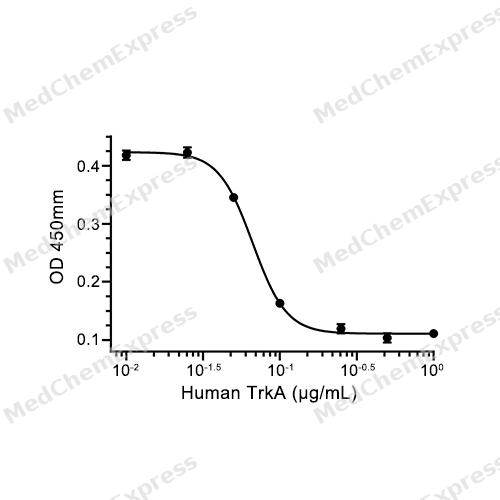
Bioactivity - Cell-Based Assay


Technical Parameters
-
Species Human
-
Source HEK293
-
Tag N-His
-
Accession
NP_002520.2 (P194-E413)
-
Molecular Construction
-
N-term
-
His
-
TrkA (P194-E413)
Accession # NP_002520.2 -
C-term
-
-
Protein Length
Partial Extracellular Domain
-
Synonyms
NTRK1; Tyrosine Kinase Receptor A; Neurotrophic Receptor Tyrosine Kinase 1; P140-TrkA; TRKA; Gp140trk; TRK; Trk-A; MTC; Neurotrophic Tyrosine Kinase Receptor Type 1; High Affinity Nerve Growth Factor Receptor; Tyrosine-Protein Kinase Receptor; Neurotrophi
-
AA Sequence
PTLKVQVPNASVDVGDDVLLRCQVEGRGLEQAGWILTELEQSATVMKSGGLPSLGLTLANVTSDLNRKNVTCWAENDVGRAEVSVQVNVSFPASVQLHTAVEMHHWCIPFSVDGQPAPSLRWLFNGSVLNETSFIFTEFLEPAANETVRHGCLRLNQPTHVNNGNYTLLAANPFGQASASIMAAFMDNPFEFNPEDPIPVSFSPVDTNSTSGDPVEKKDE
-
Molecular Weight
Approximately 45-50 kDa, based on SDS-PAGE under reducing conditions, due to the glycosylation.
-
Glycosylation
Yes
-
Purity
≥ 95%, as determined by reducing SDS-PAGE.


Product Properties
Lyophilized powder.
Lyophilized from a 0.2 μm filtered solution of 20 mM PB, 150 mM NaCl, pH 7.4.
<1 EU/μg, determined by LAL method.
It is not recommended to reconstitute to a concentration less than 100 μg/mL in ddH2O.
Stored at -20°C for 2 years from date of receipt. After reconstitution, it is stable at 4°C for 1 week or -20°C for longer (with carrier protein). It is recommended to freeze aliquots at -20°C or -80°C for extended storage.
Room temperature in continental US; may vary elsewhere.


Documentation
-
Data Sheet (237 KB)
-
SDS (251 KB)
- English - EN (251 KB)
- Français - FR (251 KB)
- Deutsch - DE (251 KB)
- Norwegian - NO (251 KB)
- Español - ES (251 KB)
- Swedish - SV (251 KB)
- Italian - IT (251 KB)
- Korean - KR (251 KB)
- Portuguese - PT (251 KB)
-
Handling Instructions (2659 KB)

Calculators
Concentration (start) × Volume (start) = Concentration (final) × Volume (final)


 Powered by Bioz

