



Vitamin D-binding protein/GC Protein, Human (HEK293, His)
Based on 1 Customer Validation
GC protein is a multifunctional protein that promotes vitamin D transport and storage while scavenging extracellular G-actin to maintain cellular homeostasis. It enhances the chemotactic activity of C5 alpha toward neutrophils during inflammation, helps macrophage activation, and interacts with B lymphocyte and T lymphocyte membranes, indicating its involvement in the immune process. Vitamin D-binding protein/GC Protein, Human (HEK293, His) is the recombinant human-derived Vitamin D-binding protein/GC protein, expressed by HEK293 , with C-6*His labeled tag.
- Species: Human
- Source: HEK293
-
Storage:Stored at -20°C for 2 years from date of receipt. After reconstitution, it is stable at 4°C for 1 week or -20°C for longer (with carrier protein). It is recommended to freeze aliquots at -20°C or -80°C for extended storage.


To place orders, for customer services and technical support, please contact: MedChemExpress USA
Tel: 609-228-6898 E-mail: [email protected] [email protected]


-
 Biological Activity
-
Technical Parameters
-
Product Properties
- Documentation
- Help & FAQs




Biological Activity
Description
GC protein is a multifunctional protein that promotes vitamin D transport and storage while scavenging extracellular G-actin to maintain cellular homeostasis. It enhances the chemotactic activity of C5 alpha toward neutrophils during inflammation, helps macrophage activation, and interacts with B lymphocyte and T lymphocyte membranes, indicating its involvement in the immune process. Vitamin D-binding protein/GC Protein, Human (HEK293, His) is the recombinant human-derived Vitamin D-binding protein/GC protein, expressed by HEK293 , with C-6*His labeled tag.
Background
Vitamin D-binding protein (GC Protein) is a multifunctional protein engaged in various physiological processes. It plays a pivotal role in the transport and storage of vitamin D, contributing to its systemic availability. Furthermore, GC Protein acts as a scavenger for extracellular G-actin, a crucial function in maintaining cellular homeostasis. In the context of inflammation, it enhances the chemotactic activity of C5 alpha for neutrophils, actively participating in immune responses. Additionally, GC Protein is implicated in macrophage activation, contributing to the orchestration of immune processes. Beyond its immune-related functions, GC Protein associates with membrane-bound immunoglobulin on B-lymphocytes and interacts with the IgG Fc receptor on T-lymphocyte membranes, suggesting its involvement in immune cell interactions. Notably, the interaction with LRP2 is essential for the renal uptake of GC in complex with 25-hydroxyvitamin D3, highlighting its significance in vitamin D metabolism and homeostasis.
MCE Validation Data
-
Purity - SDS-PAGE
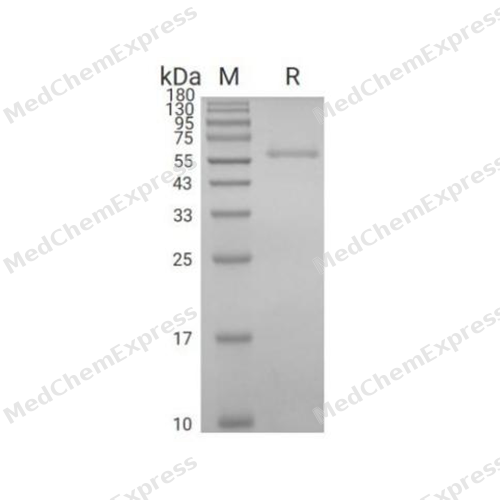
Purity - SDS-PAGE


Technical Parameters
-
Species Human
-
Source HEK293
-
Tag C-6*His
-
Accession
P02774-1 (L17-L474)
-
Molecular Construction
-
N-term
-
-1 (L17-L474)
Accession # P02774 -
6*His
-
C-term
-
-
Protein Length
Full Length of Isoform-1
-
Synonyms
GC; GcMAF; GC Vitamin D Binding Protein; HDBP; DBP; VDB; Vitamin D-Binding Protein; Epididymis Secretory Protein Li 51; Gc-Globulin; Vitamin D-Binding Alpha-Globulin; VDBP; GC, Vitamin D Binding Protein; Vitamin D-Binding Protein-Macrophage Activating Fac
-
AA Sequence
LERGRDYEKNKVCKEFSHLGKEDFTSLSLVLYSRKFPSGTFEQVSQLVKEVVSLTEACCAEGADPDCYDTRTSALSAKSCESNSPFPVHPGTAECCTKEGLERKLCMAALKHQPQEFPTYVEPTNDEICEAFRKDPKEYANQFMWEYSTNYGQAPLSLLVSYTKSYLSMVGSCCTSASPTVCFLKERLQLKHLSLLTTLSNRVCSQYAAYGEKKSRLSNLIKLAQKVPTADLEDVLPLAEDITNILSKCCESASEDCMAKELPEHTVKLCDNLSTKNSKFEDCCQEKTAMDVFVCTYFMPAAQLPELPDVELPTNKDVCDPGNTKVMDKYTFELSRRTHLPEVFLSKVLEPTLKSLGECCDVEDSTTCFNAKGPLLKKELSSFIDKGQELCADYSENTFTEYKKKLAERLKAKLPDATPTELAKLVNKHSDFASNCCSINSPPLYCDSEIDAELKNIL
-
Predicted Molecular Mass
52.3 kDa
-
Molecular Weight
Approximately 53 kDa, based on SDS-PAGE under reducing conditions.
-
Purity
≥ 95%, as determined by reducing SDS-PAGE.


Product Properties
Lyophilized powder.
Lyophilized from a 0.22 μm filtered solution of PBS, pH 7.4.
<1 EU/μg, determined by LAL method.
It is not recommended to reconstitute to a concentration less than 100 μg/mL in ddH2O. For long term storage it is recommended to add a carrier protein (0.1% BSA, 5% HSA, 10% FBS or 5% Trehalose).
Stored at -20°C for 2 years from date of receipt. After reconstitution, it is stable at 4°C for 1 week or -20°C for longer (with carrier protein). It is recommended to freeze aliquots at -20°C or -80°C for extended storage.
Room temperature in continental US;may vary elsewhere.


Documentation
-
Data Sheet (238 KB)
-
SDS (251 KB)
- English - EN (251 KB)
- Français - FR (251 KB)
- Deutsch - DE (251 KB)
- Norwegian - NO (251 KB)
- Español - ES (251 KB)
- Swedish - SV (251 KB)
- Italian - IT (251 KB)
- Korean - KR (251 KB)
- Portuguese - PT (251 KB)
-
Handling Instructions (2659 KB)

Calculators
Concentration (start) × Volume (start) = Concentration (final) × Volume (final)


 Powered by Bioz

