



WIF-1 Protein, Human (HEK293, His)
Based on 3 publication(s) in Google Scholar
WIF-1 protein critically binds to WNT protein, inhibits its activity and regulates the WNT signaling pathway. In addition to its inhibitory role, WIF-1 may also contribute to mesoderm segmentation, implicating its role in embryonic development. WIF-1 Protein, Human (HEK293, His) is the recombinant human-derived WIF-1 protein, expressed by HEK293 , with C-6*His labeled tag.
- Species: Human
- Source: HEK293
-
Storage:Stored at -20°C for 2 years from date of receipt. After reconstitution, it is stable at 4°C for 1 week or -20°C for longer (with carrier protein). It is recommended to freeze aliquots at -20°C or -80°C for extended storage.


To place orders, for customer services and technical support, please contact: MedChemExpress USA
Tel: 609-228-6898 E-mail: [email protected] [email protected]


-
 Biological Activity
-
Technical Parameters
-
Product Properties
- Documentation
- Help & FAQs




Biological Activity
Description
WIF-1 protein critically binds to WNT protein, inhibits its activity and regulates the WNT signaling pathway. In addition to its inhibitory role, WIF-1 may also contribute to mesoderm segmentation, implicating its role in embryonic development. WIF-1 Protein, Human (HEK293, His) is the recombinant human-derived WIF-1 protein, expressed by HEK293 , with C-6*His labeled tag.
Background
The WIF-1 protein plays a crucial role as it binds to WNT proteins, effectively inhibiting their activities. This interaction suggests a pivotal regulatory function in WNT signaling pathways. Beyond its inhibitory role, WIF-1 may also be involved in mesoderm segmentation, hinting at its potential contributions to embryonic development. Furthermore, WIF-1 interacts with MYOC, indicating a possible association with additional cellular processes or signaling cascades. The multifaceted interactions of WIF-1 underscore its importance in modulating WNT-mediated activities and its potential involvement in broader developmental and cellular events.
Verified Bioactivity
1.Measured by its ability to inhibit Wnt-3a-induced alkaline phosphatase production by MC3T3-E1 mouse preosteoblast cells. The ED50 this effect is 0.1022-0.1136 μg/mL in the presence of 20 ng/mL Recombinant Human Wnt-3a, corresponding to a specific activity is 8802.8169-9784.7358 units/mg.
2.Measured by its ability to inhibit Wnt-3a-induced alkaline phosphatase production by MC3T3-E1 mouse preosteoblast cells. The ED50 for this effect is ≤0.5 μg/mL in the presence of 10 ng/mL Recombinant Human Wnt-3a, corresponding to a specific activity is ≥2×10³ U/mg.
MCE Validation Data
-
Purity - SDS-PAGE
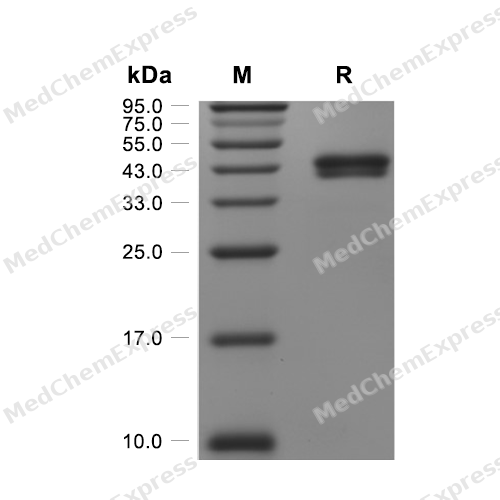
Purity - SDS-PAGE
-
Bioactivity - Cell-Based Assay
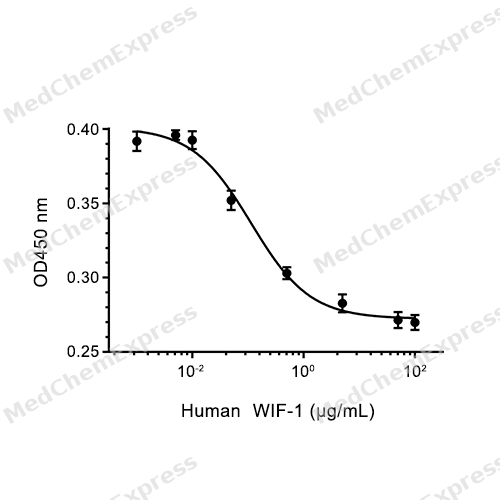
Bioactivity - Cell-Based Assay


Publications (3)
-
Journal Impact Factor
-
Most Recent
-
Trends Biotechnol
Rationally designed light-inducible RNA-releasing protein for translational regulation and optogenetic control of gene therapies. [Abstract]2026 Apr 8:S0167-7799(26)00089-2. PMID: 41956945 -
World J Psychiatry
Exosomal miR-320e through wnt2targeted inhibition of the Wnt/β-catenin pathway allevisate cerebral small vessel disease and cognitive impairment. [Abstract]2023 Sep 19;13(9):630-644. PMID: 37771642 -


Technical Parameters
-
Species Human
-
Source HEK293
-
Tag C-6*His
-
Accession
AAH18037.1 (G29-W379)
-
Molecular Construction
-
N-term
-
WIF-1 (G29-W379)
Accession # AAH18037.1 -
6*His
-
C-term
-
-
Protein Length
Full Length of Mature Protein
-
Synonyms
Wnt inhibitory factor 1; WIF-1; WIF1; UNQ191; PRO217
-
AA Sequence
GPPQEESLYLWIDAHQARVLIGFEEDILIVSEGKMAPFTHDFRKAQQRMPAIPVNIHSMNFTWQAAGQAEYFYEFLSLRSLDKGIMADPTVNVPLLGTVPHKASVVQVGFPCLGKQDGVAAFEVDVIVMNSEGNTILKTPQNAIFFKTCQQAECPGGCRNGGFCNERRICECPDGFHGPHCEKALCTPRCMNGGLCVTPGFCICPPGFYGVNCDKANCSTTCFNGGTCFYPGKCICPPGLEGEQCEISKCPQPCRNGGKCIGKSKCKCSKGYQGDLCSKPVCEPGCGAHGTCHEPNKCQCQEGWHGRHCNKRYEASLIHALRPAGAQLRQHTPSLKKAEERRDPPESNYIW
-
Predicted Molecular Mass
39.5 kDa
-
Molecular Weight
Approximately 45 kDa, based on SDS-PAGE under reducing conditions.
-
Purity
≥ 95%, as determined by reducing SDS-PAGE.


Product Properties
Lyophilized powder.
1.Lyophilized from a 0.22 μm filtered solution of 20 mM Glycine-HCl, 10% sucrose, 5% mannitol , 0.05% Tween 80, pH 3.5.
2.Lyophilized from a 0.22 μm filtered solution of 50 mM Tris-HCl, 300 mM NaCl, pH 7.4.
3.Lyophilized from a 0.22 μm filtered solution of 50 mM Tris-HCl, 300 mM NaCl, pH 7.4, 5% trehalose, 5% mannitol, 0.01% Tween 80.
Please refer to the lot-specific COA for specific buffer information.
Note: For SPR assay, please replace the buffer. Primary amine components (e.g., Tris, imidazole) can affect protein-coupled chips.
<1 EU/μg, determined by LAL method.
It is not recommended to reconstitute to a concentration less than 100 μg/mL in ddH2O. For long term storage it is recommended to add a carrier protein (0.1% BSA, 5% HSA, 10% FBS or 5% Trehalose).
Stored at -20°C for 2 years from date of receipt. After reconstitution, it is stable at 4°C for 1 week or -20°C for longer (with carrier protein). It is recommended to freeze aliquots at -20°C or -80°C for extended storage.
Room temperature in continental US; may vary elsewhere.


Documentation
-
Data Sheet (238 KB)
-
SDS (251 KB)
- English - EN (251 KB)
- Français - FR (251 KB)
- Deutsch - DE (251 KB)
- Norwegian - NO (251 KB)
- Español - ES (251 KB)
- Swedish - SV (251 KB)
- Italian - IT (251 KB)
- Korean - KR (251 KB)
- Portuguese - PT (251 KB)
-
Handling Instructions (2659 KB)

Calculators
Concentration (start) × Volume (start) = Concentration (final) × Volume (final)


 Powered by Bioz

