1. Search Result
Search Result
Pathways Recommended: Protein Tyrosine Kinase/RTK
Results for "

MET receptor tyrosine kinase

" in MedChemExpress (MCE) Product Catalog:

28

Inhibitors & Agonists

1

Fluorescent Dyes

1

Inhibitory Antibodies

4

Recombinant Proteins

3

Isotope-Labeled Compounds

5

Antibodies

1

Oligonucleotides

Cat. No. Product Name Target Research Areas Chemical Structure
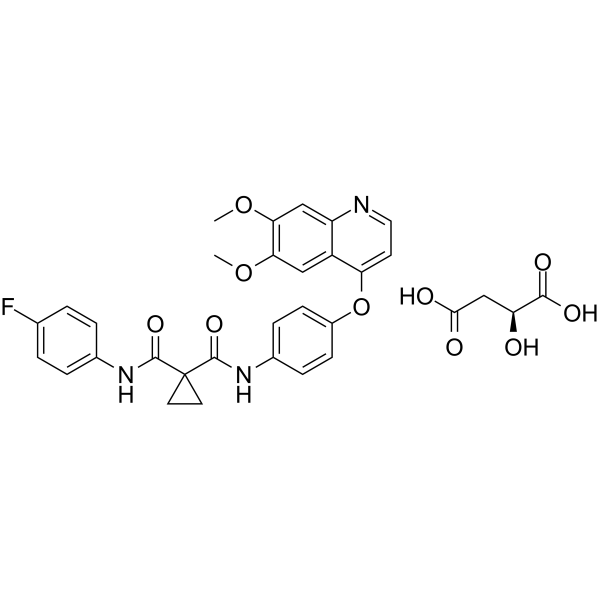
  • HY-12044
    Cabozantinib S-malate
    Maximum Cited Publications
    56 Publications Verification

    XL184 S-malate; BMS-907351 S-malate

    VEGFR Apoptosis Cancer
    Cabozantinib S-malate (XL184 S-malate) is a potent multiple receptor tyrosine kinases inhibitor that inhibits VEGFR2, c-Met, Kit, Axl and Flt3 with IC50s of 0.035, 1.3, 4.6, 7 and 11.3 nM, respectively.
    Cabozantinib S-malate
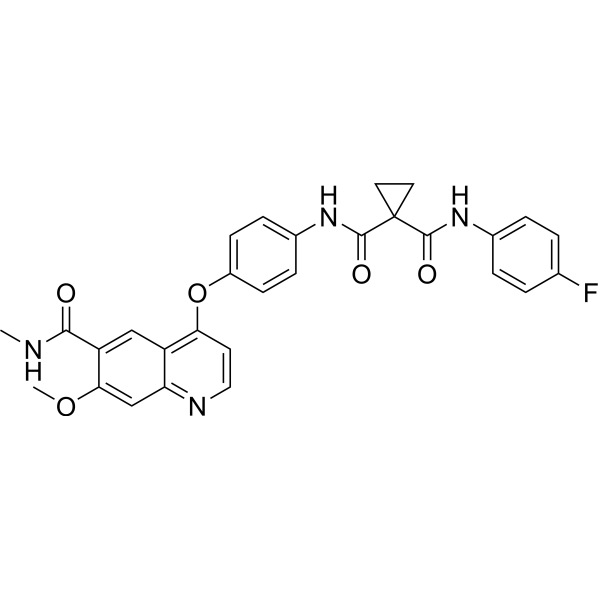
  • HY-138696
    Zanzalintinib
    1 Publications Verification

    XL092

    TAM Receptor c-Met/HGFR VEGFR Cancer
    Zanzalintinib (XL092) is an orally active, ATP-competitive inhibitor of multiple receptor tyrosine kinases (RTKs) including MET, VEGFR2, AXL and MER, with IC50s in cell-based assays of 15 nM, 1.6 nM, 3.4 nM, 7.2 nM respectively. Zanzalintinib exhibits anti-tumor activity. Zanzalintinib has the potential for kinase-dependent diseases and conditions research .
    Zanzalintinib
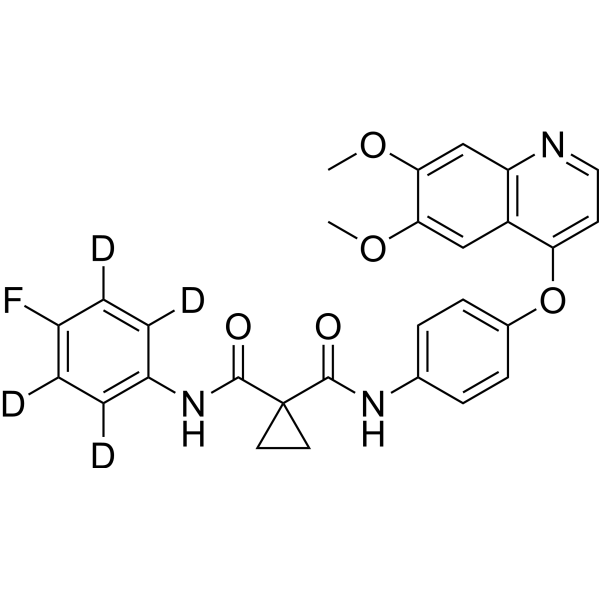
  • HY-13016S

    XL184-d6; BMS-907351-d6

    VEGFR c-Met/HGFR c-Kit TAM Receptor FLT3 Apoptosis Cancer
    Cabozantinib-d6 is the deuterium labeled Cabozantinib. Cabozantinib is a potent multiple receptor tyrosine kinases (RTKs) inhibitor that inhibits VEGFR2, c-Met, Kit, Axl and Flt3 with IC50s of 0.035, 1.3, 4.6, 7 and 11.3 nM, respectively .
    Cabozantinib-d6
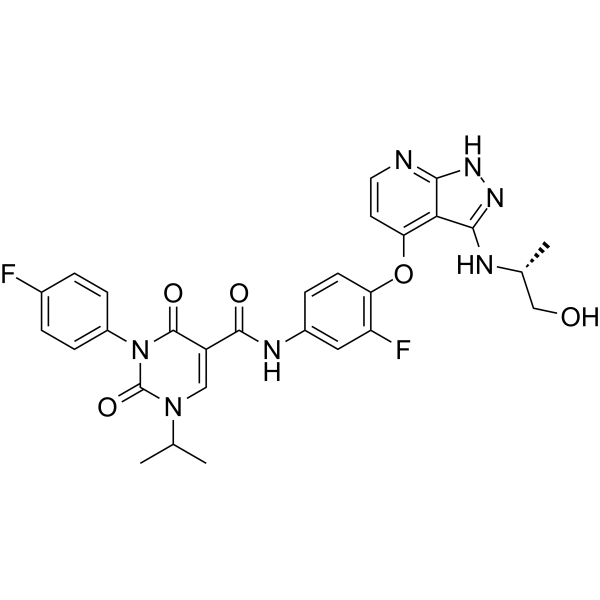
  • HY-147218

    ARRY-067

    TAM Receptor Cancer
    PF-07265807 (ARRY-067) is a kinase inhibitor with primary targets AXL, MERTK, and TYRO3. PF-07265807 acts as an immunomodulator that cross-activates CD8 + T cells by enhancing dendritic cell function. PF-07265807 blocks downstream signal transduction of AXL and MERTK, and inhibits the proliferation and migration of tumor cells with high expression of these two kinases. PF-07265807 is applicable to research related to advanced or metastatic solid tumors, such as colorectal cancer .
    PF-07265807
  • HY-13016S1

    XL184-d4; BMS-907351-d4

    VEGFR c-Met/HGFR c-Kit TAM Receptor FLT3 Apoptosis Cancer
    Cabozantinib-d4 is deuterium labeled Cabozantinib. Cabozantinib is a potent multiple receptor tyrosine kinases (RTKs) inhibitor that inhibits VEGFR2, c-Met, Kit, Axl and Flt3 with IC50s of 0.035, 1.3, 4.6, 7 and 11.3 nM, respectively.
    Cabozantinib-d4
  • HY-E70758

    c-Met/HGFR Cancer
    Mesenchymal-to-epithelial transition (MET) is a receptor tyrosine kinase for hepatocyte growth factor (HGF). MET overactivation is strongly associated with angiogenesis, cellular motility, growth, and invasion. Aberrant MET signaling can drive tumorigenesis in several cancer types through various molecular mechanisms, including MET amplification, MET exon 14 skipping mutation, MET overexpression, and MET fusions. MET Y1235D is a mutant of MET. MET Y1235D Recombinant Human Active Protein Kinase is a recombinant MET Y1235D protein that can be used to study MET Y1235D-related functions .
    MET Y1235D Recombinant Human Active Protein Kinase
  • HY-E70751

    c-Met/HGFR Cancer
    Mesenchymal-to-epithelial transition (MET) is a receptor tyrosine kinase for hepatocyte growth factor (HGF). MET overactivation is strongly associated with angiogenesis, cellular motility, growth, and invasion. Aberrant MET signaling can drive tumorigenesis in several cancer types through various molecular mechanisms, including MET amplification, MET exon 14 skipping mutation, MET overexpression, and MET fusions. MET G1163R is a mutant of MET. MET G1163R Recombinant Human Active Protein Kinase is a recombinant MET G1163R protein that can be used to study MET G1163R-related functions .
    MET G1163R Recombinant Human Active Protein Kinase
  • HY-171191

    Antibody-Drug Conjugates (ADCs) Microtubule/Tubulin c-Met/HGFR Cancer
    REGN5093-M114 is a bispecific antibody-drug conjugate (ADC) that targets two epitopes of the MET receptor tyrosine kinase inhibits the proliferation of NSCLC cells, exhibits antitumor efficacy in mouse models. REGN5093-M114 is composed of the human monoclonal anti-MET antibody Davutamig (HY-P990073) and the tubulin-inhibiting linker-payload (HY-148528) .
    REGN5093-M114
  • HY-164394

    c-Met/HGFR Cancer
    EMD 1204831 is a potent and highly selective c-Met inhibitor which selectively suppresses the c-Met receptor tyrosine kinase activity with an IC50 of 9 nM. EMD 1204831 can be utilized in cancer research .
    EMD 1204831
  • HY-E70754

    c-Met/HGFR Cancer
    Mesenchymal-to-epithelial transition (MET) is a receptor tyrosine kinase for hepatocyte growth factor (HGF). MET overactivation is strongly associated with angiogenesis, cellular motility, growth, and invasion. Aberrant MET signaling can drive tumorigenesis in several cancer types through various molecular mechanisms, including MET amplification, MET exon 14 skipping mutation, MET overexpression, and MET fusions. MET Y1230A is a mutant of MET. MET Y1230A Recombinant Human Active Protein Kinase is a recombinant MET Y1230A protein that can be used to study MET Y1230A-related functions .
    MET Y1230A Recombinant Human Active Protein Kinase
  • HY-E70749

    c-Met/HGFR Cancer
    Mesenchymal-to-epithelial transition (MET) is a receptor tyrosine kinase for hepatocyte growth factor (HGF). MET overactivation is strongly associated with angiogenesis, cellular motility, growth, and invasion. Aberrant MET signaling can drive tumorigenesis in several cancer types through various molecular mechanisms, including MET amplification, MET exon 14 skipping mutation, MET overexpression, and MET fusions. MET D1228N is a mutant of MET. MET D1228N Recombinant Human Active Protein Kinase is a recombinant MET D1228N protein that can be used to study MET D1228N-related functions .
    MET D1228N Recombinant Human Active Protein Kinase
  • HY-E70748

    c-Met/HGFR Cancer
    Mesenchymal-to-epithelial transition (MET) is a receptor tyrosine kinase for hepatocyte growth factor (HGF). MET overactivation is strongly associated with angiogenesis, cellular motility, growth, and invasion. Aberrant MET signaling can drive tumorigenesis in several cancer types through various molecular mechanisms, including MET amplification, MET exon 14 skipping mutation, MET overexpression, and MET fusions. MET D1228H is a mutant of MET. MET D1228H Recombinant Human Active Protein Kinase is a recombinant MET D1228H protein that can be used to study MET D1228H-related functions .
    MET D1228H Recombinant Human Active Protein Kinase
  • HY-E70755

    c-Met/HGFR Cancer
    Mesenchymal-to-epithelial transition (MET) is a receptor tyrosine kinase for hepatocyte growth factor (HGF). MET overactivation is strongly associated with angiogenesis, cellular motility, growth, and invasion. Aberrant MET signaling can drive tumorigenesis in several cancer types through various molecular mechanisms, including MET amplification, MET exon 14 skipping mutation, MET overexpression, and MET fusions. MET Y1230C is a mutant of MET. MET Y1230C Recombinant Human Active Protein Kinase is a recombinant MET Y1230C protein that can be used to study MET Y1230C-related functions .
    MET Y1230C Recombinant Human Active Protein Kinase
  • HY-E70752

    c-Met/HGFR Cancer
    Mesenchymal-to-epithelial transition (MET) is a receptor tyrosine kinase for hepatocyte growth factor (HGF). MET overactivation is strongly associated with angiogenesis, cellular motility, growth, and invasion. Aberrant MET signaling can drive tumorigenesis in several cancer types through various molecular mechanisms, including MET amplification, MET exon 14 skipping mutation, MET overexpression, and MET fusions. MET L1195V is a mutant of MET. MET L1195V Recombinant Human Active Protein Kinase is a recombinant MET L1195V protein that can be used to study MET L1195V-related functions .
    MET L1195V Recombinant Human Active Protein Kinase
  • HY-E70756

    c-Met/HGFR Cancer
    Mesenchymal-to-epithelial transition (MET) is a receptor tyrosine kinase for hepatocyte growth factor (HGF). MET overactivation is strongly associated with angiogenesis, cellular motility, growth, and invasion. Aberrant MET signaling can drive tumorigenesis in several cancer types through various molecular mechanisms, including MET amplification, MET exon 14 skipping mutation, MET overexpression, and MET fusions. MET Y1230D is a mutant of MET. MET Y1230D Recombinant Human Active Protein Kinase is a recombinant MET Y1230D protein that can be used to study MET Y1230D-related functions .
    MET Y1230D Recombinant Human Active Protein Kinase
  • HY-E70757

    c-Met/HGFR Cancer
    Mesenchymal-to-epithelial transition (MET) is a receptor tyrosine kinase for hepatocyte growth factor (HGF). MET overactivation is strongly associated with angiogenesis, cellular motility, growth, and invasion. Aberrant MET signaling can drive tumorigenesis in several cancer types through various molecular mechanisms, including MET amplification, MET exon 14 skipping mutation, MET overexpression, and MET fusions. MET Y1230H is a mutant of MET. MET Y1230H Recombinant Human Active Protein Kinase is a recombinant MET Y1230H protein that can be used to study MET Y1230H-related functions .
    MET Y1230H Recombinant Human Active Protein Kinase
  • HY-E70753

    c-Met/HGFR Cancer
    Mesenchymal-to-epithelial transition (MET) is a receptor tyrosine kinase for hepatocyte growth factor (HGF). MET overactivation is strongly associated with angiogenesis, cellular motility, growth, and invasion. Aberrant MET signaling can drive tumorigenesis in several cancer types through various molecular mechanisms, including MET amplification, MET exon 14 skipping mutation, MET overexpression, and MET fusions. MET M1250T is a mutant of MET. MET M1250T Recombinant Human Active Protein Kinase is a recombinant MET M1250T protein that can be used to study MET M1250T-related functions .
    MET M1250T Recombinant Human Active Protein Kinase
  • HY-77493

    (rel)-ARQ 197; (rel)-(3R,4R)-ARQ 198

    c-Met/HGFR Cancer
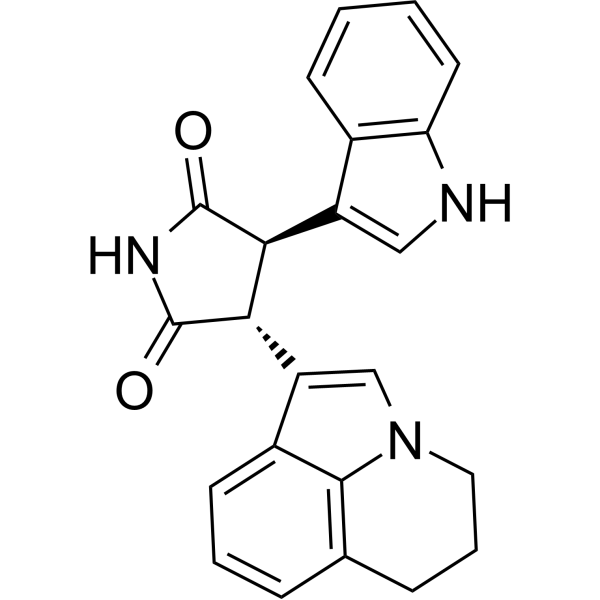
    (rel)-Tivantinib is a potent and highly selective inhibitor of the receptor tyrosine kinase c-MET. (rel)-Tivantinib has two novel targets, GSK3α and GSK3β, which play an important role in the cellular mechanism of non-small cell lung cancer (NSCLC) .
    (rel)-Tivantinib
  • HY-162085

    TAM Receptor Cancer
    Axl-IN-17 (compound 13c) is an orally active, selective AXL inhibitor with an IC50 value of 3.2 nM. Axl-IN-17 reveals antitumor efficacy .
    Axl-IN-17
  • HY-12965B

    TAM Receptor Cancer
    (Z)-S49076 hydrochloride is an orally active inhibitor of MET and AXL that blocks the downstream signaling of these receptors both in vitro and in vivo, inhibiting the proliferation and migration of tumor cells and suppressing tumor growth in xenograft models. (Z)-S49076 hydrochloride is capable of overcoming the resistance to epidermal growth factor receptor (EGFR) tyrosine kinase inhibitors (TKIs) due to MET amplification in Erlotinib (HY-50896)-resistant cell lines both in vitro and in vivo. (Z)-S49076 hydrochloride can be used for research in non-small cell lung cancer (NSCLC) .
    (Z)-S49076 hydrochloride
  • HY-50687

    (3S,4S)-ARQ 197; ARQ 198

    c-Met/HGFR Cancer
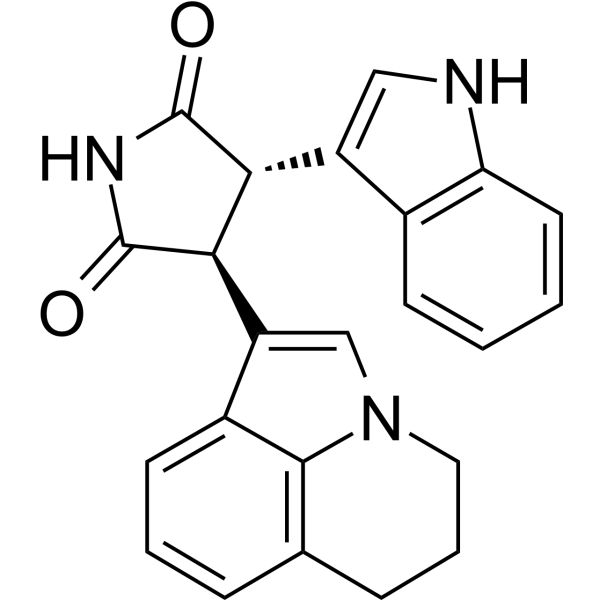
    (3S,4S)-Tivantinib is a potent and highly selective inhibitor of the receptor tyrosine kinase c-MET. (3S,4S)-Tivantinib has two novel targets, GSK3α and GSK3β, which play an important role in the cellular mechanism of non-small cell lung cancer (NSCLC) .
    (3S,4S)-Tivantinib
  • HY-12044R

    XL184 S-malate (Standard); BMS-907351 S-malate (Standard)

    Reference Standards VEGFR Apoptosis Cancer
    Cabozantinib (S-malate) (Standard) is the analytical standard of Cabozantinib (S-malate). This product is intended for research and analytical applications. Cabozantinib S-malate (XL184 S-malate) is a potent multiple receptor tyrosine kinases inhibitor that inhibits VEGFR2, c-Met, Kit, Axl and Flt3 with IC50s of 0.035, 1.3, 4.6, 7 and 11.3 nM, respectively.
    Cabozantinib S-malate (Standard)
  • HY-100833R

    Reference Standards Bacterial Antibiotic Infection
    Cabozantinib (S-malate) (Standard) is the analytical standard of Cabozantinib (S-malate). This product is intended for research and analytical applications. Cabozantinib S-malate (XL184 S-malate) is a potent multiple receptor tyrosine kinases inhibitor that inhibits VEGFR2, c-Met, Kit, Axl and Flt3 with IC50s of 0.035, 1.3, 4.6, 7 and 11.3 nM, respectively.
    Antibiotic-5d (Standard)
  • HY-W706452

    XL184-d4 S-malate; BMS-907351-d4 S-malate

    Isotope-Labeled Compounds Apoptosis VEGFR Cancer
    Cabozantinib-d4 (S-malate) (XL184-d4 (S-malate); BMS-907351-d4 (S-malate)) is the deuterium labeled Cabozantinib (S-malate) (HY-12044). Cabozantinib S-malate (XL184 S-malate) is a potent multiple receptor tyrosine kinases inhibitor that inhibits VEGFR2, c-Met, Kit, Axl and Flt3 with IC50s of 0.035, 1.3, 4.6, 7 and 11.3 nM, respectively.
    Cabozantinib-d4 S-malate
  • HY-P992396

    c-Met/HGFR Cancer
    KTN0073 is a high-affinity MET receptor tyrosine kinase inhibitor. KTN0073 can be used in studies related to non-small cell lung cancer and human cancers driven by HGF, MET amplification, or exon 14 mutation. KTN0073 binds to the Sema/PSI domain to block the HGF-MET interaction, and induces ubiquitination and degradation of oncogenic MET receptors via an HGF-independent pathway, thereby inhibiting MET-dependent signal transduction. KTN0073 exhibits significant antitumor activity in vivo, and its tumor suppressive activity is superior to that of the IgG1 subtype when grafted to the IgG2 constant region .
    KTN0073
  • HY-174581

    mRNA Cancer
    Human MET mRNA encodes the human MET proto-oncogene, receptor tyrosine kinase (MET) protein, a member of the receptor tyrosine kinase family. MET regulates many physiological processes including proliferation, scattering, morphogenesis and survival.
    Human MET mRNA
  • HY-182458

    c-Met/HGFR Cancer
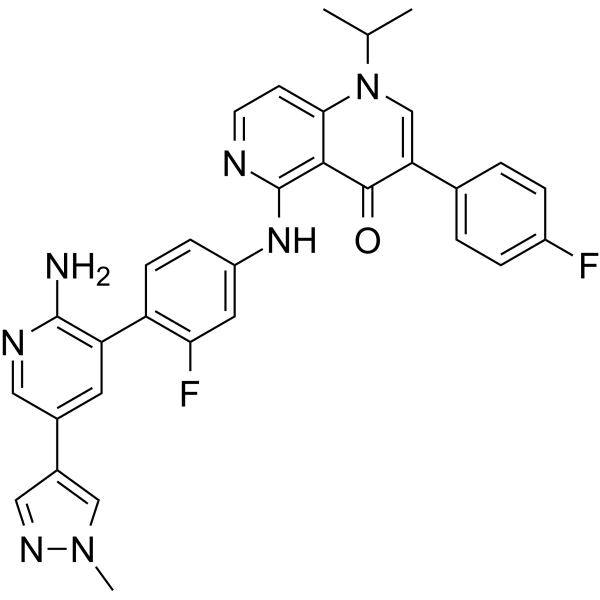
    GNE-203 is a heterobicyclic pyrazole compound and receptor tyrosine kinase inhibitor targeting c-Met.GNE-203 can be used for the research of cancer .
    GNE-203
  • HY-E70750

    c-Met/HGFR Cancer
    Mesenchymal-to-epithelial transition (MET) is a receptor tyrosine kinase for hepatocyte growth factor (HGF). MET overactivation is strongly associated with angiogenesis, cellular motility, growth, and invasion. Aberrant MET signaling can drive tumorigenesis in several cancer types through various molecular mechanisms, including MET amplification, MET exon 14 skipping mutation, MET overexpression, and MET fusions. MET F1200I is a mutant of MET. MET F1200I Recombinant Human Active Protein Kinase is a recombinant MET F1200I protein that can be used to study MET F1200I-related functions .
    MET F1200I Recombinant Human Active Protein Kinase

Inquiry Online

Your information is safe with us. * Required Fields.

Salutation


Country or Region *

Applicant Name *


Organization Name *

Department *


Email Address *


Product Name *

Cat. No.


Requested quantity *

Phone Number *


Remarks

Inquiry Online

Inquiry Information

Product Name:
Cat. No.:
Quantity:
MCE Japan Authorized Agent: