1. Search Result
Search Result
Results for "

amidation reactions

" in MedChemExpress (MCE) Product Catalog:

13

Inhibitors & Agonists

3

Biochemical Assay Reagents

1

Click Chemistry

Cat. No. Product Name Target Research Areas Chemical Structure
  • HY-D0178

    Biochemical Assay Reagents Others
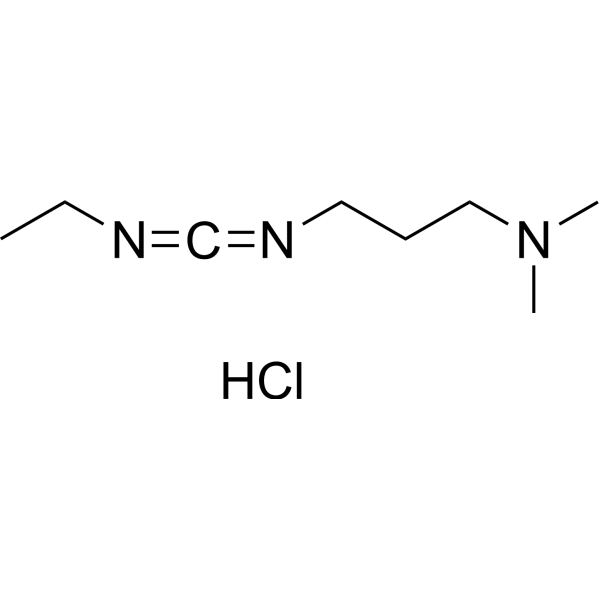
    1-Ethyl-(3-dimethylaminopropyl)carbodiimide hydrochloride is a carbodiimide reagent that can form nucleic acid and compounds with amide bonds. 1-(3-Dimethylaminopropyl)-3-ethylcarbodiimide hydrochloride accelerates the formation reaction of esters, amides, and peptides, as a condensing and dehydrating agent, which are often used for polynucleotide synthesis, anhydroxydation, lactonization and esterification .
    1-Ethyl-(3-dimethylaminopropyl)carbodiimide hydrochloride
  • HY-69142

    Drug Intermediate Pantetheinase Others
    2-Chloropyrimidine-5-carboxylic acid is a synthetic intermediate of Vanin-1 inhibitor 2 .
    2-Chloropyrimidine-5-carboxylic acid
  • HY-30014
    4-Bromo-7-azaindole
    1 Publications Verification

    Drug Intermediate Others
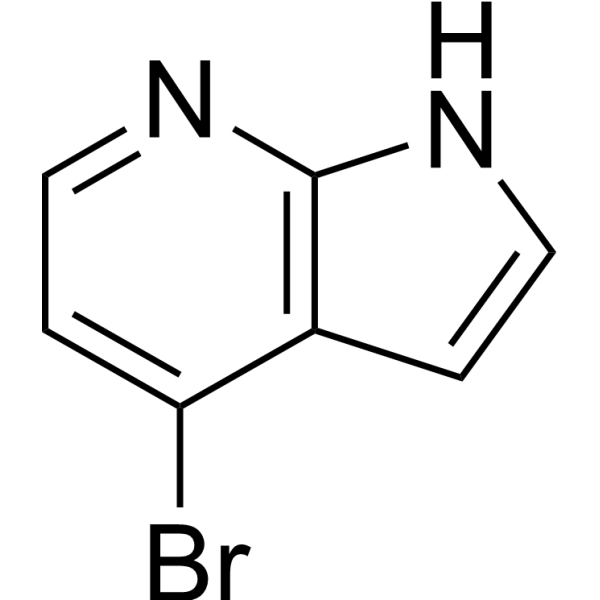
    4-Bromo-7-azaindole is a brominated derivative of 7-azaindole. 4-Bromo-7-azaindole serves as a substrate for palladium-catalyzed C-N and C-O cross-coupling reactions, reacting with amides, amines, amino acid esters and phenols .
    4-Bromo-7-azaindole
  • HY-W127342

    Decanoic acid chloride

    Biochemical Assay Reagents Others
    Decanoyl chloride is an organic compound belonging to the class of acid chlorides. It is a colorless liquid with a pungent odor and is commonly used as a reagent in various organic chemical reactions, especially in the synthesis of esters, amides and fatty acids. Decanoyl chloride has numerous applications in synthetic organic chemistry, especially in the production of pharmaceuticals, agrochemicals and specialty chemicals. In addition, it can be used as a precursor for the synthesis of surfactants and detergents.
    Decanoyl chloride
  • HY-W010361

    Biochemical Assay Reagents Others
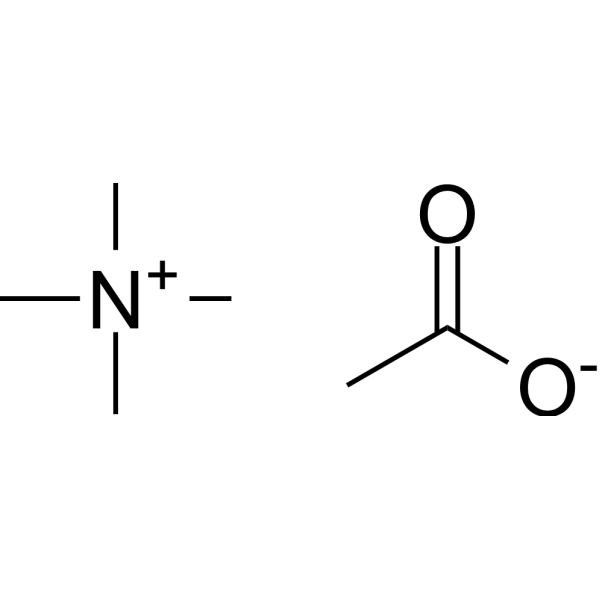
    Tetramethylammonium acetate is an organic compound commonly used as a phase transfer catalyst in organic synthesis reactions, especially those involving charged species or polar reagents. It can facilitate the transfer of reactants between two immiscible phases, such as water and organic solvents, by forming stable ion pairs. Additionally, Tetramethylammonium acetate has been used to prepare a variety of organic compounds, including esters, amides, and carboxylic acids. Due to its unique physicochemical properties, it has also been investigated for its potential use in developing new materials such as ionic liquids and liquid crystals. "x" in the formula represents the number of water molecules in the crystal structure, which can vary depending on the preparation method.
    Tetramethylammonium acetate
  • HY-W800837

    ADC Linker Cancer
    t-Boc-N-amido-PEG4-Val-Cit is a protease-cleavable ADC linker featuring a Boc-protected amine, a hydrophilic PEG spacer, and a Val-Cit dipeptide. The Val-Cit dipeptide is cleavable by cell proteases and features a carboxylic acid which is free for coupling reactions with amines to form amides. The Boc can be removed under acidic conditions to reveal a free primary amine, which may be used in a variety of reactions such as coupling or reductive amination.
    t-Boc-N-amido-PEG4-Val-Cit
  • HY-W800625

    ADC Linker Cancer
    Boc-PEG4-Val-Cit-PAB-OH is an enzyme-cleavable ADC linker featuring a Boc-protected amine, a hydrophilic PEG spacer, and a Val-Cit-PAB dipeptide. The benzylic alcohol on the PAB can be used to attach with reactive groups such as PNP for conjugation with drug payloads. The Boc protecting group may be removed with acid to reveal a primary amine which may be used in coupling reactions to form amides. The Val-Cit-PAB is cleaved by cellular proteases for efficient release of payloads to the cell.
    Boc-PEG4-Val-Cit-PAB-OH
  • HY-W800621

    ADC Linker Cancer
    Fmoc-PEG2-Val-Cit-PAB-OH is an enzyme-cleavable ADC linker featuring a Boc-protected amine, a hydrophilic PEG spacer, and a Val-Cit-PAB dipeptide. The benzylic alcohol on the PAB can be used to attach with reactive groups such as PNP for conjugation with drug payloads. The Fmoc protecting group may be removed with piperidine to reveal a primary amine for use in coupling reactions to form amides. The Val-Cit-PAB is cleaved by cellular proteases for efficient release of payloads to the cell.
    Fmoc-PEG2-Val-Cit-PAB-OH
  • HY-W800623

    ADC Linker Cancer
    Fmoc-PEG6-Val-Cit-PAB-OH is an enzyme-cleavable ADC linker featuring a Boc-protected amine, a hydrophilic PEG spacer, and a Val-Cit-PAB dipeptide. The benzylic alcohol on the PAB can be used to attach with reactive groups such as PNP for conjugation with drug payloads. The Fmoc protecting group may be removed with piperidine to reveal a primary amine which may be used in coupling reactions to form amides. The Val-Cit-PAB is cleaved by cellular proteases for efficient release of payloads to the cell.
    Fmoc-PEG6-Val-Cit-PAB-OH
  • HY-W800622

    ADC Linker Cancer
    Fmoc-PEG4-Val-Cit-PAB-OH is an enzyme-cleavable ADC linker featuring a Boc-protected amine, a hydrophilic PEG spacer, and a Val-Cit-PAB dipeptide. The benzylic alcohol on the PAB can be used to attach with reactive groups such as PNP for conjugation with drug payloads. The Fmoc protecting group may be removed with piperidine to reveal a primary amine which may be used in coupling reactions to form amides. The Val-Cit-PAB is cleaved by cellular proteases for efficient release of payloads to the cell.
    Fmoc-PEG4-Val-Cit-PAB-OH
  • HY-W800624

    ADC Linker Cancer
    Boc-PEG2-Val-Cit-PAB-OH is an enzyme-cleavable ADC linker featuring a Boc-protected amine, a hydrophilic PEG spacer, and a Val-Cit-PAB dipeptide. The benzylic alcohol on the PAB can be used to attach with reactive groups such as PNP for conjugation with drug payloads. The Boc protecting group may be removed with acid to reveal a primary amine which may be used in coupling reactions to form amides. The Val-Cit-PAB is cleaved by cellular proteases for efficient release of payloads to the cell.
    Boc-PEG2-Val-Cit-PAB-OH
  • HY-E70997

    Biochemical Assay Reagents Metabolic Disease
    Glycopeptidase A, Almonds (EC 3.5.1.52) is an enzyme that catalyzes a chemical reaction that cleaves a N4-(acetyl-beta-D-glucosaminyl)asparagine residue in which the glucosamine residue may be further glycosylated, to yield a (substituted) N-acetyl-beta-D-glucosaminylamine and a peptide containing an aspartate residue. Glycopeptidase A, Almonds (EC 3.5.1.52) belongs to the family of hydrolases, specifically those acting on carbon-nitrogen bonds other than peptide bonds in linear amides.
    Glycopeptidase A, Almonds
  • HY-183002

    Biochemical Assay Reagents Amino Acid Derivatives Others
    N6-(3-Azidopropanoyl)-N2-(tert-butoxycarbonyl)-L-lysine is an L-lysine (HY-N0469) derivative and an azide molecule used for click chemistry conjugation .
    N6-(3-Azidopropanoyl)-N2-(tert-butoxycarbonyl)-L-lysine

Inquiry Online

Your information is safe with us. * Required Fields.

Salutation


Country or Region *

Applicant Name *


Organization Name *

Department *


Email Address *


Product Name *

Cat. No.


Requested quantity *

Phone Number *


Remarks

Inquiry Online

Inquiry Information

Product Name:
Cat. No.:
Quantity:
MCE Japan Authorized Agent:

