8 Results for "

hepatic microsomal stability

" in MedChemExpress (MCE) Product Catalog:
Products (8)

8 Results for "hepatic microsomal stability" in MCE Product Catalog:

Cat. No.: HY-131905S
CAS No.: 1606150-08-6
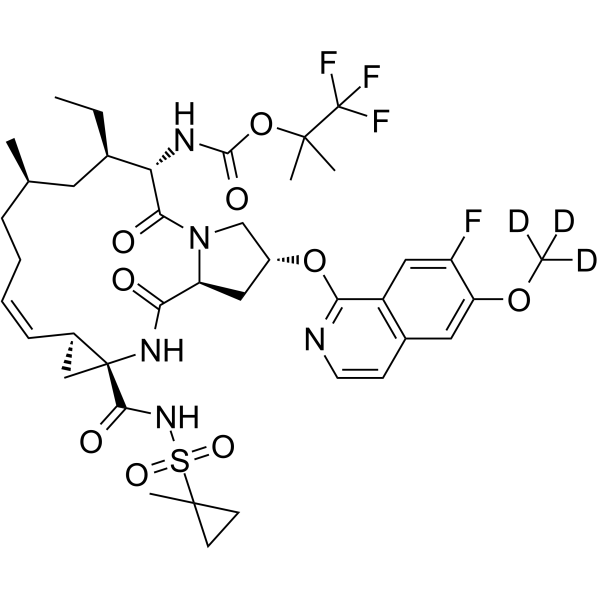
BMS-986144 is an orally active inhibitor of HCV NS3/4A protease. BMS-986144 binds to the active site of HCV NS3/4A protease and induces conformational changes in the protease. BMS-986144 reduces time-dependent CYP3A4 inhibition, exhibits hepatic microsomal metabolic stability, and undergoes oxidation of the macrocyclic linker chain. BMS-986144 can be used in studies related to hepatitis C virus infection .
loading...
    loading...
Cat. No.: HY-155354
CAS No.: 3053680-00-2
Purity:  99.13%
Target:  

Parasite

Research Areas:  

Infection

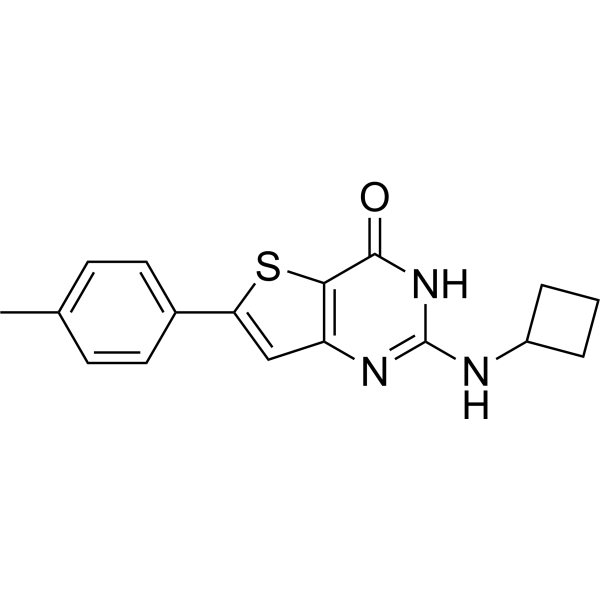
Antimalarial agent 33 (compound 5g) has antiplasmodial activity against erythrocytic and hepatic stages of Plasmodium with an EC50 of 1.1 μM for K1 P. falciparum strain. Antimalarial agent 33 demonstrats enhanced microsomal stability (T1/2=29 min). Antimalarial agent 33 has no significant cytotoxicity against primary hepatocytes .
loading...
    loading...
Cat. No.: HY-143757
CAS No.: 2663989-04-4
Target:  

Influenza Virus

Research Areas:  

Infection

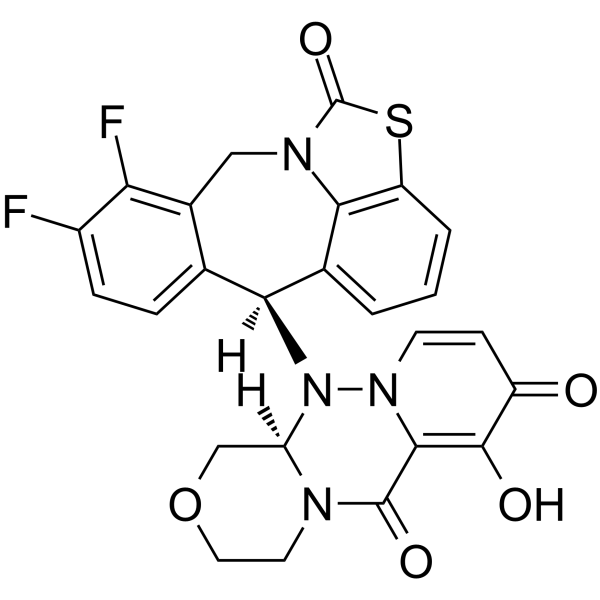
Cap-dependent endonuclease-IN-10 is a potent inhibitor of cap-dependent endonuclease (CEN). Not only can Cap-dependent endonuclease-IN-10 inhibit influenza virus well, but also has lower cytotoxicity, better in vivo pharmacokinetic and in vivo pharmacodynamic properties, and better hepatic microsomal stability. Cap-dependent endonuclease-IN-10 has the potential for the research of viral infections (including influenza A, influenza B and influenza C) (extracted from patent WO2021129799A1, compound 1-1) .
loading...
    loading...
Cat. No.: HY-163004
Target:  

Trk Receptor

Research Areas:  

Cancer

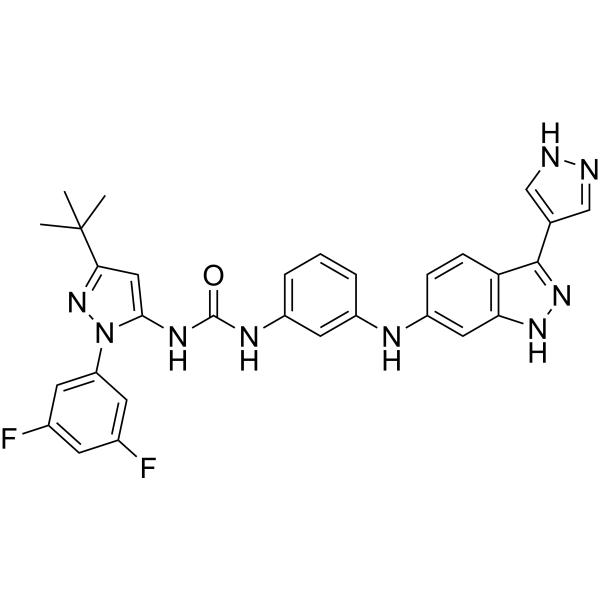
Type II TRK inhibitor 2 (compound 40l) is a selective type II TRK inhibitor with plasma stability and moderate hepatic microsomal stability. Type II TRK inhibitor 2 significantly inhibits Km-12, Ba/F3-TRKA G595R and Ba/F3-TRKA G667C cell proliferation (IC50: 4.1 nM, 41.5 nM, 1.4 nM). Type II TRK inhibitor 2 can be used to study NTRK fusion cancers .
loading...
    loading...
Cat. No.: HY-178959
Target:  

FXR

FXR agonist 13 is a selective, orally active, potent FXR agonist (EC50 = 0.097 μM) and has favorable hepatic microsomal metabolic stability. FXR agonist 13 exhibits moderate affinity for FXR-LBD upon direct binding (KD = 14.74 μM). FXR agonist 13 displays good selectivity against related nuclear receptors, including LXRα/β, PPARα/γ/δ, PXR, and TGR5. FXR agonist 13 can be used for the study of metabolic-associated steatohepatitis (MASH) .
loading...
    loading...
Cat. No.: HY-179639
Research Areas:  

Inflammation/Immunology

PDE4-IN-30 is a selective PDE4 inhibitor with an IC50 of 2.7 nM for PED4D2, targeting PDE4 through halogen bonding and metal coordination. PDE4-IN-30 exhibits at least 67-fold selectivity for other PDE subfamilies. PDE4-IN-30 can be used for the research of idiopathic pulmonary fibrosis .
loading...
    loading...
Cat. No.: HY-184880
CAS No.: 1410114-25-8
Target:  

HCV Protease HCV

Research Areas:  

Infection

BMS-986144 non-deuterated is the non-tritium form of BMS-986144 (HY-131905S). BMS-986144 is an orally active inhibitor of HCV NS3/4A protease. BMS-986144 binds to the active site of HCV NS3/4A protease and induces conformational changes in the protease. BMS-986144 reduces time-dependent CYP3A4 inhibition, exhibits hepatic microsomal metabolic stability, and undergoes oxidation of the macrocyclic linker chain. BMS-986144 can be used in studies related to hepatitis C virus infection .
loading...
    loading...
Cat. No.: HY-182356
CAS No.: 3125953-25-2
MTHFD1/2-IN-1 is an orally active dual MTHFD1/MTHFD2 inhibitor, with IC50 values of 0.26 μM and 0.031 μM against human MTHFD1 and MTHFD2, respectively. MTHFD1/2-IN-1 blocks one-carbon metabolism by inhibiting the dehydrogenase activity of MTHFD1 as well as the dehydrogenase and cyclohydrolase activities of MTHFD2, thereby disrupting nucleotide biosynthesis and redox homeostasis in cancer cells. MTHFD1/2-IN-1 exhibits favorable Caco-2 permeability and hepatic microsomal metabolic stability. MTHFD1/2-IN-1 shows significant anti-leukemic activity, which not only reduces the viability of various leukemia cells but also inhibits tumor growth of acute myeloid leukemia (AML) in mouse models .
loading...
    loading...

