8 Results for "

normoxic conditions

" in MedChemExpress (MCE) Product Catalog:
Products (8)

8 Results for "normoxic conditions" in MCE Product Catalog:

1
1 Cited Publications
Cat. No.: HY-121970
CAS No.: 27031-00-1
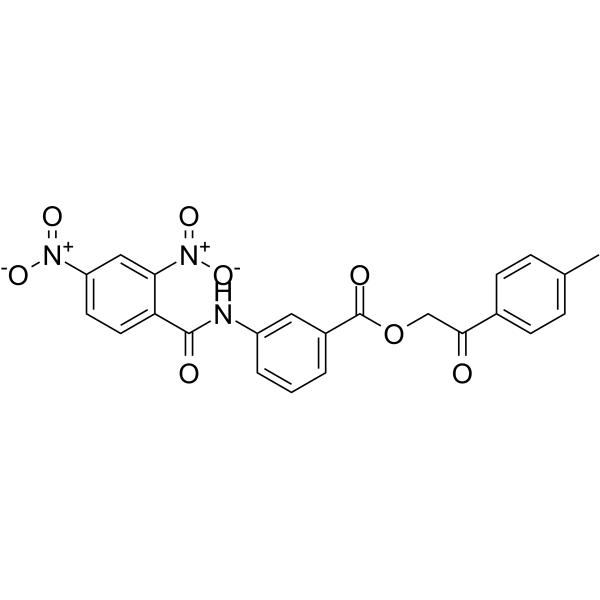
iGP-1 is a cell-permeable, selective mixed inhibitor of mitochondrial sn-glycerol-3-phosphate dehydrogenase (mGPDH), with IC50s of 6.3 μM and 13.6 μM for rat mGPDH activity and H2O2 production, respectively. iGP-1 specifically blocks the mitochondrial component of the glycerophosphate shuttle without affecting cytosolic GPDH. iGP-1 not only inhibits cell proliferation and glutaminolysis, and enhances glycolysis, but also significantly alters key cellular physiological processes such as apoptosis, ROS production, HIF-1α stability and mitochondrial membrane potential. iGP-1 remains active in neutrophil cultures under both normoxic and hypoxic conditions, and serves as an ideal probe for glycerol-3-phosphate metabolic mechanisms. iGP-1 has been applied to studies on prostate cancer and related metabolic pathways .
loading...
    loading...
Cat. No.: HY-15672
CAS No.: 329932-55-0
Purity:  98.39%
Research Areas:  

Neurological Disease Cancer

FM19G11 is a hypoxia-inducible factor-1-alpha (HIF-1α) inhibitor, and it inhibits hypoxia-induced luciferase activity with an IC50 of 80 nM in HeLa cells. FM19G11 modulates other signaling pathways, including mTOR and PI3K/Akt/eNOS, when the HIF-1α pathway is inactivated under normoxic conditions .
loading...
    loading...
Cat. No.: HY-173256
Hyp-dBET1 is a hypoxia-activated BRD4 PROTAC degrader. The IC50 of Hyp-dBET1 for reducing cell viability under hypoxic conditions is approximately 153 nM to 192 nM, while it shows low activity under normoxic conditions (IC50 of approximately 2.8 μM to 3.8 μM). Hyp-dBET1 induces BRD4 degradation under hypoxic conditions, converts to dBET1 in hypoxic environments, and downregulates the expression level of ZFP-91. Hyp-dBET1 can be used in studies related to breast cancer, cervical cancer and solid tumors .
loading...
    loading...
Cat. No.: HY-125575
CAS No.: 1380411-57-3
Target:  

Carbonic Anhydrase

Research Areas:  

Cancer

FC11409B is an ureido-sulfamate carbonic anhydrase IX (CAIX) inhibitor. FC11409B inhibits proliferation and migration of breast cancer cell lines in both hypoxic (0.5% O2) and normoxic conditions (21% O2). FC11409B also inhibits 3D spheroid of breast cancer subtypes invasion. FC11409B is promising for research of breast and ovarian cancers .
loading...
    loading...
Cat. No.: HY-181430
CAS No.: 798546-78-8
Target:  

TGF-beta/Smad

PXS 25 is a cation-independent mannose 6-phosphate receptor (CI-M6PR) inhibitor that inhibits CI-M6PR-mediated activation of latent TGF-β1. PXS 25 inhibits conversion of high glucose-induced latent TGF-β1 to active TGF-β1 in proximal tubule cells under normoxic conditions. PXS 25 suppresses high glucose-induced fibronectin, collagen IV production, and phosphorylated Smad 2 in proximal tubule cells under normoxic conditions. PXS 25 has antifibrotic properties in skin fibroblasts. PXS 25 can be used for the research of diabetic nephropathy .
loading...
    loading...
Cat. No.: HY-187192
Research Areas:  

Cancer

TBBS-CPT is a photoactivatable prodrug that selectively accumulates in biotin receptor-positive tumor cells. TBBS-CPT responds to glutathione to break disulfide bonds, releasing Camptothecin (HY-16560) and TBBS, which exert a synergistic anticancer effect. Upon light irradiation under both normoxic and hypoxic conditions, TBBS-CPT generates ROS, including superoxide anion radicals. TBBS-CPT preferentially accumulates in mitochondria. TBBS-CPT can be used in cancer-related research .
loading...
    loading...
Cat. No.: HY-181350
CAIX/XII/NAMPT-IN-1 is a triple inhibitor of carbonic anhydrase IX/XII and nicotinamide phosphoribosyltransferase (NAMPT) with a hCA IX Ki of 78.1 nM, hCA XII Ki of 64.4 nM, and hNAMPT IC50 of 168 nM. CAIX/XII/NAMPT-IN-1 induces apoptosis, ROS accumulation, suppresses ERK/AKT signaling, inhibits DNA synthesis, and causes mitochondrial dysfunction. CAIX/XII/NAMPT-IN-1 exerts antiproliferative effects against multiple cancer cells under normoxic and hypoxic conditions. CAIX/XII/NAMPT-IN-1 can be used for the research of cancer, such as renal carcinoma, glioblastoma and colorectal cancer .
loading...
    loading...
Cat. No.: HY-L045
4,283 compounds

Oxygen homeostasis regulation is the most fundamental cellular process for adjusting physiological oxygen variations, and its irregularity leads to various human diseases, including cancer. Hypoxia is closely associated with cancer development, and hypoxia/oxygen-sensing signaling plays critical roles in the modulation of cancer progression.

Hypoxia-inducible factor 1 (HIF-1) is a transcription factor that functions as a master regulator of oxygen homeostasis. A variety of HF-1 target genes have been identified thus far which encode proteins that play key roles in critical developmental and physiological processes including angiogenesis/vascular remodeling, erythropoiesis, glucose transport, glycolysis, iron transport, and cell proliferation/survival.

HIF-1 is a heterodimeric transcription factor consisting of a constitutively expressed β-subunit and an oxygen-regulated α-subunit. The unique feature of HIF-1 is the regulation of HIF-1α expression and activity based upon the cellular O2 concentration. Under normoxic conditions, hydroxylation of HIF-1α on these different proline residues is essential for HIF proteolytic degradation by promoting interaction with the von Hippel-Lindau tumor-suppressor protein (pVHL) through hydrogen bonding to the hydroxyproline-binding pocket in the pVHL β-domain. As oxygen levels decrease, hydroxylation of HIF decreases; HIF-1α then no longer binds pVHL, and becomes stabilized, allowing more of the protein to translocate to the cell’s nucleus, where it acts as a transcription factor, upregulating (often within minutes) the production of proteins that stimulate blood perfusion in tissues and thus tissue oxygenation.

MCE offers a unique collection of 4,283 oxygen sensing related compounds targeting HIF/HIF Prolyl-Hydroxylase, MAPK/ERK, PI3K/AKT signaling pathways, etc. MCE Oxygen Sensing Compound Library is a useful tool to study hypoxia, oxidative stress and discover new anti-cancer drugs.

