9 Results for "

propargylglycine

" in MedChemExpress (MCE) Product Catalog:
Products (9)

9 Results for "propargylglycine" in MCE Product Catalog:

2
2 Cited Publications
Cat. No.: HY-W040124
CAS No.: 50428-03-0
Research Areas:  

Others

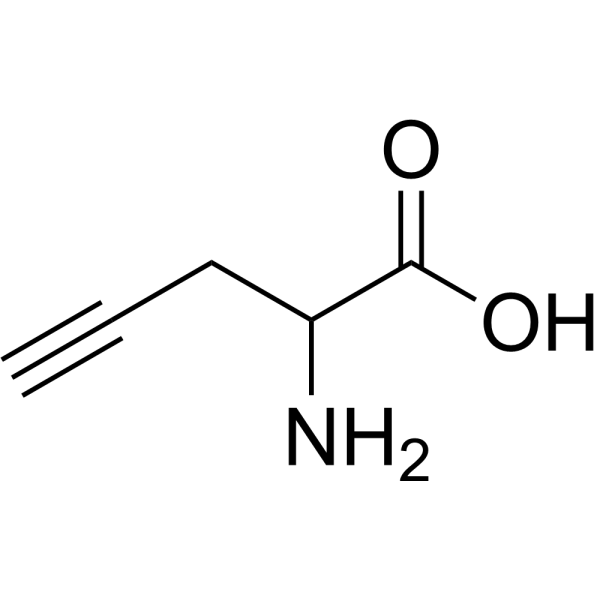
DL-Propargylglycine is a Glycine (HY-Y0966) derivative . DL-Propargylglycine is a click chemistry reagent, it contains an Alkyne group and can undergo copper-catalyzed azide-alkyne cycloaddition (CuAAc) with molecules containing Azide groups.
loading...
    loading...
2
2 Cited Publications
Cat. No.: HY-W051612A
CAS No.: 73823-66-2
Research Areas:  

Others

DL-Propargylglycine sodium is a Glycine (HY-Y0966) derivative. DL-Propargylglycine sodium is a click chemistry reagent, it contains an Alkyne group and can undergo copper-catalyzed azide-alkyne cycloaddition (CuAAc) with molecules containing Azide groups .
loading...
    loading...
1
1 Cited Publications
Cat. No.: HY-W006064
CAS No.: 23235-01-0
Synonyms: (S)-2-Aminopent-4-ynoic acid
Research Areas:  

Others

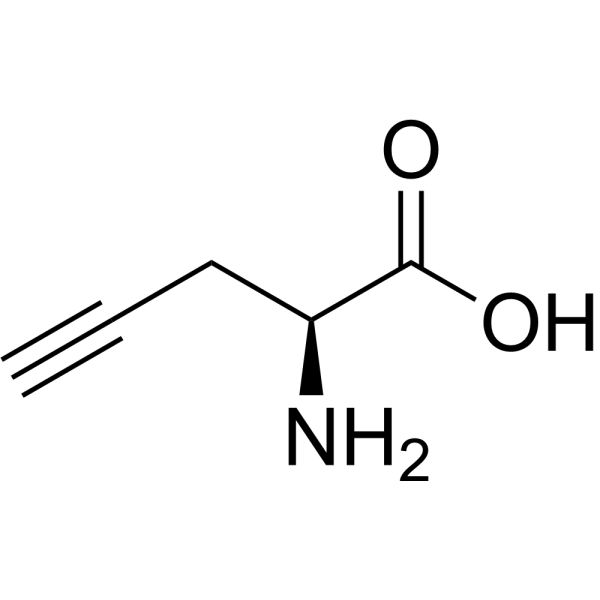
(S)-2-Aminopent-4-ynoic acid is a synthetic amino acid. (S)-2-Aminopent-4-ynoic acid can be used in synthesis of folate-conjugates and corresponding metal-chelate complexes . (S)-2-Aminopent-4-ynoic acid is a click chemistry reagent, it contains an Alkyne group and can undergo copper-catalyzed azide-alkyne cycloaddition (CuAAc) with molecules containing Azide groups.
loading...
    loading...
1
1 Cited Publications
Cat. No.: HY-142035
CAS No.: 58160-95-5
Purity:  99.70%
N-Propargylglycine is a brain-penetrant and orally active PRODH inhibitor. N-Propargylglycine covalently modifies enzyme-bound FAD and active site lysine, causing enzyme structural distortion, protein decay, and irreversible inhibition of proline and 4-hydroxyproline catabolism. N-Propargylglycine induces UPRmt, upregulates mitochondrial chaperones and YME1L1, enhances mitochondrial proteostasis, blocks astrocytic L-proline consumption, and abolishes L-proline’s ATP-maintaining and viability-protective effects. N-Propargylglycine stimulates neural processes, increases brain proline, hydroxyproline, and sarcosine levels, partially normalizes Huntington’s disease whole brain transcriptomes. N-Propargylglycine reduces hyperoxaluria, prevents calcium oxalate stone formation, reduces kidney tubular damage, and restores weight and survival in Grhpr knockout mice. N-Propargylglycine can be used for the research of breast cancer, neurodegenerative disorders, Huntington’s disease, and primary hyperoxaluria type 2 .
loading...
    loading...
1
1 Cited Publications
Cat. No.: HY-136211
CAS No.: 2165706-30-7
Purity:  ≥99.0%
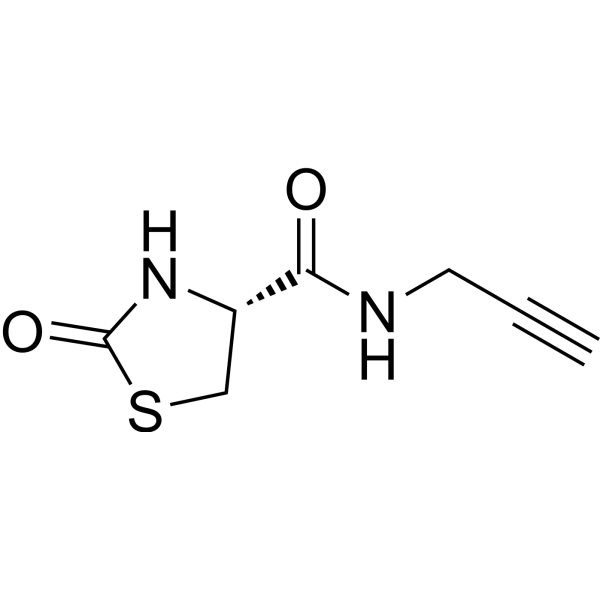
Cystathionine-γ-lyase-IN-1 is a selective cystathionine γ-lyase (CSE) enzyme inhibitor with an IC50 of 6.3 μM . Cystathionine-γ-lyase-IN-1 is a click chemistry reagent, it contains an Alkyne group and can undergo copper-catalyzed azide-alkyne cycloaddition (CuAAc) with molecules containing Azide groups.
loading...
    loading...
Cat. No.: HY-D1320
CAS No.: 1267539-32-1
Target:  

Fluorescent Dye

Research Areas:  

Others

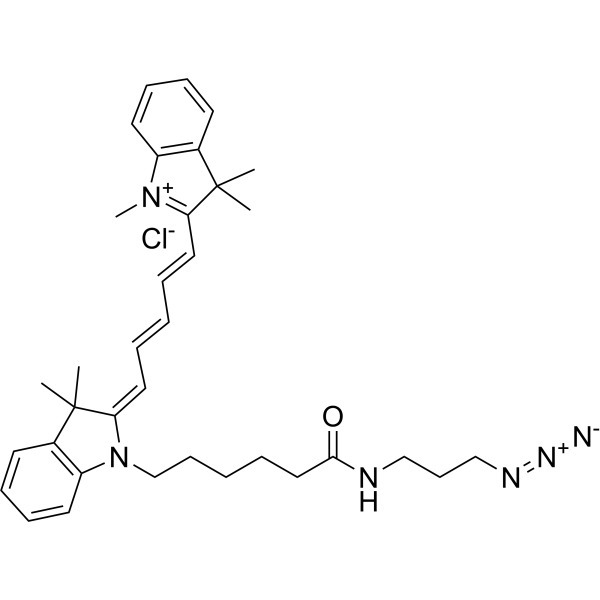
Cyanine5 azide chloride is a Fluorescent probe for cell-selective bacterial protein labeling, as well as a fluorescent dye for single-molecule imaging and dynamic tracking of intracellular organelles. Cyanine5 azide chloride can conjugate with the alkynyl side chain of propargylglycine incorporated into bacterial proteins by the engineered methionyl-tRNA synthetase variant PraRS via copper (I)-catalyzed azide-alkyne [3+2] cycloaddition reaction, thereby enabling in-gel fluorescent visualization of labeled proteins. Cyanine5 azide chloride can diffuse across cell membranes and undergo copper-free click reaction with DBCO-functionalized scAVD pre-bound to DBCO-functionalized biotin, forming fluorescent nanoprobes with enhanced brightness, photostability and localization accuracy, and exhibiting discrete photobleaching steps. The excitation wavelength of Cyanine5 azide chloride is Ex = 633 nm .
loading...
    loading...
Cat. No.: HY-130544
CAS No.: 79583-98-5
Purity:  99.77%
Synonyms: 5-Azidovaleric acid
Research Areas:  

Others

5-Azidopentanoic acid (5-Azidovaleric acid) is a crosslinker/cyclization reagent as well as an azido-containing carboxylic acid. 5-Azidopentanoic acid participates in Cu I-catalyzed azide-alkyne cycloaddition reactions; when used to cap the N-terminus of resin-bound peptides containing propargylglycine residues, it enables head-to-tail cyclodimerization of peptides. 5-Azidopentanoic acid introduces azido functional groups into chitosan via amidation for strain-promoted azide-alkyne cycloaddition click reactions. 5-Azidopentanoic acid acts as an aliphatic bifunctional ligand and capping agent for CdSe tetrapods; its bromo group can be converted to an azido group, which then undergoes catalyst-free alkyne-azide cycloaddition click reactions with ethynyl-terminated poly (3-hexylthiophene) .
loading...
    loading...
Cat. No.: HY-W051612
CAS No.: 16900-57-5
DL-Propargylglycine hydrochloride is an irreversible and selective CSE inhibitor that blocks the biosynthesis of endogenous hydrogen sulfide. DL-Propargylglycine hydrochloride induces ROS and TGF-β1 expression. DL-Propargylglycine hydrochloride downregulates carotid ACE2 and Ang-(1-7), and elevates Ang II. DL-Propargylglycine hydrochloride upregulates ICAM-1/LFA-1, exacerbating Aspirin (HY-14654)-induced gastric mucosal injury. DL-Propargylglycine hydrochloride is used in research on diabetes-induced liver injury, diabetic nephropathy, atherosclerosis, gastric mucosal injury, hemorrhagic shock, and Streptococcus agalactiae infection .
loading...
    loading...
Cat. No.: HY-105183
CAS No.: 153049-49-1
Target:  

Endothelin Receptor

Research Areas:  

Others

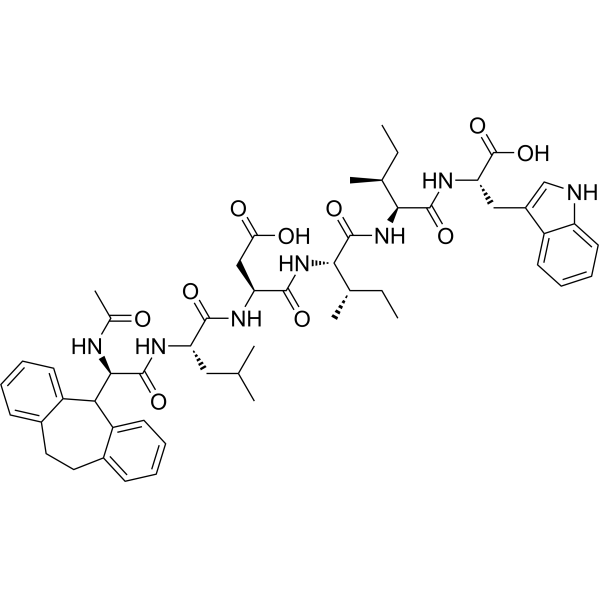
PD 145065 is a highly potent but non-selective endothelin receptor antagonist with an IC50 value of 4 nM for the ETA receptor for rabbit renal artery vascular smooth muscle cells .
loading...
    loading...

