9 Results for "

retinal cell survival

" in MedChemExpress (MCE) Product Catalog:
Products (9)

9 Results for "retinal cell survival" in MCE Product Catalog:

Cat. No.: HY-132893
CAS No.: 2830555-70-7
Target:  

TAM Receptor

Research Areas:  

Neurological Disease Cancer

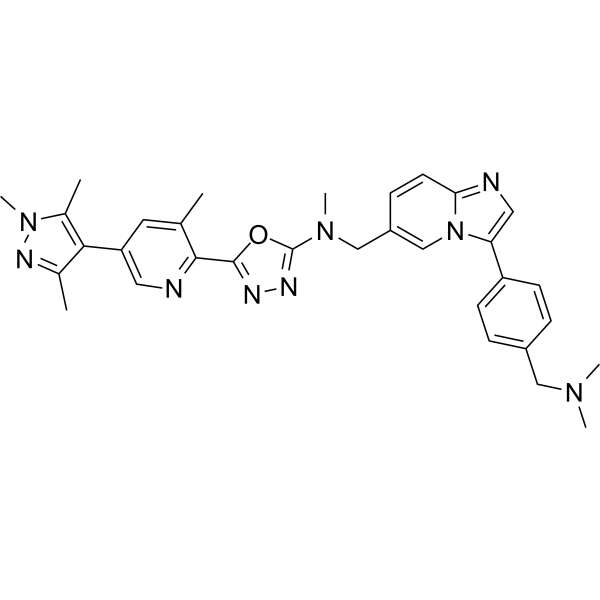
AZ14145845 is an orally active dual-target type 1½ kinase inhibitor of Mer/Axl, which inhibits Mer kinase (pIC50 = 9.0) and Axl kinase (pIC50 = 7.9) with high selectivity over Flt3 and Tyro3. AZ14145845 suppresses Mer- and Axl-dependent proliferation in Ba/F3 cells and inhibits efferocytosis in macrophages. AZ14145845 reduces the phagocytosis of photoreceptor outer segments by polarized human retinal epithelial cells. AZ14145845 inhibits tumor growth and induces tumor regression in vivo, and its combination with anti-PD1 antibody and ionizing radiation improves the survival rate of mice with colorectal cancer. AZ14145845 causes retinal degeneration in mice, with pathological changes similar to those in MERTK loss-of-function models. AZ14145845 can be used in studies related to retinal degeneration, lymphoma and colorectal cancer .
loading...
    loading...
Cat. No.: HY-119715
CAS No.: 486414-35-1
Target:  

CDK Apoptosis

Research Areas:  

Inflammation/Immunology Cancer

AG-012986 is a pan-CDK inhibitor with Ki values of 44 nM (CDK1), 9.2 nM (CDK4), 94 nM (CDK2), and IC50 values of 22 nM (CDK5), 4 nM (CDK9). AG-012986 causes apoptosis of T-cells by targeting upstream kinases in the p38 Mitogen-activated protein kinase (MAPK) pathway and impairing cellular survival. AG-012986 induces cell cycle arrest, retinoblastoma protein hypophosphorylation, and reduces Ki-67 expression. AG-012986 exerts antiproliferative activity in tumor cells, demonstrates antitumor efficacy in human xenograft models, and causes retinal and peripheral neurotoxicity, plus immune cell toxicity. AG-012986 can be used for the research of colon carcinoma, non-small cell lung carcinoma, lung carcinoma, breast carcinoma, ovarian tumor, pancreatic carcinoma, osteosarcoma, lymphoma, leukemia, retinotoxicity .
loading...
    loading...
Cat. No.: HY-138649
CAS No.: 914940-24-2
Purity:  99.88%
Target:  

Influenza Virus

Research Areas:  

Neurological Disease

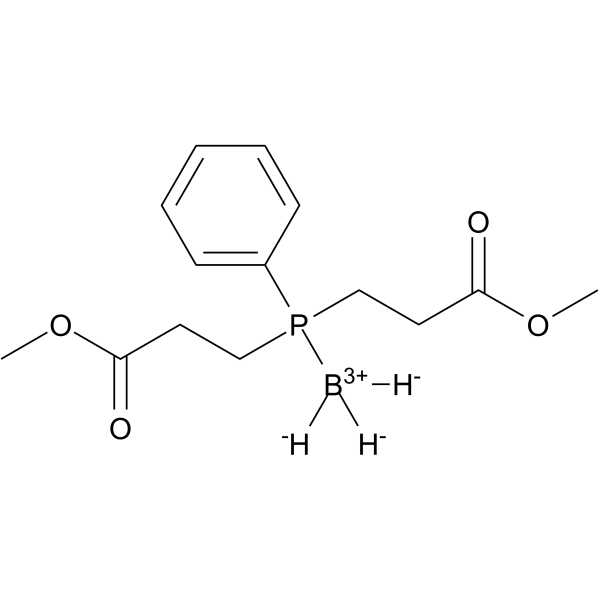
PB2 is a tris(2-carboxyethyl)phosphine (TCEP) analogue increasing retinal ganglion (RGCs) cells survival after axotomy in vitro at nanomolar and picomolar concentrations. PB2 is substantially more permeable than TCEP. PB2, as a reducing agent, is highly neuroprotective for RGCs .
loading...
    loading...
Cat. No.: HY-138648
CAS No.: 188714-28-5
Purity:  98.99%
Target:  

ERK

Research Areas:  

Neurological Disease

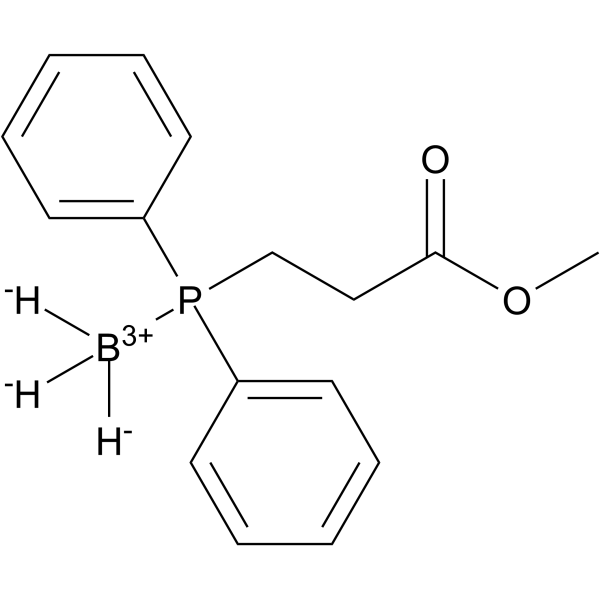
PB1 is a potent intracellular disulfide reducing agent with several advantages including good cell permeability, the ability to form a high intracellular concentration gradient, and stability. PB1 is a borane-protected TCEP (tris(2-carboxyethyl)phosphine) analogue. PB1 increases retinal ganglion cells survival after axotomy in vitro at nanomolar and picomolar concentrations. PB1 can be used for the research of neuroprotective .
loading...
    loading...
Cat. No.: HY-175671
Research Areas:  

Neurological Disease

LSD1/HDAC-IN-3 is a inhibitor targeting class I HDAC and LSD1 enzymes. LSD1/HDAC-IN-3 inhibits HDAC1, HDAC2, HDAC3, and LSD1 with IC50 values of 1702 nM, 842 nM, 358 nM, and 1074 nM, respectively. LSD1/HDAC-IN-3 exhibits antioxidant effects in H2O2-stressed ARPE-19 and 661W retinal cells, increasing levels of acetylated and methylated histone H3. LSD1/HDAC-IN-3 enhances photoreceptor survival in the rd10 mouse model of retinitis pigmentosa. LSD1/HDAC-IN-3 can be used for the study of inherited retinal diseases such as retinitis pigmentosa (RP) .
loading...
    loading...
Cat. No.: HY-187203
Target:  

ROCK

Research Areas:  

Neurological Disease

RX-021 is a ROCK1 and ROCK2 inhibitor with IC50 values of 30.01 nM and 34.31 nM, respectively. RX-021 induces reversible morphological changes in human trabecular meshwork cells, maintains the survival of retinal ganglion cells, restores electroretinogram responses, and improves retinal histopathological changes. RX-021 achieves sustained reduction of intraocular pressure in a mouse model of ocular hypertension. RX-021 can be used for the research of glaucoma .
loading...
    loading...
Cat. No.: HY-P992422

Research Areas:  

Neurological Disease

NG004 is a fully human monoclonal antibody targeting Nogo-A. NG004 reduces retinal Nogo-A levels, blocks the binding of the Nogo-A-receptor complex, and neutralizes the Nogo-A protein. NG004 can be used in studies related to diabetic retinopathy, stroke and acute spinal cord injury .
loading...
    loading...
Cat. No.: HY-187204
Target:  

ROCK

Research Areas:  

Neurological Disease

RX-044 is a ROCK1/ROCK2 inhibitor with ROCK1 IC50 10.01 nM and ROCK2 IC50 9.68 nM, and demonstrates kinase selectivity. RX-044 induces reversible cell retraction, modulates cytoskeletal organization via F-actin depolymerization, inhibits cell contractility, and attenuates TGF-β2-induced cell migration. RX-044 preserves retinal ganglion cell survival, restores electroretinography responses, and ameliorates histopathological changes. RX-044 lowers intraocular pressure in a mouse ocular hypertension model. RX-044 shows no cytotoxicity in target cells. RX-044 exhibits initial ocular irritation that subsides with extended dosing. RX-044 can be used for the research of glaucoma .
loading...
    loading...
Cat. No.: HY-182470
CAS No.: 486414-32-8
Target:  

CDK

AG-012986 (dihydrochloride) is a pan-CDK inhibitor with Ki values of 44 nM (CDK1), 9.2 nM (CDK4), 94 nM (CDK2), and IC50 values of 22 nM (CDK5), 4 nM (CDK9). AG-012986 (dihydrochloride) causes apoptosis of T-cells by targeting upstream kinases in the p38 Mitogen-activated protein kinase (MAPK) pathway and impairing cellular survival. AG-012986 (dihydrochloride) induces cell cycle arrest, retinoblastoma protein hypophosphorylation, and reduces Ki-67 expression. AG-012986 (dihydrochloride) exerts antiproliferative activity in tumor cells, demonstrates antitumor efficacy in human xenograft models, and causes retinal and peripheral neurotoxicity, plus immune cell toxicity. AG-012986 (dihydrochloride) can be used for the research of colon carcinoma, non-small cell lung carcinoma, lung carcinoma, breast carcinoma, ovarian tumor, pancreatic carcinoma, osteosarcoma, lymphoma, leukemia, retinotoxicity .
loading...
    loading...

