



E 64c
Based on 4 publication(s) in Google Scholar
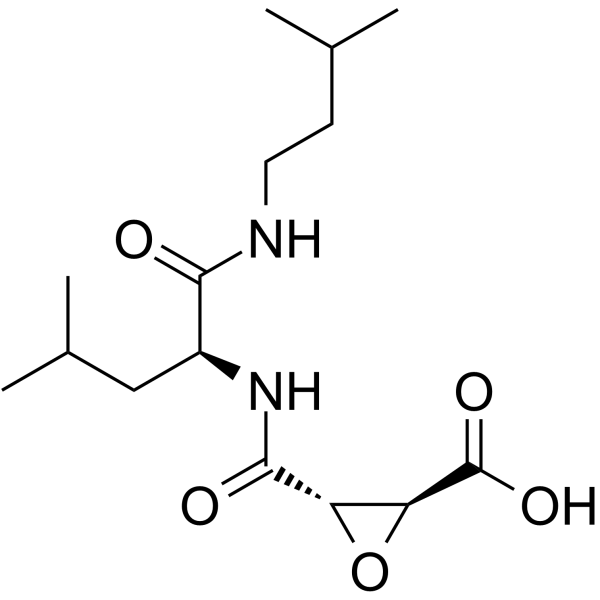
E 64c is a derivative of naturally occurring epoxide inhibitor of cysteine proteases, a Calcium-activated neutral protease (CANP) inhibitor and a very weak irreversible cathepsin C inhibitor. E 64c exhibits entry-blocking effect for MERS-CoV.
For research use only. We do not sell to patients.
- Purity : 99.32%
- CAS No.: 76684-89-4
- Formula: C15H26N2O5
- Molecular Weight:314.38
-
Storage:Powder -20°C, 3 years , 4°C, 2 years ; In solvent -80°C, 6 months , -20°C, 1 month

To place orders, for customer services and technical support, please contact: MedChemExpress USA
Tel: 609-228-6898 E-mail: [email protected] [email protected]


-
 Biological Activity
-
Chemical Information
-
Solvent & Solubility
- Purity & Documentation
- References
-
 Help & FAQs


-
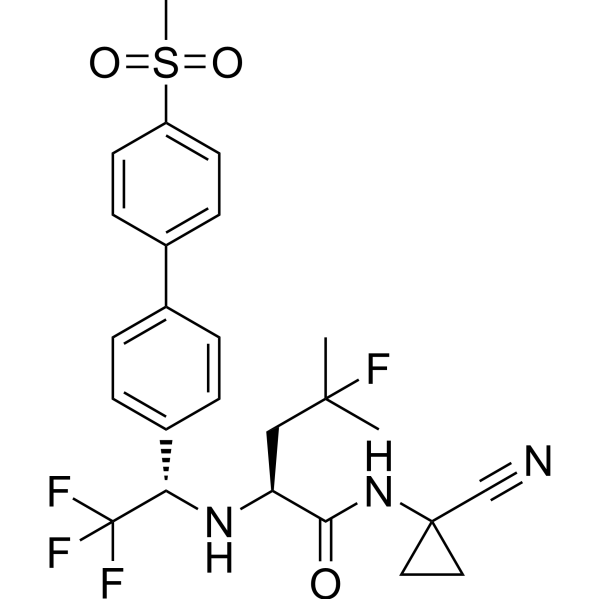
HY-10042
OdanacatibCathepsin K Inhibitor -
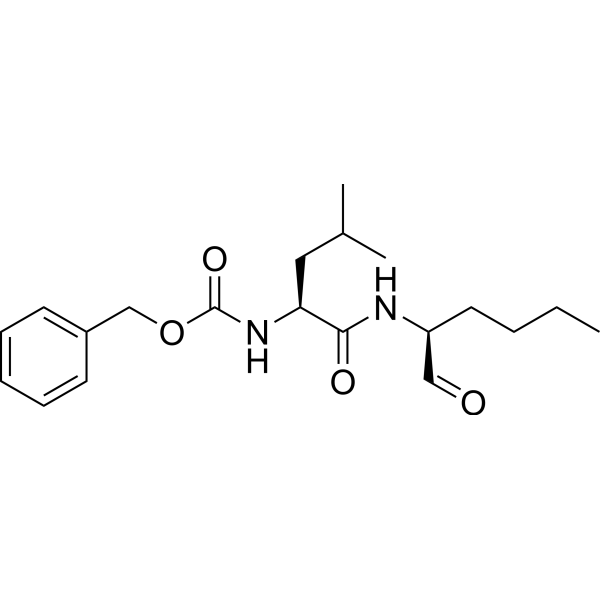
HY-100223
CalpeptinCalpain Inhibitor -
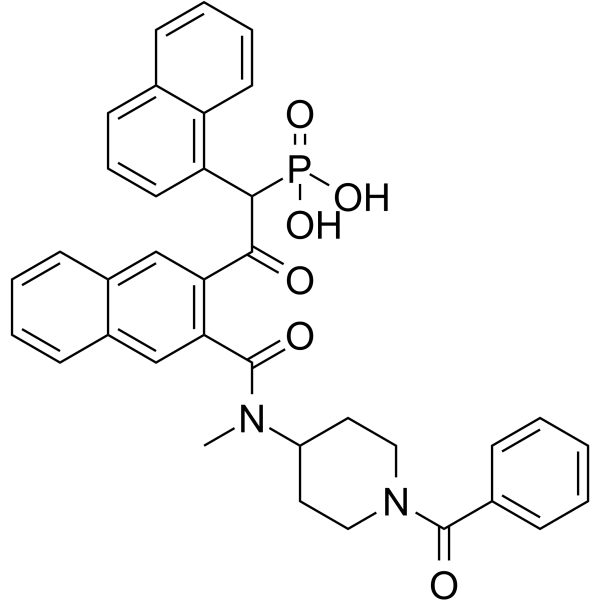
HY-103351
Cathepsin G Inhibitor ICathepsin G Inhibitor -
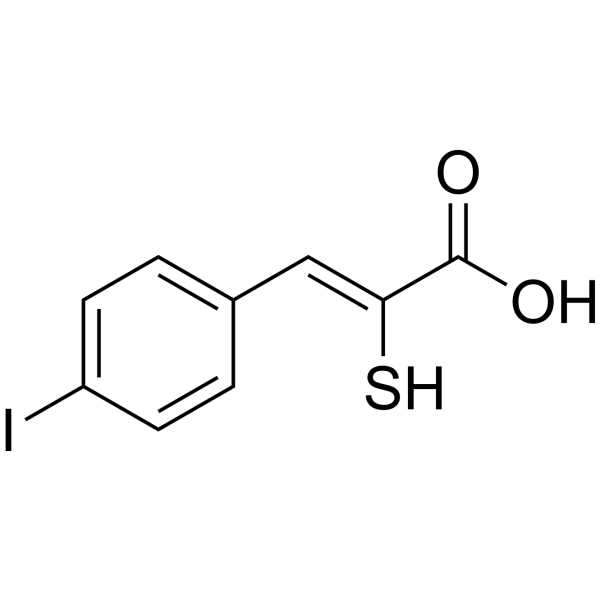
HY-100529
PD150606Calpain Inhibitor -
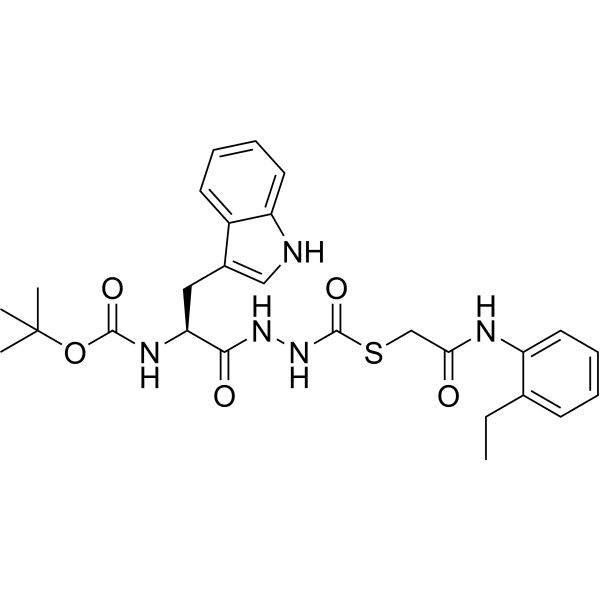
HY-103353
SID 26681509Cathepsin L Inhibitor -
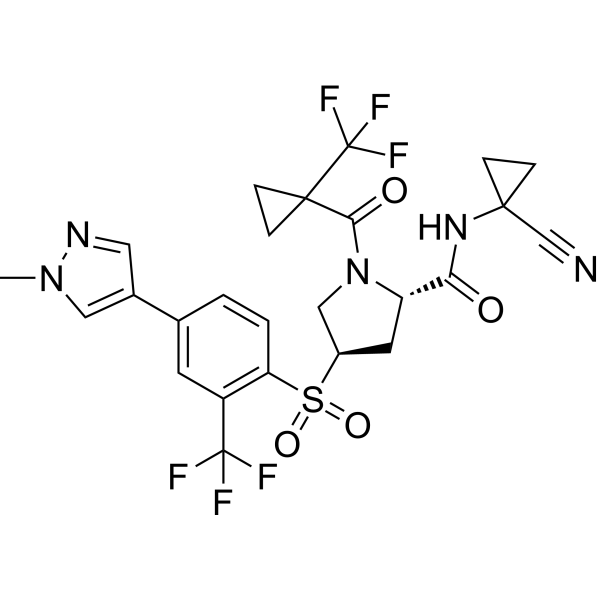
HY-109069
PetesicatibCathepsin S Inhibitor -
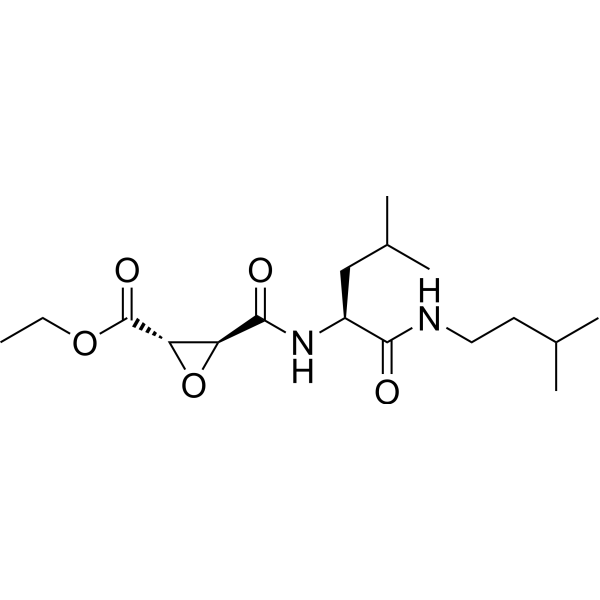
HY-100229
AloxistatinCysteine Protease Inhibitor -
HY-15533
LY 3000328Cathepsin S Inhibitor -
HY-15282
E-64Cysteine Peptidase Inhibitor -
HY-100350
CA-074 methyl esterCathepsin B Inhibitor -
HY-D0843
N-EthylmaleimideCysteine Residues Modifier -
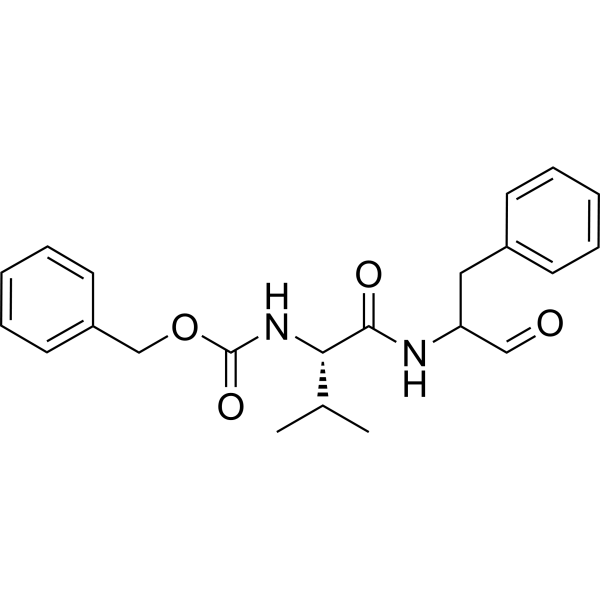
HY-18236
MDL-28170Calpain Inhibitor
Publications Citing Use of MedChemExpress (MCE) E 64c
MoreAll Cathepsin Isoforms
More

Biological Activity
Description
IC50 & Target
|
Cathepsin C |
In Vitro
E-64c, a derivative of naturally occurring epoxide inhibitor of cysteine proteases, with papain; especially with regard to the hydrogen bonding and hydrophobic interactions of the ligands with conserved residues in the catalytic binding site[1]. E 64c (k2/Ki=140±5M-1s-1) is demonstrated to be a lead structure for the development of irreversible cathepsin C inhibitors[3].
MedChemExpress (MCE) has not independently confirmed the accuracy of these methods. They are for reference only.
In Vivo
MedChemExpress (MCE) has not independently confirmed the accuracy of these methods. They are for reference only.


Chemical Information
-
CAS No. 76684-89-4
-
Appearance Solid
-
Molecular Weight 314.38
-
Formula C15H26N2O5
-
Color White to off-white
-
SMILES
O=C([C@H]1O[C@@H]1C(N[C@H](C(NCCC(C)C)=O)CC(C)C)=O)O
-
Shipping
Room temperature in continental US; may vary elsewhere.
-
Storage
Powder -20°C 3 years 4°C 2 years In solvent -80°C 6 months -20°C 1 month


Publications (4)
-
Journal Impact Factor
-
Most Recent
-
Nucleic Acids Res
COVID19 Drug Repository: text-mining the literature in search of putative COVID19 therapeutics. [Abstract]2021 Jan 8;49(D1):D1113-D1121. PMID: 33166390 -
Commun Biol
Astrocytic EAAT1 suppression by EV-ACLY underlies glutamate imbalance and cognitive impairment in POCD. [Abstract]2026 Mar 19. PMID: 41857316 -
Sci Rep
Hepatitis C virus NS3/4A inhibitors and other drug-like compounds as covalent binders of SARS-CoV-2 main protease. [Abstract]2022 Jul 16;12(1):12197. PMID: 35842458 -
Animal Model Exp Med
2026 Jun 9. PMID: 42265830


Solvent & Solubility
In Vitro:
DMSO : 250 mg/mL (795.22 mM; Need ultrasonic; Hygroscopic DMSO has a significant impact on the solubility of product, please use newly opened DMSO)
Please refer to the solubility information to select the appropriate solvent. Once prepared, please aliquot and store the solution to prevent product inactivation from repeated freeze-thaw cycles.
Storage method and period of stock solution: -80°C, 6 months; -20°C, 1 month. When stored at -80°C, please use it within 6 months. When stored at -20°C, please use it within 1 month.
Please refer to the solubility information to select the appropriate solvent. Once prepared, please aliquot and store the solution to prevent product inactivation from repeated freeze-thaw cycles.
Storage method and period of stock solution: -80°C, 6 months; -20°C, 1 month. When stored at -80°C, please use it within 6 months. When stored at -20°C, please use it within 1 month.
Concentration (start) × Volume (start) = Concentration (final) × Volume (final)
In Vivo:
Select the appropriate dissolution method based on your experimental animal and administration route.
- For the following dissolution methods, please ensure to first prepare a clear stock solution using an In Vitro approach and then sequentially add co-solvents:
- To ensure reliable experimental results, the clarified stock solution can be appropriately stored based on storage conditions. As for the working solution for In Vivo experiments, it is recommended to prepare freshly and use it on the same day.
- The percentages shown for the solvents indicate their volumetric ratio in the final prepared solution. If precipitation or phase separation occurs during preparation, heat and/or sonication can be used to aid dissolution.
Add each solvent one by one: 10% DMSO 40% PEG300 5% Tween-80 45% Saline
Solubility: ≥ 2.08 mg/mL (6.62 mM); Clear solution
This protocol yields a clear solution of ≥ 2.08 mg/mL (saturation unknown).
Taking 1 mL working solution as an example, add 100 μL DMSO stock solution (20.8 mg/mL) to 400 μL PEG300, and mix evenly; then add 50 μL Tween-80 and mix evenly; then add 450 μL Saline to adjust the volume to 1 mL.
Preparation of Saline: Dissolve 0.9 g sodium chloride in ddH₂O and dilute to 100 mL to obtain a clear Saline solution.
Add each solvent one by one: 10% DMSO 90% (20% SBE-β-CD in Saline)
Solubility: ≥ 2.08 mg/mL (6.62 mM); Clear solution
This protocol yields a clear solution of ≥ 2.08 mg/mL (saturation unknown).
Taking 1 mL working solution as an example, add 100 μL DMSO stock solution (20.8 mg/mL) to 900 μL 20% SBE-β-CD in Saline, and mix evenly.
Preparation of 20% SBE-β-CD in Saline (4°C, storage for one week): 2 g SBE-β-CD powder is dissolved in 10 mL Saline, completely dissolve until clear.
In Vivo Dissolution Calculator
Please enter the basic information of animal experiments:
-
-
-
-
Recommended: Prepare an additional quantity of animals to account for potential losses during experiments.
Please enter your animal formula composition:
-
%DMSO +
Recommended: Keep the proportion of DMSO in working solution below 2% if your animal is weak.
-
%+
-
+%Tween-80 + +
-
%Saline +
The co-solvents required include: DMSO, . All of co-solvents are available by MedChemExpress (MCE). , Tween 80. All of co-solvents are available by MedChemExpress (MCE).
Working solution concentration: 0.22 mg/mL
Method for preparing stock solution: mg drug dissolved in μL DMSO. Stock solution concentration: mg/mL.
1. Take μL DMSO stock solution;
2. Add μL .
μL , mix evenly;
3. Then add μL Tween 80, mix evenly;
4. Then add μL
Please ensure that the stock solution in the first step is dissolved to a clear state, and add co-solvents in sequence. You can use ultrasonic heating (ultrasonic cleaner, recommended frequency 20-40 kHz), vortexing, etc. to assist dissolution.


Purity & Documentation
-
Data Sheet (291 KB)
-
SDS (393 KB)
- English - EN (393 KB)
- Français - FR (393 KB)
- Deutsch - DE (393 KB)
- Norwegian - NO (393 KB)
- Español - ES (393 KB)
- Swedish - SV (393 KB)
- Italian - IT (393 KB)
- Korean - KR (393 KB)
- Portuguese - PT (393 KB)
-
Handling Instructions (2659 KB)
References
[1]. Khan MS, et al. Design, synthesis, evaluation and thermodynamics of 1-substituted pyridylimidazo[1,5-a]pyridine derivatives as cysteine protease inhibitors. PLoS One. 2013 Aug 5;8(8):e69982. [Content Brief]
[2]. Toda G, et al. Calcium-activated neutral protease inhibitor (E-64c) and reperfusion for experimental myocardial infarction. Jpn Heart J. 1989 May;30(3):375-86. [Content Brief]
[3]. Radzey H, et al. E-64c-hydrazide: a lead structure for the development of irreversible cathepsin C inhibitors. ChemMedChem. 2013 Aug;8(8):1314-21. [Content Brief]
[4]. Ji Yeun Kim, et al. Safe, High-Throughput Screening of Natural Compounds of MERS-CoV Entry Inhibitors Using a Pseudovirus Expressing MERS-CoV Spike Protein. Int J Antimicrob Agents. 2018 Nov;52(5):730-732. [Content Brief]


Complete Stock Solution Preparation Table
Please refer to the solubility information to select the appropriate solvent. Once prepared, please aliquot and store the solution to prevent product inactivation from repeated freeze-thaw cycles.
Storage method and period of stock solution: -80°C, 6 months; -20°C, 1 month. When stored at -80°C, please use it within 6 months. When stored at -20°C, please use it within 1 month.
| Optional Solvent | Concentration Solvent Mass | 1 mg | 5 mg | 10 mg | 25 mg |
|---|---|---|---|---|---|
| DMSO | 1 mM | 3.1809 mL | 15.9043 mL | 31.8086 mL | 79.5216 mL |
| 5 mM | 0.6362 mL | 3.1809 mL | 6.3617 mL | 15.9043 mL | |
| 10 mM | 0.3181 mL | 1.5904 mL | 3.1809 mL | 7.9522 mL | |
| 15 mM | 0.2121 mL | 1.0603 mL | 2.1206 mL | 5.3014 mL | |
| 20 mM | 0.1590 mL | 0.7952 mL | 1.5904 mL | 3.9761 mL | |
| 25 mM | 0.1272 mL | 0.6362 mL | 1.2723 mL | 3.1809 mL | |
| 30 mM | 0.1060 mL | 0.5301 mL | 1.0603 mL | 2.6507 mL | |
| 40 mM | 0.0795 mL | 0.3976 mL | 0.7952 mL | 1.9880 mL | |
| 50 mM | 0.0636 mL | 0.3181 mL | 0.6362 mL | 1.5904 mL | |
| 60 mM | 0.0530 mL | 0.2651 mL | 0.5301 mL | 1.3254 mL | |
| 80 mM | 0.0398 mL | 0.1988 mL | 0.3976 mL | 0.9940 mL | |
| 100 mM | 0.0318 mL | 0.1590 mL | 0.3181 mL | 0.7952 mL |


E 64c Related Classifications
HY-100227 Related Classifications
 Powered by Bioz