



BCL6
B-cell lymphoma 6 protein; B-cell lymphoma 5 protein (BCL-5); Zinc finger and BTB domain-containing protein 27; Zinc finger protein 51
BCL6 (B-cell lymphoma 6) is a zinc-finger transcriptional repressor that plays a crucial role in the germinal center (GC) reaction of B cells. BCL6 can promote the continuous proliferation of B cells in the highly mutagenic GC environment by suppressing DNA damage checkpoint genes (ATR, CHEK1, TP53), thereby reducing the cellular response to DNA damage. Additionally, BCL6 facilitates B cell proliferation by downregulating cell cycle inhibitors (CDKN1A, PTEN) and prevents premature differentiation into plasma cells by repressing terminal differentiation genes (IRF4, PRDM1), ensuring the maintenance of the GC reaction. Furthermore, BCL6 competitively inhibits inflammatory signaling pathways (STAT3, NF-κB), thereby reducing excessive immune activation and exerting an anti-inflammatory effect.
The stable expression of BCL6 relies on positive feedback mechanisms, such as p300-mediated inhibition of HSP90 acetylation, which stabilizes BCL6, and EZH2-catalyzed H3K27 methylation, which further enhances BCL6's transcriptional repression. In various cancers, including diffuse large B-cell lymphoma (DLBCL), B-cell acute lymphoblastic leukemia (B-ALL), chronic myeloid leukemia (CML), breast cancer, and non-small cell lung cancer (NSCLC), BCL6 contributes to cancer cell survival through genetic mutations, chromosomal translocations, or dysregulation of co-repressors. Therefore, inhibitors targeting the BTB domain of BCL6 can effectively block its interaction with co-repressors, thereby suppressing tumor growth and providing a novel therapeutic strategy for malignant tumors[1].
All Product Categories
-
BCL6 Related Products (46)
Related Products (46)

-
Antibodies (1)
-
BCL6-IN-11
 0 ImagesCat. No.: HY-177756CAS No.: 2230406-60-5BCL6-IN-11 is a potent inhibitor of the BCL6 BTB domain and a partial degrader of BCL6. BCL6-IN-11 inhibits the interaction between the BCL6 BTB domain and BCOR with an IC50 of 6 nM. BCL6-IN-11 can be used for research related to BCL6 degradation in diffuse large B-cell lymphoma (DLBCL).
-
CCT373567
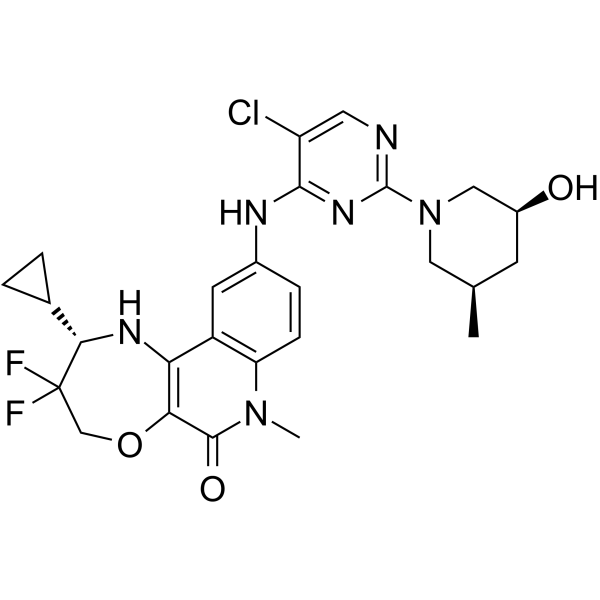 0 ImagesCat. No.: HY-146184CAS No.: 2378853-67-7CCT373567 is a non-degrading isomer of the BCL6 degrader CCT373566 (HY-146185). CCT373567 acts as a BCL6 inhibitor with an IC50 of 2.9 nM. CCT373567 exerts growth inhibitory activity against cancer cells expressing BCL6, but shows low activity against cancer cells with low BCL6 expression. CCT373567 can be used in research related to diffuse large B-cell lymphoma.
-
WK692
 0 ImagesCat. No.: HY-169218CAS No.: 2694055-38-2WK692 is a BCL6 inhibitor that inhibits the BCL6BTB/SMRT interaction. WK692 can effectively inhibit the growth of diffuse large B-cell lymphoma cells and synergize with EZH2 and PRMT5 inhibitors..
-
JWZ-7-7-Neg1
 0 ImagesCat. No.: HY-164098CAS No.: 3008612-30-1

-
BCL6-760
 0 ImagesCat. No.: HY-178777CAS No.: 3084696-50-1BCL6-760 is an orally active BCL-6 PROTAC degrader with an EC50 of 0.8 nM. BCL6-760 only degrades BCL6 and has no effect on other CRBN substrates. BCL6-760 demonstrates significant efficacy in the orthotopic xenograft mouse model of OCI-LY-1 tumors. BCL6-760 can be used in the research of diffuse Large B-cell Lymphoma (DLBCL) (Pink: BCL-6 ligand (HY-179317); Blue: CRBN ligand (HY-179305); Black: Linker).

-
ALV-05-077-01
 0 ImagesCat. No.: HY-178683CAS No.: 2438125-72-3ALV-05-077-01 is a BCL6/BCL6B degrader. ALV-05-077-01 binds to CRBN and recruits specific zinc finger proteins as neo-substrates for ubiquitination and proteasomal degradation. ALV-05-077-01 induces the degradation of full-length endogenous BCL6 zinc finger protein. ALV-05-077-01 induces the degradation of full-length endogenous BCL6B zinc finger protein. ALV-05-077-01 can be used in the research of hematological malignancies.
-
BCL6 PROTAC 1
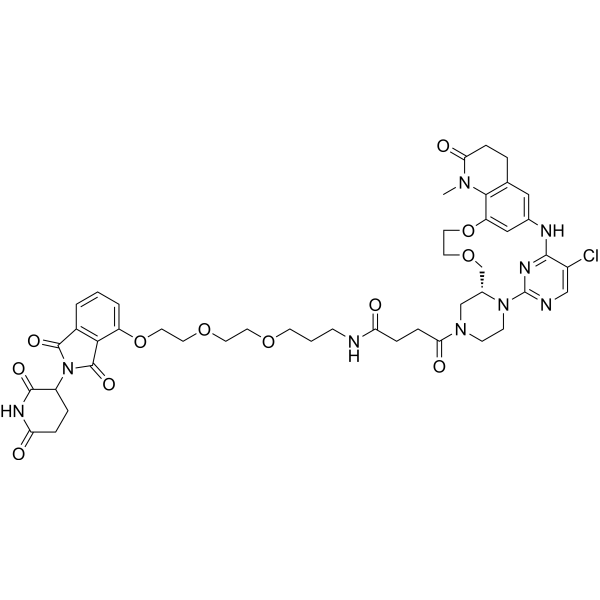 0 ImagesCat. No.: HY-122829CAS No.: 2257479-54-0
-
PROTAC BCL6 Degrader-4
 0 ImagesCat. No.: HY-184007CAS No.: 3121287-19-9PROTAC BCL6 Degrader-4 is a potent PROTAC BCL6 degrader. PROTAC BCL6 Degrader-4 recruits CRBN E3 ligase machinery to promote ubiquitination and proteasomal degradation of BCL6. PROTAC BCL6 Degrader-4 can be used for the research of diffuse large B-cell lymphoma and related hematological malignancies.
-
PROTAC BCL6/GSPT1 Degrader-1
 0 ImagesCat. No.: HY-181084CAS No.: 3039500-55-2PROTAC BCL6/GSPT1 Degrader-1 is a dual-target PROTAC degrader that targets BCL6 and GSPT1. PROTAC BCL6/GSPT1 Degrader-1 inhibits cell proliferation, promotes DNA damage, and induces cell cycle arrest and apoptosis in diffuse large B-cell lymphoma. PROTAC BCL6/GSPT1 Degrader-1 can be used for research on tumors such as lymphoma.

-
ZD-1-186
 0 ImagesCat. No.: HY-180886ZD-1-186 is a non-degradative, covalent-dependent molecular glue that targets BCL6 and BRD9. ZD-1-186 inhibits the transcriptional output of MYC, relieves the repression of canonical BCL6 target loci (including CDKN1A (p21)), and mediates the selective recruitment of BRD9 to BCL6. ZD-1-186 can be used for research on diffuse large B-cell lymphoma.
-
BCL6-IN-12
 0 ImagesCat. No.: HY-180166BCL6-IN-12 (Compound 11e) is a BCL6 inhibitor with a Kd of 0.81 μM. BCL6-IN-12 binds to the BTB domain of BCL6. BCL6-IN-12 can be used in the research of diffuse large B-cell lymphoma.
-
WK500B
 0 ImagesCat. No.: HY-148640CAS No.: 2253985-29-2WK500B is a potent and orally active BCL6 inhibitor with a KD of 1.61 μM. WK500B engages intracellular BCL6 and disrupts BCL6‑corepressor interactions to reactivate BCL6 target genes. WK500B exerts cytotoxicity against diffuse large B‑cell lymphoma cells and induces apoptosis and cell cycle arrest. WK500B suppresses germinal center formation in C57BL/6 mice and DLBCL tumor growth in SCID xenograft models without observable toxicity. WK500B can be used for the study of diffuse large B‑cell lymphoma (DLBCL).

-
BCL6-IN-10
 0 ImagesCat. No.: HY-177755CAS No.: 2230406-52-5BCL6-IN-10 is a molecular glue inhibitor targeting the BCL6 BTB domain with an IC50 of 4 nM. BCL6-IN-10 blocks the interaction between BCL6 and transcriptional co-repressors, and induces partial degradation of BCL6 via the ubiquitin-proteasome pathway, thereby de-repressing BCL6 target genes and inhibiting cancer cell proliferation. BCL6-IN-10 can be used in the research of diffuse large B-cell lymphoma.

-
ALV-05-151-02
 0 ImagesCat. No.: HY-178700CAS No.: 2744249-11-2ALV-05-151-02 is a BCL6B zinc finger protein degrader that selectively targets BCL6B over BCL6. ALV-05-151-02 redirects the E3 ubiquitin ligase CRL4CRBN to induce BCL6B degradation and interacts with the H357 residue of BCL6B.




