



Fluorescent Dye
Fluorescence is a phenomenon of photoluminescence in luminescence. When an atom is irradiated by light, some electrons around the nucleus jump from their original orbitals to higher energy orbitals under the influence of light energy, i.e., from the ground state to the first or second excited single-line state, etc. Due to the instability of the first or second excited singlet state, the electron returns from the excited singlet state to the ground state accompanied by released energy, resulting in fluorescence.
Fluorescent dyes can be covalently bound or physically adsorbed in the structure of the substance. The fluorescence properties allow for the characterization, localization and quantitative analysis of the labeled object. Fluorescent dyes have shown great potential for the detection of proteins, nucleic acids, cells, and immunoassays, attributed to the advantages in non-radioactive contamination, simple experimental operation and easy observation.
Fluorescent dyes have penetrated many fields such as pharmacology, physiology, environmental science, and information science, as well as functional studies of proteins and drug screening.
All Product Categories
-
Fluorescent Dye Related Products (4891)
Related Products (4891)

-
Antibodies (4)
-
FITC-PEG3400-MAL
 0 ImagesCat. No.: HY-D2800BFITC-PEG3400-MAL is a fluorescent dye composed of polyethylene glycol (PEG), FITC (HY-66019) and Maleimide (HY-W007324) (MAL). FITC-PEG3400-MAL can be used for fluorescent labeling and imaging.
-
4-Nitro-7-piperazinobenzofurazan
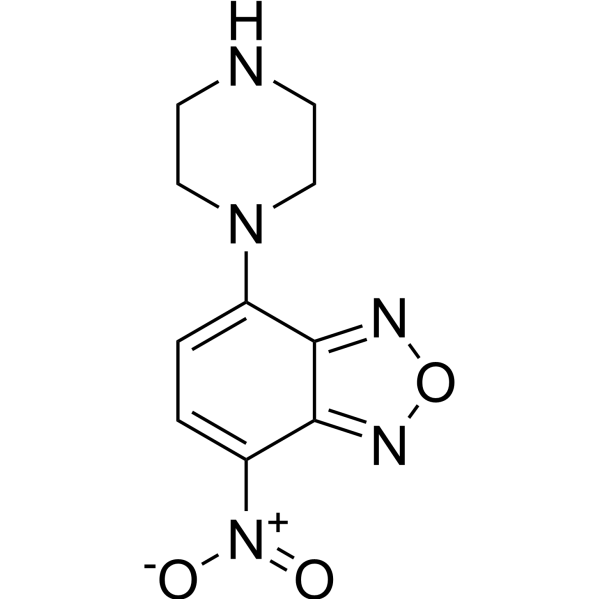 0 ImagesCat. No.: HY-D0136CAS No.: 139332-66-44-Nitro-7-piperazinobenzofurazan is a multifunctional dye. Dyes are important tools in biological experiments. They can help researchers observe and analyze cell structures, track biomolecules, evaluate cell functions, distinguish cell types, detect biomolecules, study tissue pathology and monitor microorganisms. Their applications range from basic scientific research to clinical A wide range of diagnostics. Dyes are also widely used in traditional fields such as textile dyeing, as well as in emerging fields such as functional textile processing, food pigments and dye-sensitized solar cells.
-
FITC-Polysucrose 70
 0 ImagesCat. No.: HY-179074CFITC-Polysucrose 70 is FITC-labeled Polysucrose 70 (HY-131960A). Polysucrose 70 is a high molecular weight branched polysaccharide polymer. Polysucrose 70 is a copolymer of sucrose and epichlorohydrin and can be used for cell separation. FITC-Polysucrose 70 is mainly used for permeability and microcirculation studies (Ex/Em = 488/525 nm).
-
Cy3 labled Tomligisiran sodium
 0 ImagesCat. No.: HY-177667DCy3 labled Tomligisiran sodium is a Cy3 labled Tomligisiran sodium.
-
Sulfo-cyanine3.5 NHS ester tripotassium
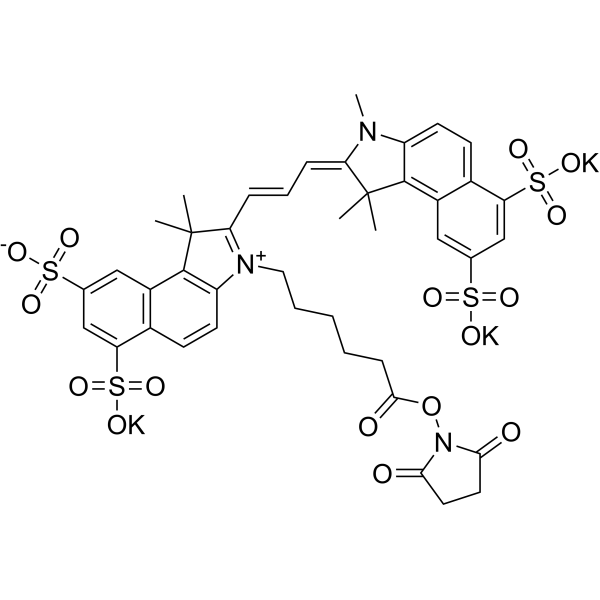 0 ImagesCat. No.: HY-D1310CAS No.: 176978-76-0Sulfo-cyanine3.5 NHS ester tripotassium is a water-soluble cyanine dye that contains NHS ester groups and is amino-reactive.
-
Biotin-tagged KR-33493
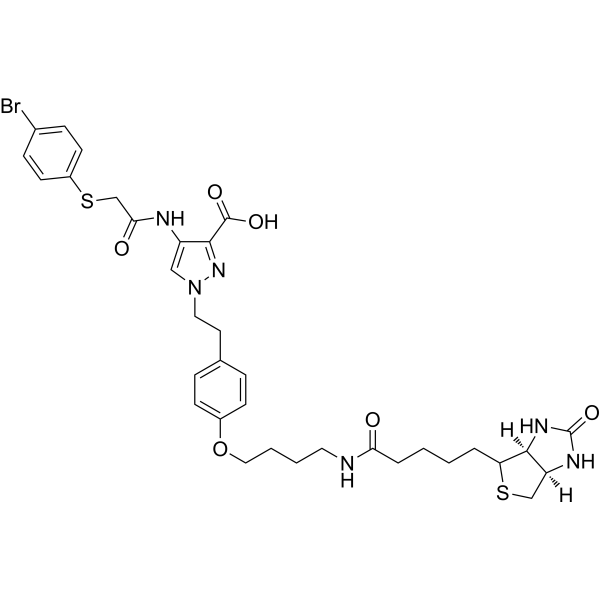 0 ImagesCat. No.: HY-D1033CAS No.: 1872262-53-7Biotin-tagged KR-33493 is a multifunctional dye. Dyes are important tools in biological experiments. They can help researchers observe and analyze cell structures, track biomolecules, evaluate cell functions, distinguish cell types, detect biomolecules, study tissue pathology and monitor microorganisms. Their applications range from basic scientific research to clinical A wide range of diagnostics. Dyes are also widely used in traditional fields such as textile dyeing, as well as in emerging fields such as functional textile processing, food pigments and dye-sensitized solar cells.

-
AF647 Picolyl Azide
 0 ImagesCat. No.: HY-D3584AF647 Picolyl Azide is a far-red fluorescent probe used in bioorthogonal click chemistry. It reacts with terminal alkynes via copper-catalyzed azide-alkyne cycloaddition (CuAAC). The integrated picolyl group chelates copper, which speeds up the reaction and allows for lower copper concentrations to protect sensitive proteins (Ex/Em = 650/665 nm)[1].


-
NBDT
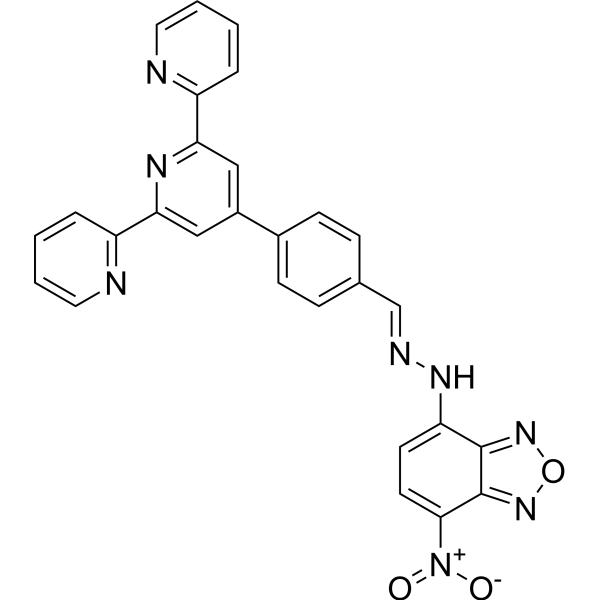 0 ImagesCat. No.: HY-D2115CAS No.: 2376850-99-4NBDT is sensitive and selective light-up fluorescent probe for monitoring gallium and chromium ionsin vitro and in vivo and can be detected at 574 nM.
-
Cy3 labled Vupanorsen sodium
 0 ImagesCat. No.: HY-153497ECy3 labled Vupanorsen sodium is a Cy3 labled Vupanorsen sodium.
-
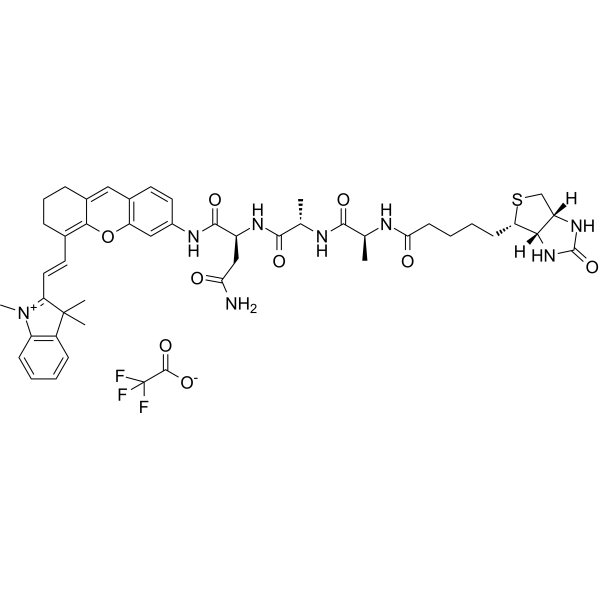
AlDeSense AM
 0 ImagesCat. No.: HY-D3185CAS No.: 2243148-62-9AlDeSense AM is a cell-permeable ALDH1A1-selective fluorescent reporter. AlDeSense AM is oxidized by ALDH1A1, which eliminates photoinduced electron transfer quenching and enhances the fluorescent signal. AlDeSense AM can be used to detect cells with cancer stem cell properties, as well as to monitor the plasticity of cancer stem cells in cell culture systems and animal models. AlDeSense AM is applicable to the study of cancers associated with cancer stem cells, including chronic myeloid leukemia, melanoma, and breast cancer.
-
Cy3 labled Lepodisiran sodium
 0 ImagesCat. No.: HY-177640DCy3 labled Lepodisiran (LY3819469) sodium is a Cy3 labled Lepodisiran sodium. Lepodisiran sodium is a GalNAc-conjugated small interfering RNA lipid-lowering agent. Lepodisiran sodium targets the hepatic LPA gene and degrades apolipoprotein (a) mRNA to silence its expression, thereby effectively reducing the production of apolipoprotein (a) and serum lipoprotein (a) in a dose-dependent manner. Lepodisiran sodium can be used in studies related to atherosclerotic cardiovascular disease.
-
RB-PEG600-NHS
 0 ImagesCat. No.: HY-D2884ASynonyms: Rhodamine B-PEG600-NHSRB-PEG600-NHS (Rhodamine B-PEG600-NHS) is a fluorescent dye composed of Rhodamine B (HY-Y0016), PEG and a hydroxysuccinimide (NHS) group. The NHS group can react with amine-containing groups. RB-PEG600-NHS can be used for fluorescent labeling and imaging (Ex/Em=546/610 nm).
-
Peanut Agglutinin (CY3)
 0 ImagesCat. No.: HY-NP093Synonyms: PNA (CY3)Peanut Agglutinin (PNA) CY3 is a plant lectin that can be used as a probe to specifically bind biomolecules (such as polysaccharides, peptides, etc.).Peanut Agglutinin (PNA) CY3 is a biological material or organic compound that can be used in life science research.
-
Cy3 labled Drisapersen sodium
 0 ImagesCat. No.: HY-145724ECy3 labled Drisapersen sodium is a Cy3 labled Drisapersen sodium.
-
TNO211 TFA
 0 ImagesCat. No.: HY-P5380ASynonyms: Dabcyl-GABA-Pro-Gln-Gly-Leu-Glu(EDANS)-Ala-Lys-NH2 TFATNO211 (Dabcyl-GABA-Pro-Gln-Gly-Leu-Glu(EDANS)-Ala-Lys-NH2) TFA is a fluorogenic substrate, containing the MMP cleavable Gly-Leu bond and EDANS/Dabcyl as fluorophore/quencer combination. TNO211 TFA can specifically detect MMP activity (Ex/Em = 340/485 nm).
-
Cy3 labled RG-101 sodium
 0 ImagesCat. No.: HY-132600ECy3 labled RG-101 sodium is a Cy3 labled RG-101 sodium.




