



Fluorescent Dye
Fluorescence is a phenomenon of photoluminescence in luminescence. When an atom is irradiated by light, some electrons around the nucleus jump from their original orbitals to higher energy orbitals under the influence of light energy, i.e., from the ground state to the first or second excited single-line state, etc. Due to the instability of the first or second excited singlet state, the electron returns from the excited singlet state to the ground state accompanied by released energy, resulting in fluorescence.
Fluorescent dyes can be covalently bound or physically adsorbed in the structure of the substance. The fluorescence properties allow for the characterization, localization and quantitative analysis of the labeled object. Fluorescent dyes have shown great potential for the detection of proteins, nucleic acids, cells, and immunoassays, attributed to the advantages in non-radioactive contamination, simple experimental operation and easy observation.
Fluorescent dyes have penetrated many fields such as pharmacology, physiology, environmental science, and information science, as well as functional studies of proteins and drug screening.
All Product Categories
-
Fluorescent Dye Related Products (4851)
Related Products (4851)

-
Antibodies (4)
-
Mca-KPLGL-Dap(Dnp)-AR-NH2 TFA
 0 ImagesCat. No.: HY-P4931ACAS No.: 1392300-20-7Mca-KPLGL-Dap(Dnp)-AR-NH2 TFA is a fluorogenic substrate for matrix metalloproteinases (MMPs). 7-methoxycoumarin-4 acetyl (Mac) is released and its fluorescence can be used to quantify MMP activity. Mac displays Ex/Em of 328/420 nm.
-
TRITC-Polysucrose 20
 0 ImagesCat. No.: HY-179073TRITC-Polysucrose 20 is TRITC-labeled Polysucrose 20 (HY-131960B). Polysucrose 20 is a copolymer of sucrose and epichlorohydrin. Polysucrose 20 can be used to prepare cross-linked polysucrose microspheres. TRITC-Polysucrose 20 is mainly used for permeability and microcirculation studies (Ex/Em = 544/570 nm).
-
TPE-Ph-In
 0 ImagesCat. No.: HY-D3148CAS No.: 1804107-88-7TPE-Ph-In is a mitochondria-targeted voltage-sensitive probe that can be used for mitochondrial membrane potential detection, mitochondrial imaging of animal and plant cells and tissues, mouse sperm activity indication, and detection of mitochondrial membrane potential changes associated with early apoptosis. TPE-Ph-In is non-fluorescent in solution, but emits strong fluorescence when aggregated via restriction of intramolecular rotation/movement, and its fluorescence intensity is directly correlated with local probe concentration or mitochondrial membrane potential level. TPE-Ph-In can penetrate cell membranes, target mitochondria through charge-dependent accumulation, has low cytotoxicity and high photostability, and enables super-resolution imaging of plant mitochondrial fission, fusion and cristae structures. The excitation wavelengths of TPE-Ph-In include 450 nm, 488 nm, and 489 nm, while its emission wavelengths include 551-661 nm, 660 nm, and 694 nm. TPE-Ph-In can be used for studies on mitochondrial dysfunction associated with early apoptosis.
-
N-(3-Fluoranthenyl)maleimide
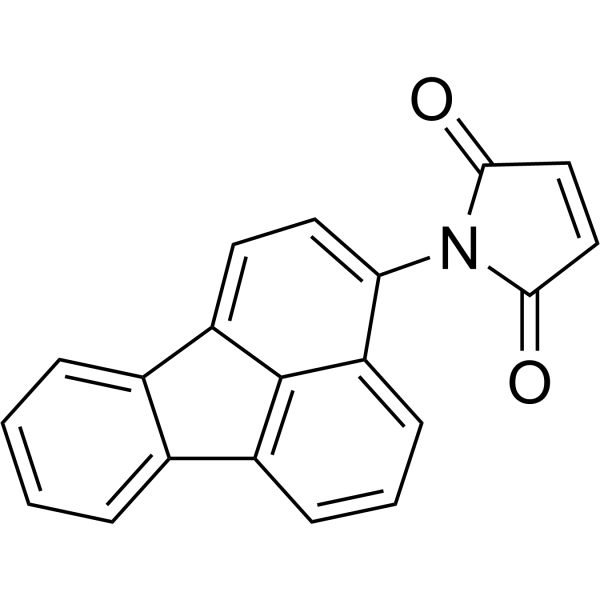 0 ImagesCat. No.: HY-D1527CAS No.: 60354-76-9N-(3-Fluoranthyl)maleimide is a thiol fluorescent probe with a lifetime of 20 nsec. N-(3-Fluoranthyl)maleimide has a maximum excitation wavelength of 370 nm and can be used to study the time-dependent processes of biopolymers.
-
FAM labled RGLS4326 sodium
 0 ImagesCat. No.: HY-139290DFAM labled RGLS4326 sodiumis a FAM labled RGLS4326 sodium.
-
P2-Aggregate
 0 ImagesCat. No.: HY-D3112P2-Aggregate is a polarity-sensitive fluorescent probe for protein aggregation, which is based on the Nile Red scaffold and modified with a morpholine ring to enhance water solubility. P2-Aggregate improves anti-precipitation ability in aqueous phase via morpholine ring modification, and enables site-specific labeling of target proteins by combining with HaloTag technology. Utilizing the property that its emission wavelength blue-shifts with decreasing local polarity (excited at 543 nm), P2-Aggregate quantitatively detects changes in local polarity during protein aggregation and polarity heterogeneity inside aggregates in living cells. P2-Aggregate can be used in the research of diseases associated with the aggregation of Htt-110Q and SOD1 proteins, such as Huntington's disease and amyotrophic lateral sclerosis.
-
C12 NBD Lactosylceramide
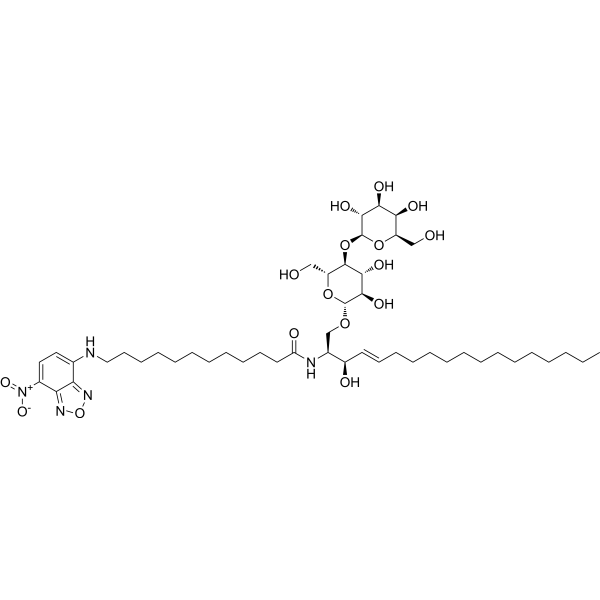 0 ImagesCat. No.: HY-D1580CAS No.: 474943-06-1C12 NBD Lactosylceramide is a derivative of Lactosylceramide labeled with a C12 NBD fluorescent group. C12 NBD Lactosylceramide can be used to identify Lactosylceramides.
-
MCA succinimidyl ester
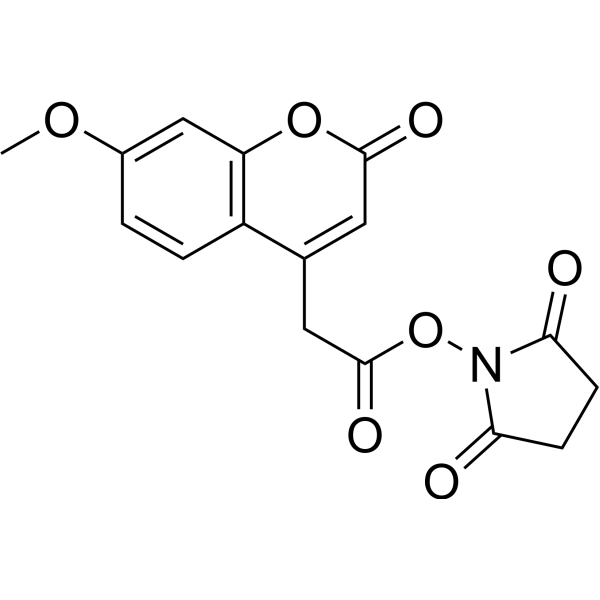 0 ImagesCat. No.: HY-W324458CAS No.: 359436-89-8MCA succinimidyl ester is a derivative of MCA (HY-W027544). MCA succinimidyl ester has succinimidyl ester can react selectively with amines. MCA succinimidyl ester can be used as peptide substrate for fluorescence resonance energy transfer.
-
BOD-NH-NP
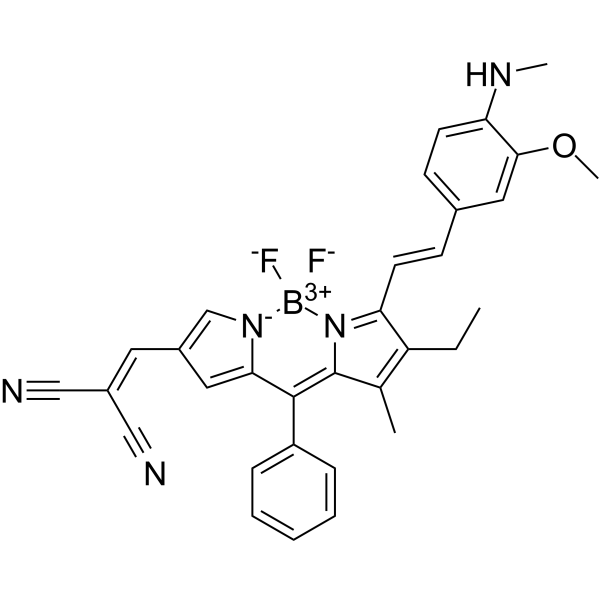 0 ImagesCat. No.: HY-145882CAS No.: 3004972-07-7BOD-NH-NP is an activatable fluorescent probe for imaging endogenous nitric oxide via the eNOS enzymatic pathway.
-
(±)-ANAP
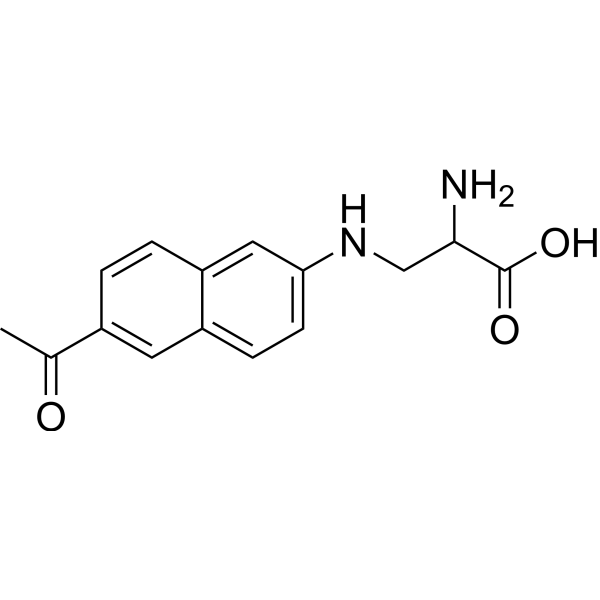 0 ImagesCat. No.: HY-101937ACAS No.: 1185251-08-4(±)-ANAP is the unnatural amino acid analog of prodan, acts as a fluorescent probes, and enhances environmental sensitivity.
-
FAM labled Viltolarsen sodium
 0 ImagesCat. No.: HY-132586DFAM labled Viltolarsen sodiumis a FAM labled Viltolarsen sodium.
-
Boc-Leu-Ser-Thr-Arg-AMC
 0 ImagesCat. No.: HY-P2715CAS No.: 73554-93-5Boc-Leu-Ser-Thr-Arg-AMC is a fluorogenic AMC-linked protease substrate.
-
AMCA-PEG4-azide
 0 ImagesCat. No.: HY-D3338AMCA-PEG4-azide is a derivative of AMCA (aminomethylcoumarin acetate) , a blue fluorescent coumarin dye. It features azide group for click chemistry (CuAAC) ; PEG4 linker for improved solubility and reduced steric hindrance. Main applications: click chemistry-based bioconjugation. Commonly used in fluorescence microscopy, flow cytometry, immunoassays, and nucleic acid detection. (Ex/Em = 347/444 nm)

-
Fluorescent Red Mega 485 NHS-ester
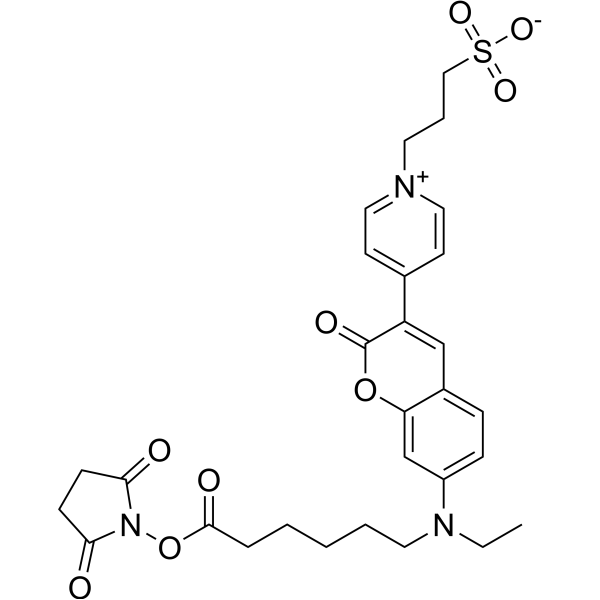 0 ImagesCat. No.: HY-D1496CAS No.: 890317-36-9Fluorescent Red Mega 485 NHS-ester is an amine conjugating fluorescent biolabel that can be used to label proteins.
-
Cy3 labled Cadapersen sodium
 0 ImagesCat. No.: HY-177620DCy3 labled Cadapersen sodium is a Cy3 labled Cadapersen sodium.

-
ATTO 620
 0 ImagesCat. No.: HY-D2043ATTO 620 is a new type of fluorescent dye with high fluorescence yield, which can be used for most labeling applications, maximum excitation/emission wavelength: 620/642 nm.
-
Dusquench2 NHS ester
 0 ImagesCat. No.: HY-D3350Dusquench2 NHS ester is a non-fluorescent quencher containing an amine-reactive group, which can be used to label amine-modified oligonucleotides, amine-containing proteins and other molecules. The maximum absorption wavelength of Dusquench2 NHS ester is 552 nm. Dusquench2 NHS ester can serve as an acceptor in fluorescence resonance energy transfer (RET) and nucleic acid detection applications.
-
Pyrromethene 605
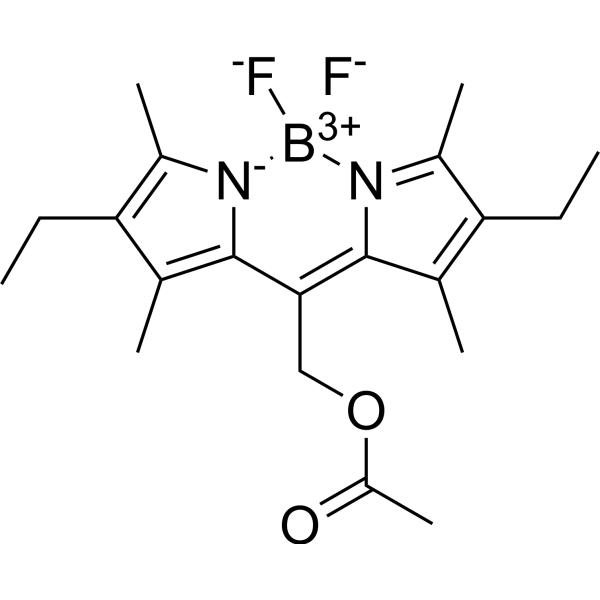 0 ImagesCat. No.: HY-D1777CAS No.: 137829-80-2Synonyms: PM605Pyrromethene 605 (PM605) is a green-fluorescent polar tracer dye. It is used for investigations of membrane fusion, lysis, and gap-junctional communication and to detect volume changes in cells or liposomes.




