



5,5'-Difluoro BAPTA
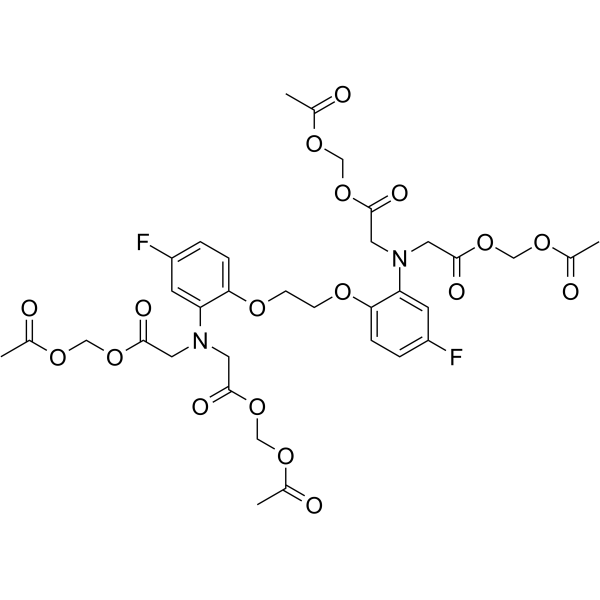
5,5'-Difluoro BAPTA is a difluoro-derivative of BAPTA (HY-100168). 5,5'-Difluoro BAPTA is the most widely used probe for studying cytosolic free Ca2+ by 19F NMR. 5,5'-Difluoro BAPTA has high selectivity for Ca2+. 5,5'-Difluoro BAPTA can inhibit the growth of pollen tube.
For research use only. We do not sell to patients.
- CAS No.: 156027-00-8
- Formula: C34H38F2N2O18
- Molecular Weight:800.66
-
Storage:
Please store the product under the recommended conditions in the Certificate of Analysis.

To place orders, for customer services and technical support, please contact: MedChemExpress USA
Tel: 609-228-6898 E-mail: [email protected] [email protected]


-
 Biological Activity
-
Chemical Information
- Protocols
- Purity & Documentation
- References
-
 Help & FAQs




Biological Activity
Description
In Vitro
5,5'-Difluoro BAPTA shows large 19F NMR chemical shifts upon chelating divalent cations[1].
Fe2+ ion concentrations were measured following addition of 5 mM 5,5'-Difluoro BAPTA to the culture medium. Fe2+ forms a complex with 5,5'-Difluoro BAPTA (Kd=50 nM) that exhibits a characteristic peak down-field from biological ions such as Ca2+ and Zn2+[3].
MedChemExpress (MCE) has not independently confirmed the accuracy of these methods. They are for reference only. Further protocols information, click here.


Chemical Information
-
CAS No. 156027-00-8
-
Molecular Weight 800.66
-
Formula C34H38F2N2O18
-
SMILES
O=C(C)OCOC(CN(CC(OCOC(C)=O)=O)C1=CC(F)=CC=C1OCCOC2=CC=C(C=C2N(CC(OCOC(C)=O)=O)CC(OCOC(C)=O)=O)F)=O
-
Shipping
Room temperature in continental US; may vary elsewhere.
-
Storage
Please store the product under the recommended conditions in the Certificate of Analysis.

Protocols
-
Ca2+ Staining Technique
Ca2+ staining is an experimental technique that utilizes specific fluorescent probes (such as Fluo-4 AM, Fura-2, etc.) to qualitatively or quantitatively detect dynamic changes in intracellular Ca2+ concentrations; this is achieved by monitoring the changes in fluorescent signals generated when these probes bind to free intracellular calcium ions. The underlying principle relies primarily on the presence of chelating groups within the probe's molecular structure that possess high affinity for calcium ions.


Purity & Documentation
References
[1]. Bar-Shir A, et al. Metal ion sensing using ion chemical exchange saturation transfer 19F magnetic resonance imaging. J Am Chem Soc. 2013 Aug 21;135(33):12164-7. [Content Brief]
[2]. Pierson ES, et al. Pollen tube growth is coupled to the extracellular calcium ion flux and the intracellular calcium gradient: effect of BAPTA-type buffers and hypertonic media. Plant Cell. 1994 Dec;6(12):1815-28. [Content Brief]
[3]. Kostellow AB, et al. Iron-catalyzed lipid peroxidation in aortic cells in vitro: protective effect of extracellular magnesium. Atherosclerosis. 2004 Jul;175(1):15-22. [Content Brief]

Calculators
Concentration (start) × Volume (start) = Concentration (final) × Volume (final)


5,5'-Difluoro BAPTA Related Classifications
HY-147186 Related Classifications
 Powered by Bioz