



Fluorescent Dye
Fluorescence is a phenomenon of photoluminescence in luminescence. When an atom is irradiated by light, some electrons around the nucleus jump from their original orbitals to higher energy orbitals under the influence of light energy, i.e., from the ground state to the first or second excited single-line state, etc. Due to the instability of the first or second excited singlet state, the electron returns from the excited singlet state to the ground state accompanied by released energy, resulting in fluorescence.
Fluorescent dyes can be covalently bound or physically adsorbed in the structure of the substance. The fluorescence properties allow for the characterization, localization and quantitative analysis of the labeled object. Fluorescent dyes have shown great potential for the detection of proteins, nucleic acids, cells, and immunoassays, attributed to the advantages in non-radioactive contamination, simple experimental operation and easy observation.
Fluorescent dyes have penetrated many fields such as pharmacology, physiology, environmental science, and information science, as well as functional studies of proteins and drug screening.
All Product Categories
-
Fluorescent Dye Related Products (4914)
Related Products (4914)

-
Antibodies (4)
-
RB-PEG600-Mal
 0 ImagesCat. No.: HY-D2885ASynonyms: Rhodamine B-PEG600-MalRB-PEG600-Mal (Rhodamine B-PEG600-Mal) is a fluorescent dye composed of Rhodamine B (HY-Y0016), PEG and Maleimide (HY-W007324) (Mal). RB-PEG600-Mal can be used for fluorescent labeling and imaging (Ex/Em=546/610 nm).
-
AM4-66
 0 ImagesCat. No.: HY-D3385AM4-66 is a fluorescent dye used for cell membrane surface labeling. AM4-66 serves as a cell membrane surface marker and can label intact plasma membranes; when used sequentially with fluid-phase endocytosis markers such as fluorescent dextran, it does not stain dextran-positive intracellular structures that have detached from the cell surface, thus confirming that these internalized membranes no longer belong to the intact cell membrane surface (Ex/Em = 510/750 nm).
-
FAM labled ATU027 sodium
 0 ImagesCat. No.: HY-153482DFAM labled ATU027 sodiumis a FAM labled ATU027 sodium.
-
BODIPY 480/508-cholesteryl oleate
 0 ImagesCat. No.: HY-113217FBODIPY 480/508-cholesteryl oleate is a fluorescently tagged derivative of Cholesteryl oleate (HY-113217). BODIPY 480/508-cholesteryl oleate can be used to monitor lipid transport mechanisms in mammalian cells (Ex/Em = 480/508 nm).
-
Cy3 labled Mipomersen sodium
 0 ImagesCat. No.: HY-108764DCy3 labled Mipomersen sodium is a Cy3 labled Mipomersen sodium.

-
Narcissus Pseudonarcissus (Daffodil) Lectin (Biotinylated)
 0 ImagesCat. No.: HY-NP154Synonyms: NPL (Biotinylated)Narcissus Pseudonarcissus (Daffodil) Lectin Biotinylated is a plant lectin that can be used as a probe to specifically bind biomolecules (such as polysaccharides, peptides, etc.). Narcissus Pseudonarcissus (Daffodil) Lectin Biotinylated is a biological material or organic compound that can be used in life science research.
-
NSP-DMAE-HEG-Giu-NHS
 0 ImagesCat. No.: HY-171491CAS No.: 1253933-74-2NSP-DMAE-HEG-Giu-NHS (Fig.18) is an activated labeling reagent containing acridine ester, and it is a key component of Cyclosporine A (HY-B0579) tracers.
-
FAM labled Afovirsen sodium
 0 ImagesCat. No.: HY-177610CFAM labled Afovirsen sodiumis a FAM labled Afovirsen sodium.
-
Cy5-PEG3400-DSPE
 0 ImagesCat. No.: HY-D2543Cy5-PEG3400-DSPE is a PEG phospholipid with Cy5 (HY-D0821) dye used in protein/nucelic acid labeling and fluorescence microscopy. Cy5-PEG3400-DSPE can self-assemble in aqueous solution to form micelles/lipid bilayer and used to prepare liposomes or nanoparticles for nutrients delivery such as mRNA or DNA vaccine.
-
Ctrl-CSR1
 0 ImagesCat. No.: HY-D3281CAS No.: 1949810-17-6Ctrl-CSR1 is a non-responsive CSR1 control dye and a matched control dye with a photostable, hydrophilic silicon rhodol backbone. Ctrl-CSR1 lacks a copper-responsive receptor.
-
Cy3 labled Tivanisiran sodium
 0 ImagesCat. No.: HY-132596ECy3 labled Tivanisiran sodium is a Cy3 labled Tivanisiran sodium.
-
RB-PEG2000-Mal
 0 ImagesCat. No.: HY-D2885CSynonyms: Rhodamine B-PEG2000-MalRB-PEG2000-Mal (Rhodamine B-PEG2000-Mal) is a fluorescent dye composed of Rhodamine B (HY-Y0016), PEG and Maleimide (HY-W007324) (Mal). RB-PEG2000-Mal can be used for fluorescent labeling and imaging (Ex/Em=546/610 nm).
-
FM 2-10
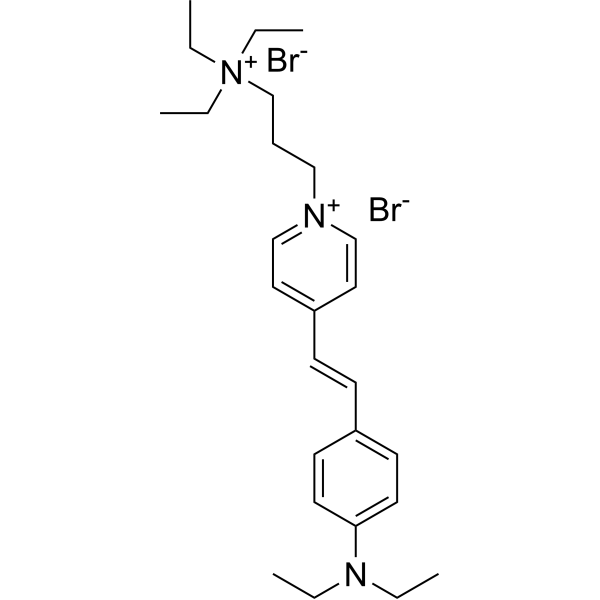 0 ImagesCat. No.: HY-D1517CAS No.: 336185-20-7FM 2-10 is a fluorescent dye. FM 2-10 is a less hydrophobic version of FM 1-43 (HY-D1434). FM 2-10 can be used for identifying actively firing neurons and investigating the mechanisms of activity-dependent vesicle cycling.
-
Lens Culinaris Agglutinin (Fluorescein)
 0 ImagesCat. No.: HY-NP0134Synonyms: LCA (Fluorescein)Lens Culinaris Agglutinin (LCA) Fluorescein is a plant lectin that can be used as a probe to specifically bind biomolecules (such as polysaccharides, peptides, etc.).Lens Culinaris Agglutinin (LCA) Fluorescein is a biological material or organic compound that can be used in life science research.
-
Dihydrotetramethylrosamine
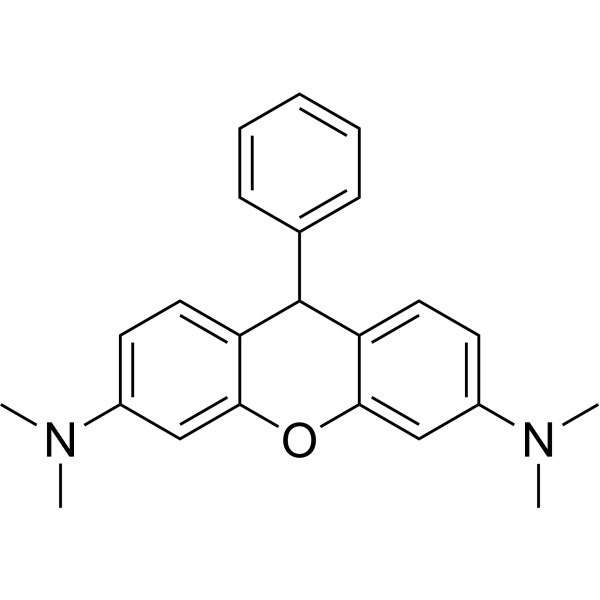 0 ImagesCat. No.: HY-D1740CAS No.: 105284-17-1Synonyms: DHTM RosDihydrotetramethylrosamine (DHTM Ros) is a fluorogenic substrate for peroxidase that oxidizes to fluorescent tetramethylrosamine chloride.
-
PiF
 0 ImagesCat. No.: HY-D3174CAS No.: 2688758-23-6PiF is a fluorescent probe with high specificity for pancreatic β-cells (Ex/Em = 535 nm/565 nm), and its fluorescence signal increases significantly with elevated insulin concentrations in in vitro experiments. PiF enables visualization of rat and human islets transplanted via the portal vein in mouse livers with low liver background signals. The fluorine atom of PiF can be replaced by radioactive 18F to prepare a PET tracer. PiF can be used for research on type 1 diabetes.
-
FITC-PLL
 0 ImagesCat. No.: HY-D2817FITC-PLL is a fluorescently labeled polycationic polypeptide probe composed of polylysine (PLL) and FITC (HY-66019), with a typical Ex/Em of 495/520 nm. The fluorescence intensity and lifetime of FITC-PLL are sensitive to pH and FITC density. FITC-PLL can be used for quantifying hapten receptor binding and endocytosis kinetics in macrophages, as a patternable substrate for neuron guidance, for negatively charged phospholipid membrane binding and transmembrane transport, and for live-cell imaging of starch nanoparticle conjugates and lysosome labeling.




