



Fluorescent Dye
Fluorescence is a phenomenon of photoluminescence in luminescence. When an atom is irradiated by light, some electrons around the nucleus jump from their original orbitals to higher energy orbitals under the influence of light energy, i.e., from the ground state to the first or second excited single-line state, etc. Due to the instability of the first or second excited singlet state, the electron returns from the excited singlet state to the ground state accompanied by released energy, resulting in fluorescence.
Fluorescent dyes can be covalently bound or physically adsorbed in the structure of the substance. The fluorescence properties allow for the characterization, localization and quantitative analysis of the labeled object. Fluorescent dyes have shown great potential for the detection of proteins, nucleic acids, cells, and immunoassays, attributed to the advantages in non-radioactive contamination, simple experimental operation and easy observation.
Fluorescent dyes have penetrated many fields such as pharmacology, physiology, environmental science, and information science, as well as functional studies of proteins and drug screening.
All Product Categories
-
Fluorescent Dye Related Products (4914)
Related Products (4914)

-
Antibodies (4)
-
Mag-Fura-2 tetrapotassium
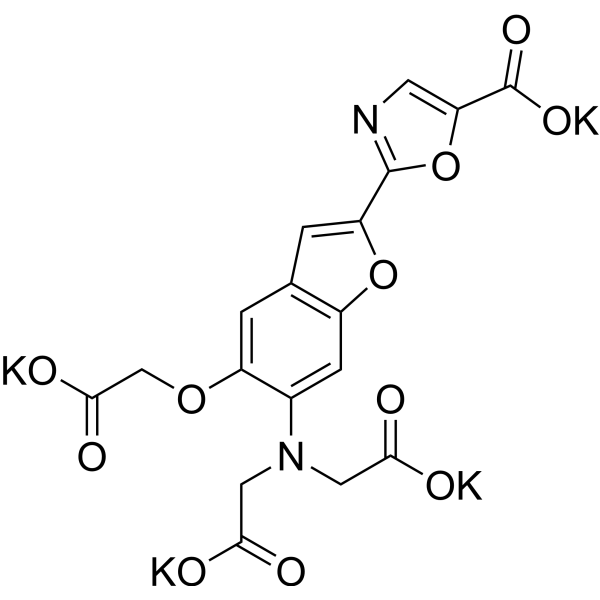 0 ImagesCat. No.: HY-D1702CAS No.: 132319-57-4Mag-Fura-2 tetrapotassium is a cell-impermeant UV excitable rational fluorescent Mg2+/Ca2+ indicator (Ex=334-360 nm, Em=510 nm). Mag-Fura-2 tetrapotassium can be used for the determination of Mg2+ and Ca2+ concentrations.
-
Abz-LVEALYQ-EDDnp
 0 ImagesCat. No.: HY-P12221CAS No.: 1000184-52-0Abz-LVEALYQ-EDDnp is a fluorescence resonance energy transfer (FRET) oligopeptide substrate containing a peptide bond that is specifically recognized and cleaved by snake venom metalloproteinases (SVMP). Abz-LVEALYQ-EDDnp is specifically hydrolyzed by SVMP, resulting in the physical separation of the Abz fluorophore and the EDDnp quencher, which relieves the quenching effect and releases a detectable fluorescent signal.. Abz-LVEALYQ-EDDnp is used for research on inflammatory pain and antivenom (Ex/Em = 320-340/420-440 nm).
-
Cy3-PEG5000-SH
 0 ImagesCat. No.: HY-D2512Cy3-PEG5000-SH is a fluorescent labeling reagent that combines Cy3 (HY-D0822) fluorescent dye, polyethylene glycol (PEG) and sulfhydryl (SH) derivatives, and is suitable for molecular coupling. SH is highly reactive and can react with a variety of functional groups (such as maleimide) to form stable thioether bonds.
-
1,2-Diamino-3,4-ethylenedioxybenzene
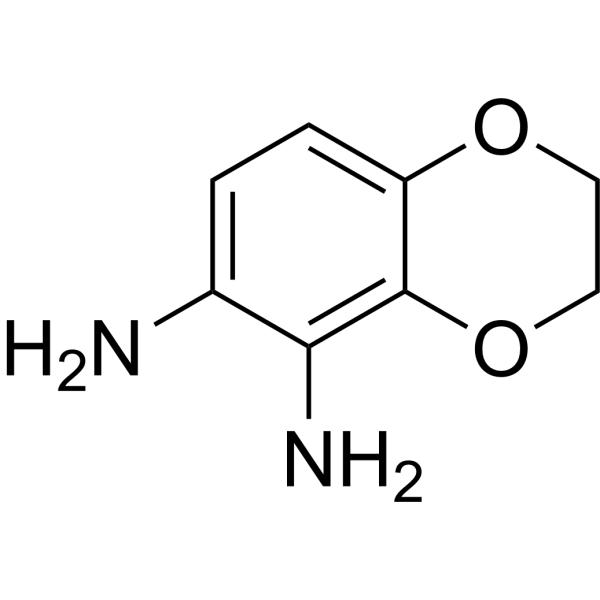 0 ImagesCat. No.: HY-W324406CAS No.: 320386-55-81,2-Diamino-3,4-ethylenedioxybenzene is a carbonyl-reactive fluorometric labeling agent.
-
Cy3 labled Viltolarsen sodium
 0 ImagesCat. No.: HY-132586ECy3 labled Viltolarsen sodium is a Cy3 labled Viltolarsen sodium.
-
Cy3 labled GPI2A sodium
 0 ImagesCat. No.: HY-177636DCy3 labled GPI2A sodium is a Cy3 labled GPI2A sodium.
-
LRhod-PM
 0 ImagesCat. No.: HY-D3437LRhod-PM is a photo-activated plasma membrane fluorescent probe based on a self-initiating photo-oxidation cascade mechanism. LRhod-PM, a non-fluorescent reduced rhodamine, is oxidized to the fluorescent form Rhod-PM upon visible light irradiation. LRhod-PM has maximum excitation and emission wavelengths of 560 nm and 585 nm, respectively. LRhod-PM enables wash-free labeling of the plasma membrane of living cells, including fine structures such as filopodia and tunneling nanotubes. LRhod-PM can be used in studies related to single-molecule localization super-resolution imaging of living cells.
-
Cy5-PEG10000-DSPE
 0 ImagesCat. No.: HY-D2545Cy5-PEG10000-DSPE is a PEG phospholipid with Cy5 (HY-D0821) dye used in protein/nucelic acid labeling and fluorescence microscopy. Cy5-PEG10000-DSPE can self-assemble in aqueous solution to form micelles/lipid bilayer and used to prepare liposomes or nanoparticles for nutrients delivery such as mRNA or DNA vaccine.
-
TRITC-Polysucrose 400
 0 ImagesCat. No.: HY-179073CTRITC-Polysucrose 400 is TRITC-labeled Polysucrose 400 (HY-131960). TRITC-Polysucrose 400 is mainly used for permeability and microcirculation studies (Ex/Em = 544/570 nm).

-
Acid yellow 199
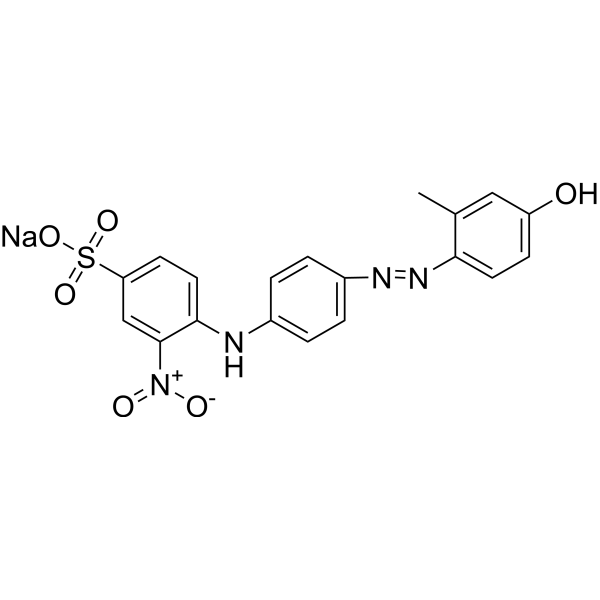 0 ImagesCat. No.: HY-D0676CAS No.: 70865-20-2Acid yellow 199 is an azo dye that can be decolorized through reduction reaction.
-
Cy5-PEG5000-N3
 0 ImagesCat. No.: HY-D2535Cy5-PEG5000-N3 is a Cy5 (HY-D0821)-azide fluorescent dye used to label for protein and nucleic acid. Cy5-PEG5000-N3 is a click chemistry reagent, it contains an Azide group and can undergo copper-catalyzed azide-alkyne cycloaddition reaction (CuAAc) with molecules containing Alkyne groups. It can also undergo strain-promoted alkyne-azide cycloaddition (SPAAC) reactions with molecules containing DBCO or BCN groups.
-
JAS239
 0 ImagesCat. No.: HY-123612JAS239 is a blood-brain barrier-permeable ChoK inhibitor. JAS239 inhibits phosphocholine synthesis and reduces the expression level of E2F1 protein. JAS239 exhibits near-infrared fluorescence properties. JAS239 exerts anti-tumor activity against glioblastoma. JAS239 can be used in studies related to glioblastoma.
-
FAM labled Tilsotolimod sodium
 0 ImagesCat. No.: HY-150212DFAM labled Tilsotolimod sodiumis a FAM labled Tilsotolimod sodium.
-
BOP-JF646
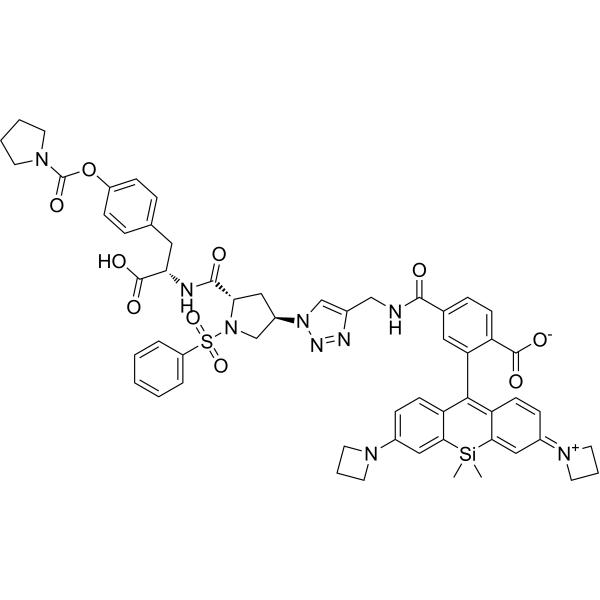 0 ImagesCat. No.: HY-D1284BOP-JF646 is a multifunctional dye. Dyes are important tools in biological experiments. They can help researchers observe and analyze cell structures, track biomolecules, evaluate cell functions, distinguish cell types, detect biomolecules, study tissue pathology and monitor microorganisms. Their applications range from basic scientific research to clinical A wide range of diagnostics. Dyes are also widely used in traditional fields such as textile dyeing, as well as in emerging fields such as functional textile processing, food pigments and dye-sensitized solar cells.
-
ATTO 647
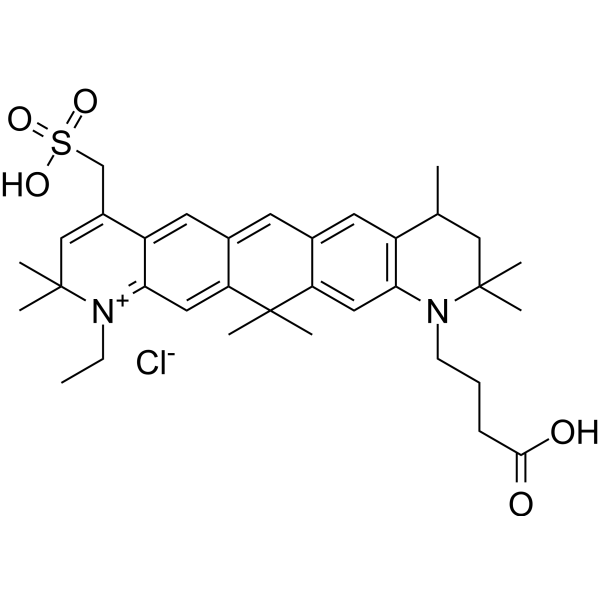 0 ImagesCat. No.: HY-D1991CAS No.: 906664-68-4ATTO 647 is a carborhodamine fluorophore and imaging tracer with photostable properties. ATTO 647 serves as a fluorescent probe to investigate cell membrane structure and diffusion characteristics. When conjugated with wheat germ agglutinin, ATTO 647 specifically binds to N-acetyl-β-D-glucosamine and sialic acid residues on membrane glycoproteins, enabling single-molecule tracing of glycoprotein diffusion. ATTO 647 exhibits highly stable fluorescence properties with significantly reduced blinking in mounting media such as ROXS (AA/MV) and ROXS (TX/TQ), whereas its brightness properties vary in Ibidi-MM and Vectashield. ATTO 647 can also be used to label histone H2B-GFP in fixed cells for confocal microscopy photobleaching experiments.
-
FITC-PEG400-N3
 0 ImagesCat. No.: HY-D2802FITC-PEG400-N3 is a fluorescent agent conjugated with FITC and an azide group, which can be used to synthesize fluorescent probes via click chemistry reactions. FITC-PEG400-N3 and its related probe molecules can be applied to targeted imaging, tissue distribution and drug delivery studies of prostate cancer (including castration-resistant prostate cancer), such as serving as a subcellular localization tool for GnRH-II binding proteins. Among them, the excitation wavelength of FITC-N3 is approximately 494 nm, and its emission wavelength is approximately 520 nm.

-
ALP Green
 0 ImagesCat. No.: HY-D3008CAS No.: 3032633-52-3ALP Green (Probe 4) is an amphiphilic ALP fluorescent probe (Em = 550 nm). ALP Green can be used in the research of APAP (HY-66005)-induced liver injury.
-
Lycopersicon esculentum (Tomato) Lectin-AF680
 0 ImagesCat. No.: HY-NP071ISynonyms: LEL-AF680Lycopersicon esculentum (Tomato) Lectin-AF680 (LEL-AF680) is Lycopersicon esculentum lectin (LEL) labeled with the AF680 fluorescent dye. Lycopersicon esculentum (Tomato) lectin specifically recognizes and binds to glycan structures, primarily targeting N-acetyl-β-D-glucosamine residues. Lycopersicon esculentum (Tomato) Lectin-AF680 can be used to study glycosylation and localize glycan structures on cell surfaces and in tissue sections (Ex/Em = 684/707 nm).




