



PIN1
peptidylprolyl cis/trans isomerase, NIMA-interacting 1
PIN1 is a peptidyl-prolyl isomerase (PPIase) that specifically recognizes the pSer/Thr-Pro motif, catalyzes the cis and trans isomerization of the proline amide bond, changes the conformation of the substrate protein, thereby affecting its function, stability or intracellular localization. PIN1 regulates cell cycle proteins such as cyclin D, cyclin E, and CDC25, thereby regulating the G1-S process and mitotic progression. PIN1 regulates the stability of proteins such as p53 and p73, responds to stress signals such as DNA damage, and thus affects cell cycle arrest or apoptosis. PIN1 regulates the phosphorylation of tau protein, mediating the neurological functions. PIN1 regulates transcription factors such as NF-κB and JUN, mediates immune responses. PIN1 dysfunction could lead to Alzheimer's disease, cancer, asthma, or microbial infection[1][2].
All Product Categories
-
PIN1 Related Products (33)
Related Products (33)

-
Antibodies (2)
- 1
- 2

-
ZL-Pin01
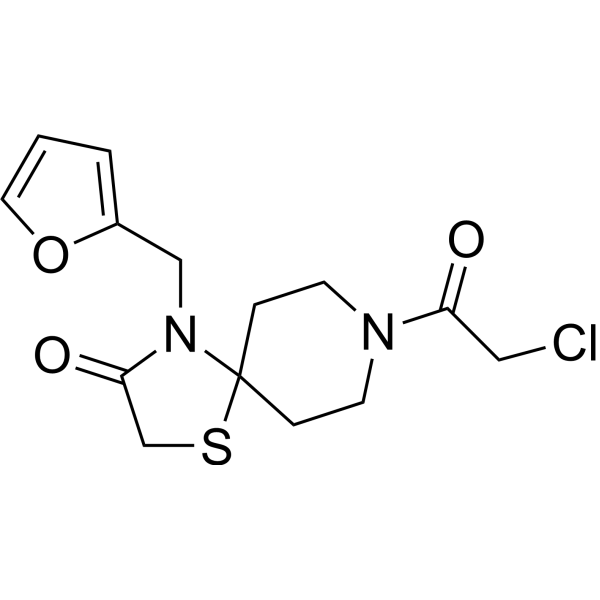 0 ImagesCat. No.: HY-143902CAS No.: 1047464-92-5ZL-Pin01 is a high potent covalent Pin1 (Peptidyl-Prolyl Isomerase NIMA-Interacting-1) inhibitor. ZL-Pin01 shows potent disruption of the Pin1-substrate interaction with an IC50 of 1.33 μM.

-
PIN1 degrader-2
 0 ImagesCat. No.: HY-164896CAS No.: 3080918-74-4PIN1 degrader-2 is a covalent PIN1 degrader with an IC50 of 4.1 nM. PIN1 degrader-2 induces a decrease in the thermal stability of PIN1 and triggers concentration-dependent PIN1 degradation in various cancer cells. PIN1 degrader-2 covalently modifies PIN1 Cys113. PIN1 degrader-2 also reduces the cell viability of pancreatic cancer, breast cancer, prostate cancer and lung cancer cells. PIN1 degrader-2 can be used in research related to pancreatic cancer, breast cancer, prostate cancer and non-small cell lung cancer.
-
(R)-PIN1 ligand-2
 0 ImagesCat. No.: HY-171442A(R)-PIN1 ligand-2 is a PIN1 ligand, and can be used for synthesis of PROTACs, such as P1D-34 (HY-171334A).

-
API32
 0 ImagesCat. No.: HY-168872CAS No.: 162320-41-4
-
BJP-07-017-3
 0 ImagesCat. No.: HY-170429CAS No.: 2468783-22-2
-
Poloxipan
 0 ImagesCat. No.: HY-12135CAS No.: 1239513-63-3Poloxipan is a pan-specific polo-like kinase (PLK) inhibitor that can inhibit a non-catalytic region at the C-terminus called the Polo-box domain (PBD) found in kinases. The IC50 values for Poloxipan against the PBDs of PLK-1/2/3 are 3.2 μM, 1.7 μM, and 3.0 μM, respectively. Poloxipan also inhibits other phospho-tyrosine binding domains, such as the forkhead-associated (FHA) domain of CHK-2, the WW domain of peptidyl-prolyl cis/trans isomerase (PIN1), and the phospho-tyrosine binding domains of STAT1/3/5 and lymphocyte-specific protein tyrosine kinase's SH2 domain. Poloxipan can be used in cancer research.
-
L-Balenine
 0 ImagesL-Balenine is an orally active Pin1 inhibitor and intracellular pH buffer. L-Balenine enhances the phagocytic activity of macrophages, and promotes the expression of pro-inflammatory and anti-inflammatory cytokines during muscle degeneration. L-Balenine also upregulates the expression of myogenic marker genes associated with regeneration, thereby effectively driving skeletal muscle regeneration. L-Balenine can be widely used in studies related to skeletal muscle injury and its repair mechanisms.

-
BJP-06-005-3
 0 ImagesCat. No.: HY-187694CAS No.: 2400958-08-7BJP-06-005-3 is a selective Pin1 inhibitor with a Ki value of 48 nM. BJP-06-005-3 induces the degradation of mutant KRAS. BJP-06-005-3 inhibits pancreatic ductal adenocarcinoma via the Pin1-mediated pathway. BJP-06-005-3 is used in studies related to KRAS-mutant pancreatic ductal adenocarcinoma.
-
PIN1 inhibitor 6
 0 ImagesCat. No.: HY-W843265CAS No.: 637325-53-2
- 1
- 2




