



Anti-TSHR Antibody (M22)

Based on 1 Customer Validation
Anti-TSHR Antibody (M22) is a selective agonist targeting TSHR (thyroid-stimulating hormone receptor), acting through competitive binding to the extracellular domain of TSHR. Anti-TSHR Antibody (M22) can mimic the biological effects of thyroid-stimulating hormone (TSH), activating downstream cAMP-PKA and other signaling pathways. Anti-TSHR Antibody (M22) can stimulate the proliferation of thyroid follicular epithelial cells and human umbilical vein endothelial cells (HUVECs), promote angiogenesis and tube formation, cell migration, and also upregulate the expression of angiogenesis-related proteins such as PROX1. Anti-TSHR Antibody (M22) can be used in research areas such as the mechanisms of goiter formation in Graves' disease (GD), angiogenesis regulation, and TSHR antagonist screening.
For research use only. We do not sell to patients.
- Purity : 98.56%
- Molecular Weight:145.17 kDa
-
Storage:
Please store the product under the recommended conditions in the Certificate of Analysis.


To place orders, for customer services and technical support, please contact: MedChemExpress USA
Tel: 609-228-6898 E-mail: [email protected] [email protected]


-
 Biological Activity
-
Chemical Information
- Purity & Documentation
- References
-
 Help & FAQs


-

HY-P990534
Anti-TSHR Antibody (K1-70) -
HY-13259
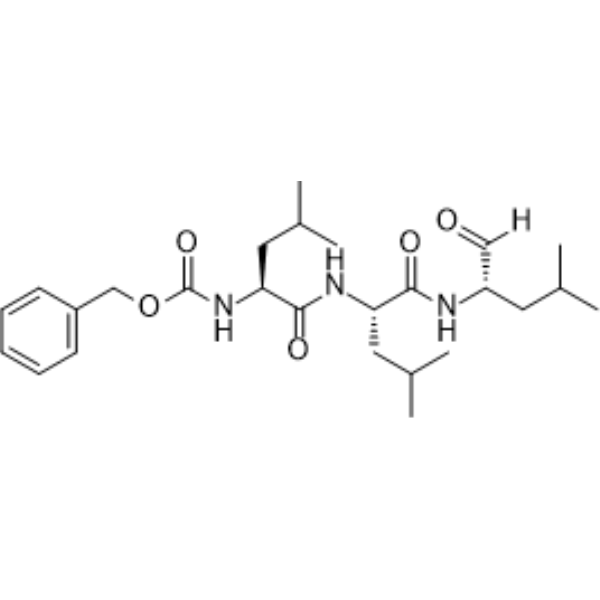
MG-132 -
HY-15772
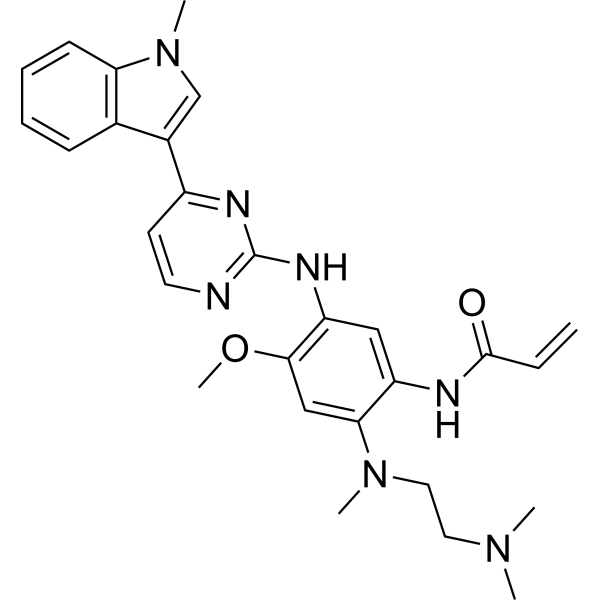
Osimertinib -
HY-P9903
Nivolumab -

HY-P99165
Teprotumumab -

HY-P99187
Bococizumab -
HY-P99001
Human IgG1 kappa, Isotype Control -
HY-112582C
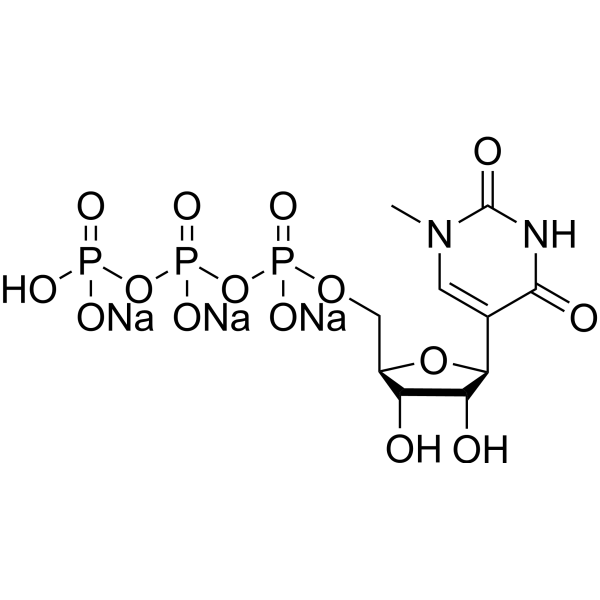
N1-Methylpseudouridine-5′-triphosphate trisodium solution (100 mM) -
HY-P99992
Human IgG1 lambda1, Isotype Control -

HY-158100
SYD5115


Biological Activity
Description
Isotype
Human IgG1 lambda
Recommend Isotype Controls
Species Reactivity
Human
IC50 & Target
TSHR
In Vitro
Anti-TSHR Antibody (M22) (0.125-8 μg/mL; 24-72 h) promotes the proliferation of human thyroid follicular epithelial cells (Nthy-ori 3-1) and human umbilical vein endothelial cells (HUVECs) in a dose- and time-dependent manner[1].
Anti-TSHR Antibody (M22) (0.125, 0.5 μg/mL; 4-12 h) promotes the tube formation ability of HUVECs in a dose-dependent manner, with improvements in parameters such as total branch length and mesh area[1].
Anti-TSHR Antibody (M22) (0.5 μg/mL; 12 h) significantly promotes the migration of HUVECs[1].
Anti-TSHR Antibody (M22) (0, 0.5 μg/mL; 72 h) induces the significant upregulation of 16 proteins and the significant downregulation of 24 proteins in HUVECs, among which PROX1 protein, closely related to angiogenesis, which is the most significantly upregulated[1].
MedChemExpress (MCE) has not independently confirmed the accuracy of these methods. They are for reference only.
-
Cell Line:HUVECs (human umbilical vein endothelial cells)
-
Concentration:0 μg/mL, 0.125 μg/mL, 0.5 μg/mL
-
Incubation Time:12 hours
-
Result:Significantly increased the migratory rate of HUVECs, as reflected by the higher ratio of the healed scratch area to the initial area compared to the control and 0.125 μg/mL M22 groups.
In Vivo
MedChemExpress (MCE) has not independently confirmed the accuracy of these methods. They are for reference only.
-
Animal Model:BALB/c mice (female, 18.7 g, 8-13 weeks old) T3-pretreated model to inhibit endogenous TSH effects[2]
-
Dosage:0.5 μg (PBS)
-
Administration:single dose
-
Result:Significantly increased the serum free T4 (FT4) level by 2.8-fold compared with the T3-treated control group.
Also elevated the mRNA levels of sodium-iodide cotransporter (NIS) and thyroperoxidase (TPO) in thyroid tissues by 4.0-fold and 6.1-fold, respectively.
Reversed by the TSHR antagonist ANTAG3, which reduced the FT4 level by 38%, NIS mRNA by 73%, and TPO mRNA by 40%.
Gene ID
Accession
P16473-1 / NP_000360.2
Conjugated
Unconjugated
Reconsititution
The product can be reconstituted/diluted with sterile PBS or saline.
Application
ELISA, FACS, Functional assay
Verified Bioactivity
-
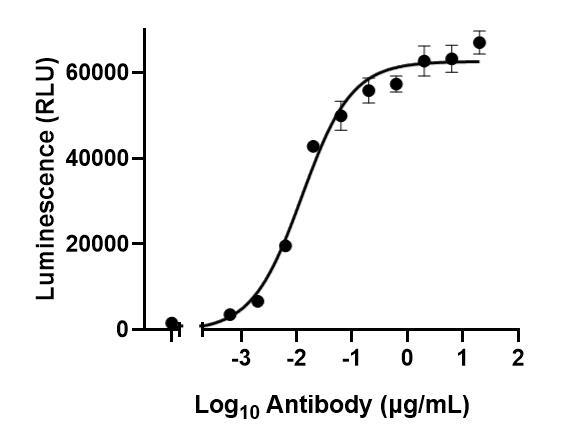 Flow Cytometry analysis of CHOK1-CRE-Luc2-TSHR-Mc4-2A3 cells with Anti-TSHR Antibody (M22) (HY-P991202). The EC50 for this effect is 13 ng/mL.


Chemical Information
-
Appearance Liquid
-
Molecular Weight 145.17 kDa
-
Color Colorless to light yellow
-
SMILES
N/A
-
Shipping
Shipping with dry ice.
-
Formulation
Please refer to the lot-specific COA for specific buffer information.
-
Storage
Please store the product under the recommended conditions in the Certificate of Analysis.


Purity & Documentation
-
Data Sheet (262 KB)
-
SDS (251 KB)
- English - EN (251 KB)
- Français - FR (251 KB)
- Deutsch - DE (251 KB)
- Norwegian - NO (251 KB)
- Español - ES (251 KB)
- Swedish - SV (251 KB)
- Italian - IT (251 KB)
- Korean - KR (251 KB)
- Portuguese - PT (251 KB)
-
Inhibitory Antibodies User Guide (603 KB)
References
[1]. Yuan Y, et al. Proangiogenic effect of thyrotropin receptor stimulating antibody in human umbilical vein endothelial cells. Endocrine. 2025 Feb;87(2):697-706. [Content Brief]
[2]. Neumann S, et al. A selective TSH receptor antagonist inhibits stimulation of thyroid function in female mice. Endocrinology. 2014 Jan;155(1):310-4. [Content Brief]

Calculators
Concentration (start) × Volume (start) = Concentration (final) × Volume (final)


Anti-TSHR Antibody (M22) Related Classifications
HY-P991202 Related Classifications
 Powered by Bioz