



Cathepsin L Antibody (YA6531)
(Synonyms: Cathepsin L antibody; cathepsin L, 1 b antibody; Cathepsin L1 antibody; Cathepsin L1 light chain antibody; CathepsinL antibody; CATL antibody; CATL1_HUMAN antibody; cb15 antibody; CTSL antibody; CTSL1 antibody; Cathepsin L antibody; cathepsin L, 1 b antibody; Cathepsin L1 antibody; Cathepsin L1 light chain antibody; CathepsinL antibody; CATL antibody; CATL1_HUMAN antibody; cb15 antibody; CTSL antibody; CTSL1 antibody; ctsl1b antibody; FLJ31037 antibody; hgg1 antibody; Major excreted protein antibody; MEP antibody; MGC123162 antibody; wu:fb30g09 antibody; )
Based on 1 Customer Validation
Cathepsin L Antibody (YA6531) is a Rabbit-derived and non-conjugated IgG monoclonal antibody, targeting to Cathepsin L.
-
Host:
Rabbit
-
Isotype:
IgG
-
Application:
WB, IHC-P, FC
-
Reactivity :
Human, Mouse, Rat, Monkey
-
Formulation:
Supplied in PBS (pH7.4), 0.1% BSA, 40% Glycerol. Preservative: 0.05% Sodium Azide.
-
Conjugation:
Non-conjugated


To place orders, for customer services and technical support, please contact: MedChemExpress USA
Tel: 609-228-6898 E-mail: [email protected] [email protected]





Applications
| Application |
WB

WB: Western Blot
|
IHC-P
IHC-P: Immunohistochemistry-Paraffin
|
FC
FC: Flow Cytometry
|
|---|---|---|---|
| Dilution Ratio | 1:5000 | 1:5000 | 1:1000 |


Product Details
Cathepsin L Antibody (YA6531) is a Rabbit-derived and non-conjugated IgG monoclonal antibody, targeting to Cathepsin L.
-
Host Rabbit

-
Clonality Recombinant,Monoclonal

-
Species ReactivityHuman, Mouse, Rat, Monkey
-
Observed Molecular WeightObserved band size: 20-45 kDa
Note: Due to possible protein modifications or aggregation, the molecular weight should be confirmed by actual measurement, and the predicted value is for reference only.

-
Calculated Molecular Weight Predicted band size: 38 kDa

Recombinant protein within human Cathepsin L aa 84-333 / 333.
affinity purified.
Non-conjugated
Unmodified
IgG


Product Properties
-
Appearance
Solution
-
Formulation
Supplied in PBS (pH7.4), 0.1% BSA, 40% Glycerol. Preservative: 0.05% Sodium Azide.
-
Concentration
Batch-dependent, Please check the COA for the concentration of each lot. Check Lot Concentration
-
Storage & Stability
Stored at -20°C for 1 year. Avoid repeated freeze / thaw cycles.
-
Shipping
Shipping with blue ice.


Verification Images
-
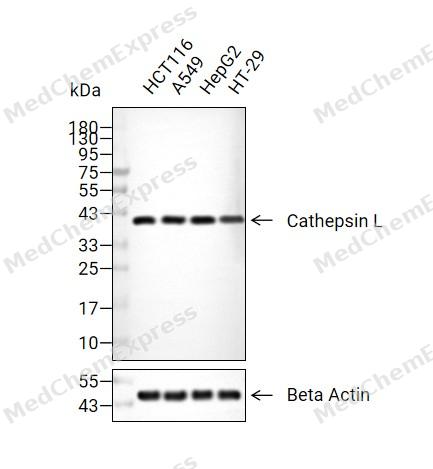 Western blot analysis of extracts from HCT116 (lane 2(20μg), A549 (lane 3(20μg), HepG2 (lane 4(20μg), HT-29 (lane 5(20μg) using Cathepsin L Antibody(HY-P86838). Proteins were transferred to a PVDF membrane and blocked with 5% non-fat milk in TBST for 2 hour at room temperature. The primary antibody (1/5000) and Loading control antibody (Beta Actin, HY-P80993, 1/10,000) was used in 5% non-fat milk in TBST at 4°C overnight. Goat Anti-Rabbit IgG-HRP Secondary Antibody (HY-P8001 ,1/10,000) was used for 1 hour at room temperature.
 -
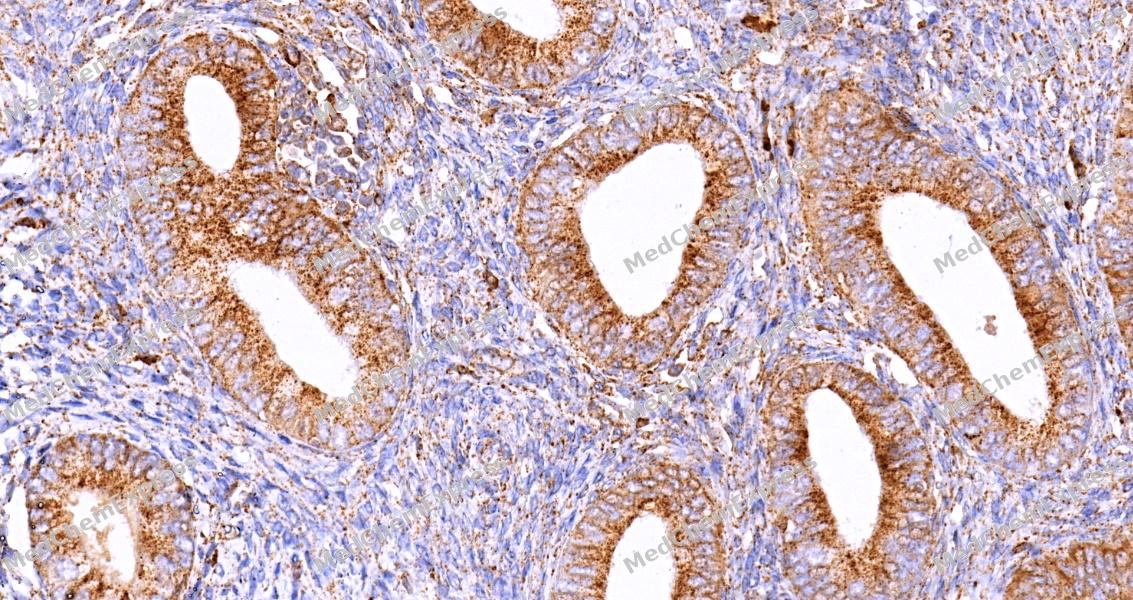 Immunohistochemical analysis of paraffin-embedded human endometrium tissue using Cathepsin L Antibody (HY-P86838, 1/5000) . The section was pretreated using heat mediated antigen retrieval with sodium citrate buffer (PH 6.0)for 8 minutes. The tissues were blocked with quick block buffer for 0.5 hours at room temperature, washed with PBS and PBST, and then incubated with the primary antibody overnight at 7℃. The detection was performed using an HRP conjugated compact polymer system. DAB was used as the chromogen. Tissues were counterstained with hematoxylin and mounted with DPX.
 -
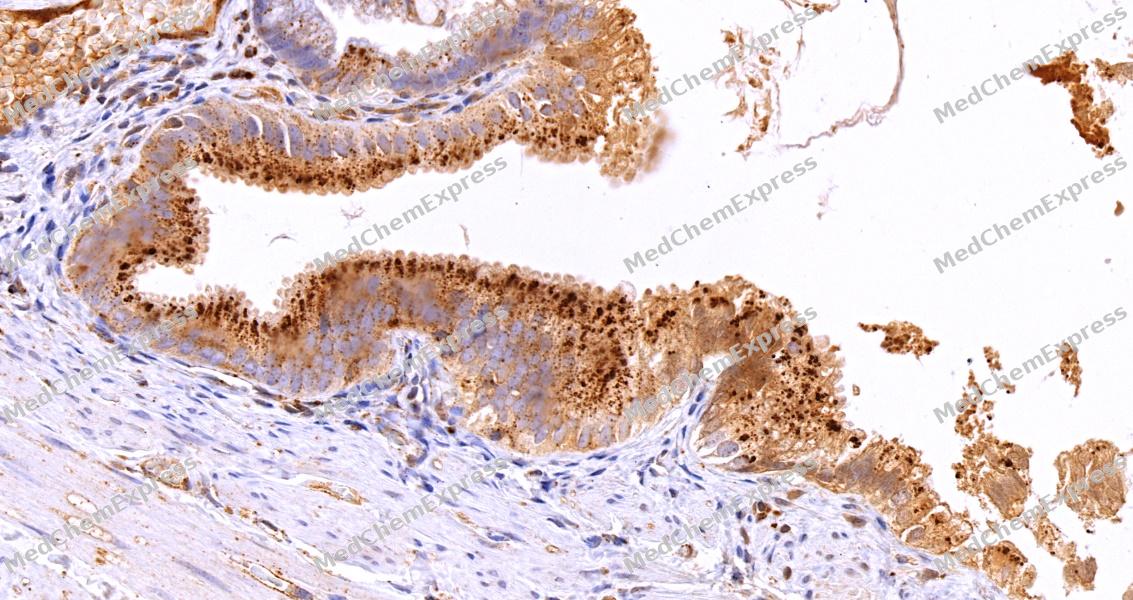 Immunohistochemical analysis of paraffin-embedded human gallbladder tissue using Cathepsin L Antibody (HY-P86838, 1/5000) . The section was pretreated using heat mediated antigen retrieval with sodium citrate buffer (PH 6.0)for 8 minutes. The tissues were blocked with quick block buffer for 0.5 hours at room temperature, washed with PBS and PBST, and then incubated with the primary antibody overnight at 7℃. The detection was performed using an HRP conjugated compact polymer system. DAB was used as the chromogen. Tissues were counterstained with hematoxylin and mounted with DPX.
 -
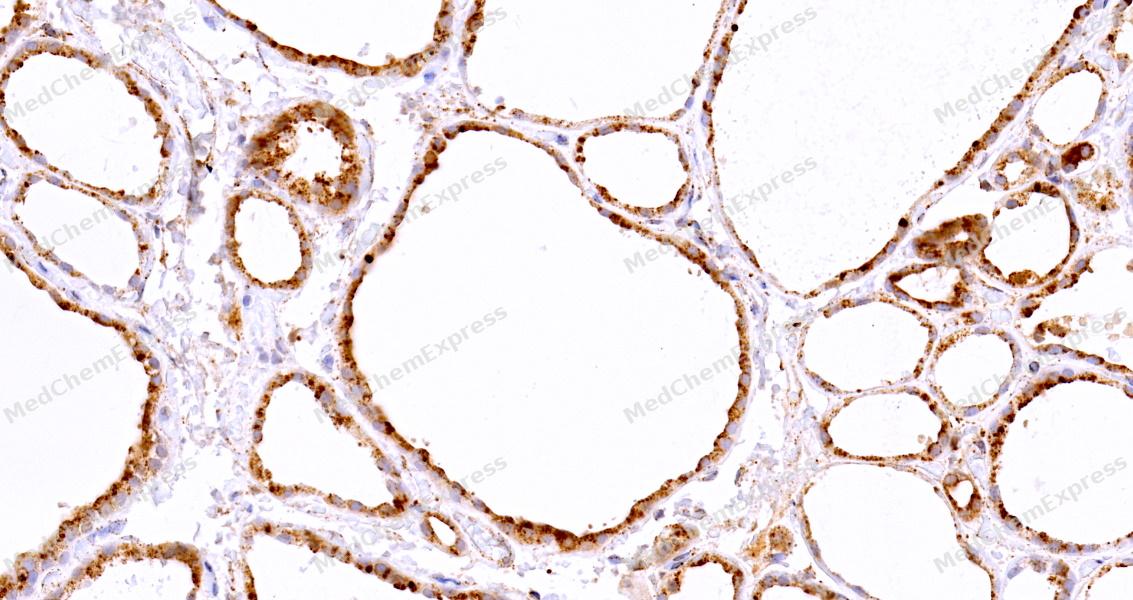 Immunohistochemical analysis of paraffin-embedded human thyroid gland tissue using Cathepsin L Antibody (HY-P86838, 1/5000) . The section was pretreated using heat mediated antigen retrieval with sodium citrate buffer (PH 6.0)for 8 minutes. The tissues were blocked with quick block buffer for 0.5 hours at room temperature, washed with PBS and PBST, and then incubated with the primary antibody overnight at 7℃. The detection was performed using an HRP conjugated compact polymer system. DAB was used as the chromogen. Tissues were counterstained with hematoxylin and mounted with DPX.
 -
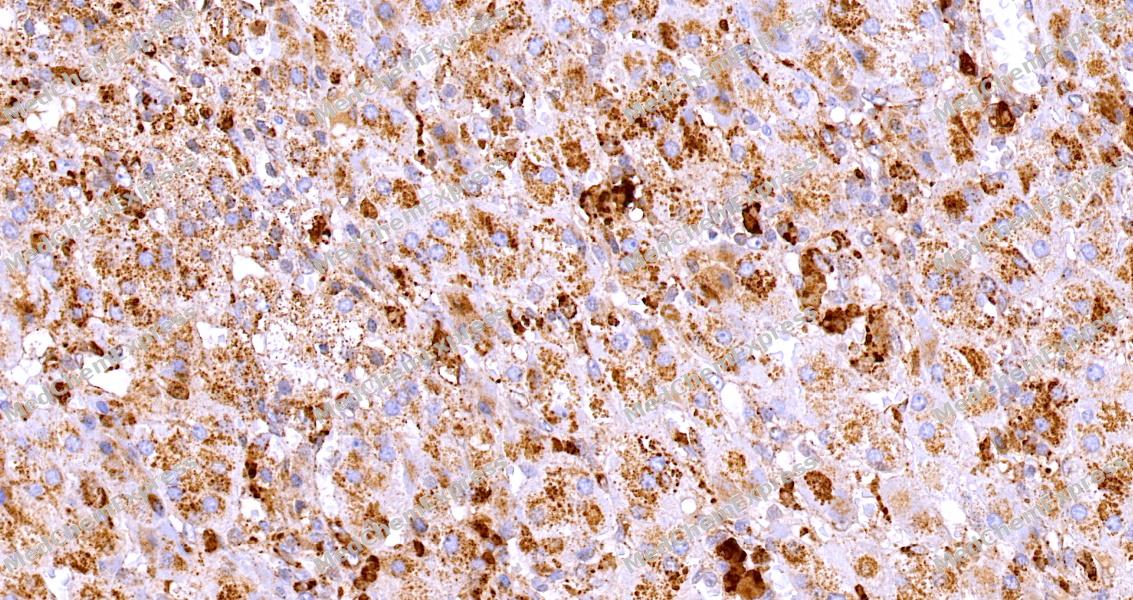 Immunohistochemical analysis of paraffin-embedded human adrenal gland tissue using Cathepsin L Antibody (HY-P86838, 1/5000) . The section was pretreated using heat mediated antigen retrieval with sodium citrate buffer (PH 6.0)for 8 minutes. The tissues were blocked with quick block buffer for 0.5 hours at room temperature, washed with PBS and PBST, and then incubated with the primary antibody overnight at 7℃. The detection was performed using an HRP conjugated compact polymer system. DAB was used as the chromogen. Tissues were counterstained with hematoxylin and mounted with DPX.
 -
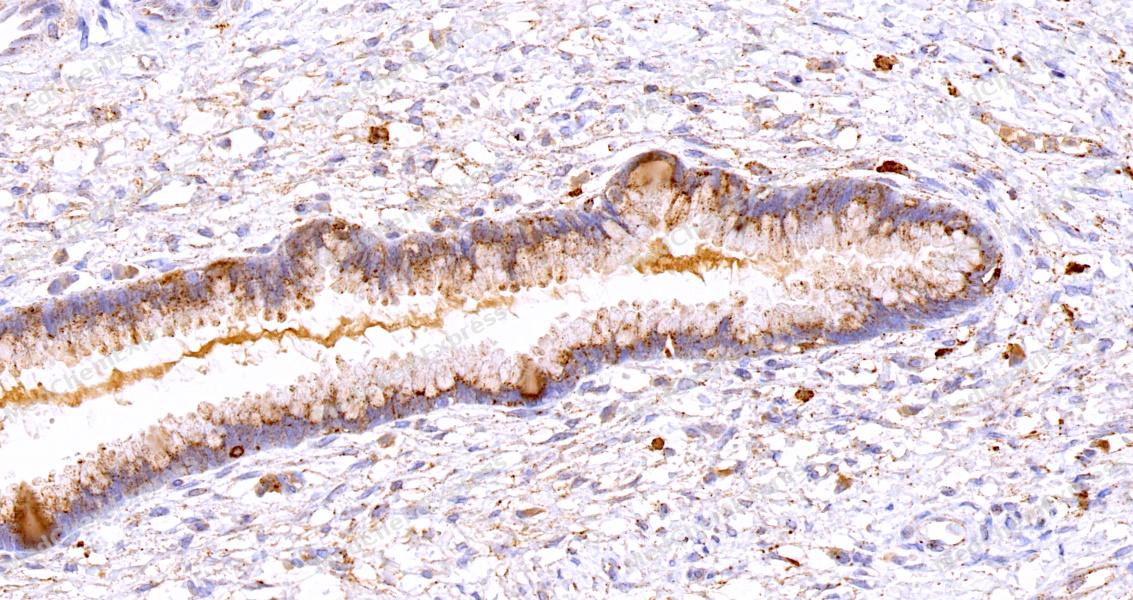 Immunohistochemical analysis of paraffin-embedded human cervix tissue using Cathepsin L Antibody (HY-P86838, 1/5000) . The section was pretreated using heat mediated antigen retrieval with sodium citrate buffer (PH 6.0)for 8 minutes. The tissues were blocked with quick block buffer for 0.5 hours at room temperature, washed with PBS and PBST, and then incubated with the primary antibody overnight at 7℃. The detection was performed using an HRP conjugated compact polymer system. DAB was used as the chromogen. Tissues were counterstained with hematoxylin and mounted with DPX.
 -
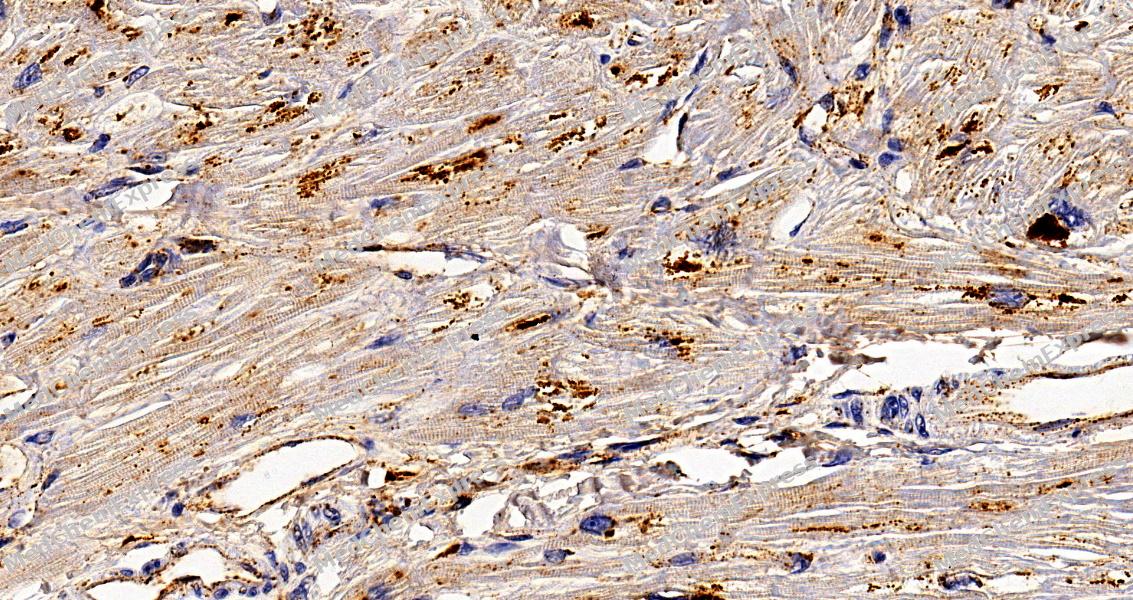 Immunohistochemical analysis of paraffin-embedded human heart muscle tissue using Cathepsin L Antibody (HY-P86838, 1/5000) . The section was pretreated using heat mediated antigen retrieval with sodium citrate buffer (PH 6.0)for 8 minutes. The tissues were blocked with quick block buffer for 0.5 hours at room temperature, washed with PBS and PBST, and then incubated with the primary antibody overnight at 7℃. The detection was performed using an HRP conjugated compact polymer system. DAB was used as the chromogen. Tissues were counterstained with hematoxylin and mounted with DPX.


Background
-
Function
Cathepsin L (CTSL) is a ubiquitously expressed lysosomal cysteine proteinase involved in lysosomal proteolysis, MHC class II antigen presentation, prohormone processing, and extracellular matrix remodeling[1]. Mechanistically, CTSL supports invariant chain degradation in cortical thymic epithelial cells and contributes to CD4+ T-cell selection in the thymus[2]. It also regulates positively selecting peptide ligands independently of invariant chain degradation, showing that CTSL affects thymic MHC class II presentation through more than one mechanism[3]. In skin models, CTSL deficiency causes periodic hair loss, epidermal hyperplasia, altered hair follicle morphogenesis, and disturbed hair follicle cycling[1]. Keratinocyte hyperproliferation in CTSL-knockout mice results from enhanced recycling of growth factors and receptors from endosomes to the plasma membrane[4]. Compared with related isoforms, human cathepsin V is highly homologous to cathepsin L, is expressed in human thymus and testis, and lacks a mouse orthologue[5]. In SARS-CoV-2 models, CTSL cleaves spike protein and enhances viral entry, while CTSL inhibition reduces pseudovirus infection in vitro and in vivo[6]. For experimental applications, small-molecule inhibitors and functional probes help define human CTSL mechanisms in specific cellular contexts[7].
-
Subcellular Localization
Lysosome,Apical cell membrane,Cytoplasmic vesicle, secretory vesicle, chromaffin granule,Secreted, extracellular space,Secreted,Nucleus
-
Isoforms & Post-Translational Modification
P07711 has two isomers: P07711-1: 37564 Da (predicted); P07711-3: 31173 Da (predicted).
During export along the endocytic pathway, pro-CTSL undergoes several proteolytic cleavages to generate the CTSL single-chain and two-chain mature forms, composed of a heavy chain linked to a light chain by disulfide bonds (By similarity) -
Subunit
Dimer of a heavy and a light chain linked by disulfide bonds
-
SwissProt ID
-
Synonyms
Cathepsin L antibody; cathepsin L, 1 b antibody; Cathepsin L1 antibody; Cathepsin L1 light chain antibody; CathepsinL antibody; CATL antibody; CATL1_HUMAN antibody; cb15 antibody; CTSL antibody; CTSL1 antibody; Cathepsin L antibody; cathepsin L, 1 b antibody; Cathepsin L1 antibody; Cathepsin L1 light chain antibody; CathepsinL antibody; CATL antibody; CATL1_HUMAN antibody; cb15 antibody; CTSL antibody; CTSL1 antibody; ctsl1b antibody; FLJ31037 antibody; hgg1 antibody; Major excreted protein antibody; MEP antibody; MGC123162 antibody; wu:fb30g09 antibody;


Documentation
-
Data Sheet (260 KB)
-
SDS (254 KB)
- English - EN (254 KB)
- Français - FR (254 KB)
- Deutsch - DE (254 KB)
- Norwegian - NO (254 KB)
- Español - ES (254 KB)
- Swedish - SV (254 KB)
- Italian - IT (254 KB)
- Korean - KR (254 KB)
- Portuguese - PT (254 KB)
-
User Guide for Antibodies (1077 KB)
References
[1]. Roth W, et al. Cathepsin L deficiency as molecular defect of furless: hyperproliferation of keratinocytes and pertubation of hair follicle cycling. FASEB J. 2000 Oct;14(13):2075-86. [Content Brief]
[2]. Nakagawa T, et al. Cathepsin L: critical role in Ii degradation and CD4 T cell selection in the thymus. Science. 1998 Apr 17;280(5362):450-3. [Content Brief]
[3]. Honey K, et al. Cathepsin L regulates CD4+ T cell selection independently of its effect on invariant chain: a role in the generation of positively selecting peptide ligands. J Exp Med. 2002 May 20;195(10):1349-58. [Content Brief]
[4]. Reinheckel T, et al. The lysosomal cysteine protease cathepsin L regulates keratinocyte proliferation by control of growth factor recycling. J Cell Sci. 2005 Aug 1;118(Pt 15):3387-95. [Content Brief]
[5]. Tolosa E, et al. Cathepsin V is involved in the degradation of invariant chain in human thymus and is overexpressed in myasthenia gravis. J Clin Invest. 2003 Aug;112(4):517-26. [Content Brief]
[6]. Zhao MM, et al. Cathepsin L plays a key role in SARS-CoV-2 infection in humans and humanized mice and is a promising target for new drug development. Signal Transduct Target Ther. 2021 Mar 27;6(1):134. [Content Brief]
[7]. Dana D, et al. A Review of Small Molecule Inhibitors and Functional Probes of Human Cathepsin L. Molecules. 2020 Feb 6;25(3):698. [Content Brief]

 Powered by Bioz
