



MAVS Antibody (YA6648)
(Synonyms: CARD adapter inducing interferon beta antibody; CARD adaptor inducing IFN beta antibody; Cardif antibody; DKFZp666M015 antibody; FLJ27482 antibody; FLJ41962 antibody; IFN B promoter stimulator 1 antibody; Interferon beta promoter stimulator protein 1 antibody; Ips 1 antibody; IPS-1 antibody; CARD adapter inducing interferon beta antibody; CARD adaptor inducing IFN beta antibody)
Based on 1 Customer Validation
MAVS Antibody (YA6648) is a Rabbit-derived and non-conjugated IgG monoclonal antibody, targeting to MAVS.
-
Host:
Rabbit
-
Isotype:
IgG
-
Application:
WB, IHC-P, ICC/IF, IP
-
Reactivity :
Human, Mouse
-
Formulation:
Supplied in PBS (pH7.4), 0.1% BSA, 40% Glycerol. Preservative: 0.05% Sodium Azide.
-
Conjugation:
Non-conjugated


To place orders, for customer services and technical support, please contact: MedChemExpress USA
Tel: 609-228-6898 E-mail: [email protected] [email protected]





Applications
| Application |
WB

WB: Western Blot
|
IHC-P
IHC-P: Immunohistochemistry-Paraffin
|
ICC/IF
ICC/IF: Immunocytochemistry/
Immunofluorescence |
IP
IP: Immunoprecipitation
|
|---|---|---|---|---|
| Dilution Ratio | 1:1000 | 1:200-1:1000 | 1:100 | 1-2μg/sample |


Product Details
MAVS Antibody (YA6648) is a Rabbit-derived and non-conjugated IgG monoclonal antibody, targeting to MAVS.
-
Host Rabbit

-
Clonality Recombinant,Monoclonal

-
Species ReactivityHuman, Mouse
-
Observed Molecular WeightObserved band size: 75 kDa
Note: Due to possible protein modifications or aggregation, the molecular weight should be confirmed by actual measurement, and the predicted value is for reference only.

-
Calculated Molecular Weight Predicted band size: 56 kDa

Synthetic peptide within human MAVS aa 2-50.
affinity purified.
Non-conjugated
Unmodified
IgG


Product Properties
-
Appearance
Liquid
-
Formulation
Supplied in PBS (pH7.4), 0.1% BSA, 40% Glycerol. Preservative: 0.05% Sodium Azide.
-
Concentration
Batch-dependent, Please check the COA for the concentration of each lot. Check Lot Concentration
-
Storage & Stability
Stored at -20°C for 1 year. Avoid repeated freeze / thaw cycles.
-
Shipping
Shipping with blue ice.


Verification Images
-
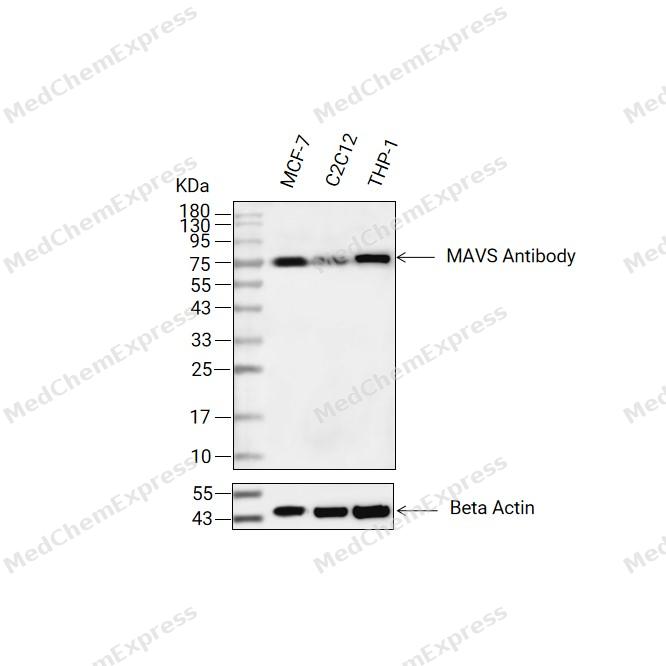 Western blot analysis of extracts from MCF-7(lane 2(20ug) , C2C12(lane 3(20ug) and THP-1(lane 4(20ug) using MAVS Antibody (HY-P86955) Rabbit mAb. Proteins were transferred to a PVDF membrane and blocked with 5% non-fat milk in TBST for 2 hour at room temperature. The primary antibody (1/1000) and Loading control antibody (Beta Actin, HY-P83730, 1/10000) was used in 5% non-fat milk in TBST at 4°C overnight. Goat Anti-Mouse/Rabbit IgG-HRP Secondary Antibody (1/10000) was used for 1 hour at room temperature.
 -
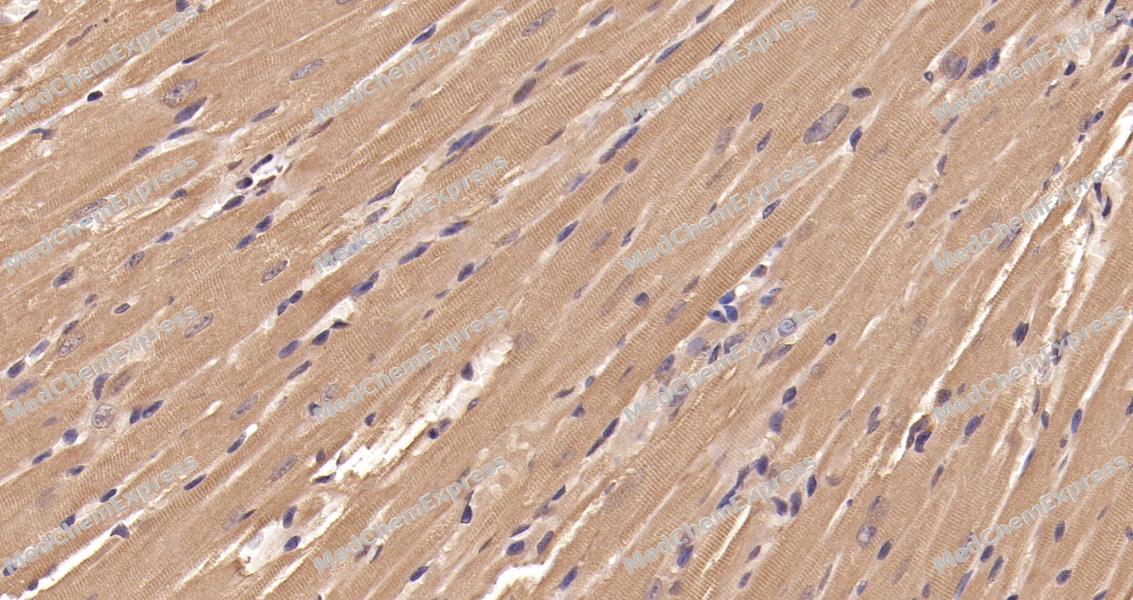 Immunohistochemical analysis of paraffin-embedded mouse heart tissue using MAVS Antibody. The section was pre-treated using heat mediated antigen retrieval with sodium citrate buffer (pH 6.0) for 8 minutes. The tissues were blocked in QuickBlock for 20 minutes at room temperature, washed with ddH2O and PBS, and then probed with the primary antibody at 1/100 dilution in 4℃ overnight. The detection was performed using an HRP conjugated compact polymer system. DAB was used as the chromogen. Tissues were counterstained with hematoxylin and mounted with DPX.
 -
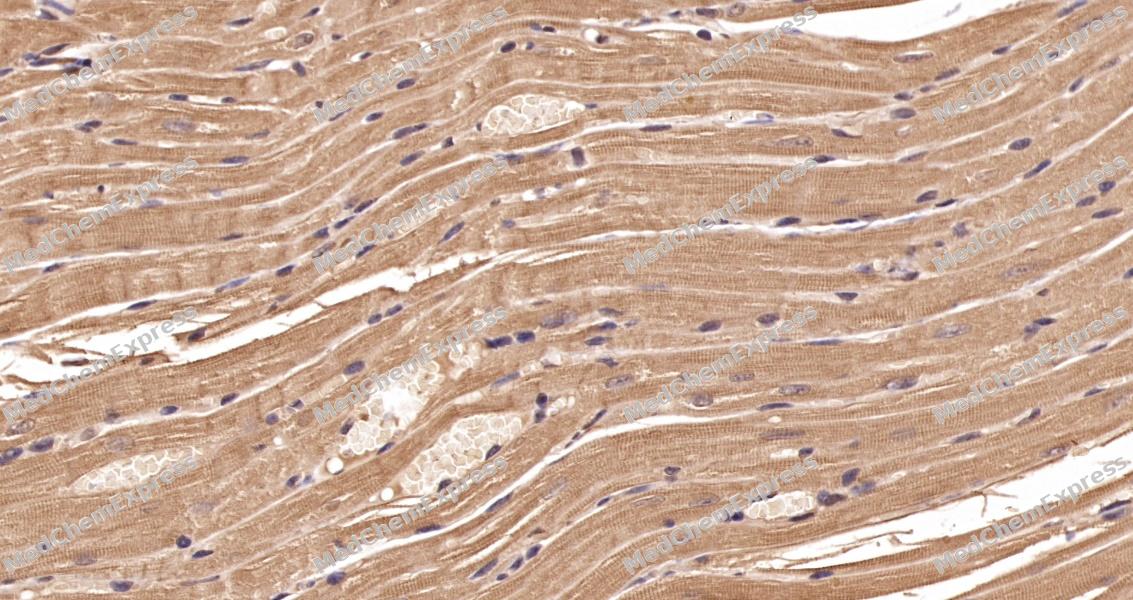 Immunohistochemical analysis of paraffin-embedded mouse heart tissue using MAVS Antibody. The section was pre-treated using heat mediated antigen retrieval with sodium citrate buffer (pH 6.0) for 8 minutes. The tissues were blocked in QuickBlock for 20 minutes at room temperature, washed with ddH2O and PBS, and then probed with the primary antibody at 1/100 dilution in 4℃ overnight. The detection was performed using an HRP conjugated compact polymer system. DAB was used as the chromogen. Tissues were counterstained with hematoxylin and mounted with DPX.
 -
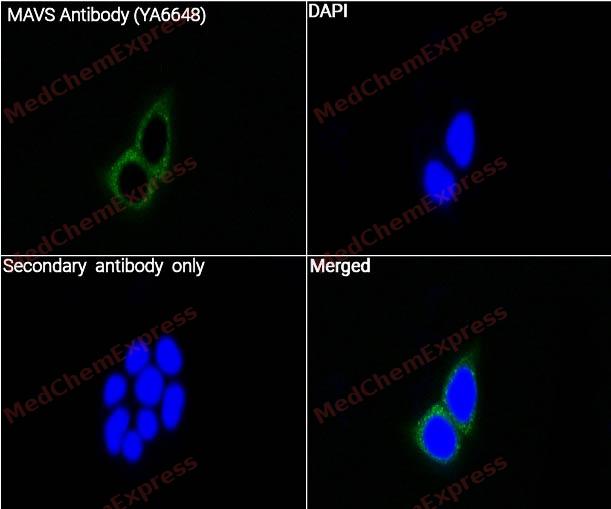 Immunocytochemistry analysis of MCF-7 cells labeling MAVS with MAVS Antibody (YA6648) (HY-P86955) at 1/50 dilution. Cells were fixed in 4% paraformaldehyde for 15 minutes at room temperature, permeabilized with 0.1% Triton X-100 for 10 minutes at room temperature, then blocked with QuickBlock™ Blocking Buffer for Immunol Staining for 10 min at room temperature. Cells were then incubated with MAVS Antibody (YA6648) ((HY-P86955) at 1/50 dilution in QuickBlock™ Blocking Buffer for Immunol Staining at 4 ℃. Alexa Fluor® 488-conjugated AffiniPure Goat Anti-Rabbit IgG H&L(HY-P8002, Green) was used as the secondary antibody at 1/1,000 dilution. PBS instead of the primary antibody was used as the secondary antibody only control. The Nuclear counterstain was DAPI (Blue).
 -
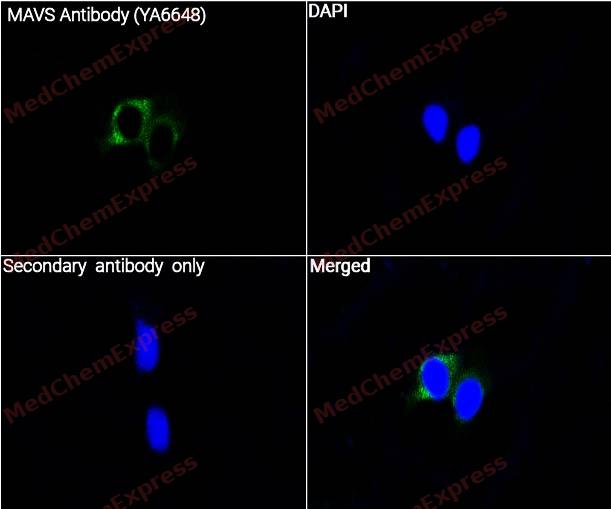 Immunocytochemistry analysis of A431 cells labeling MAVS with MAVS Antibody (YA6648) (HY-P86955) at 1/50 dilution. Cells were fixed in 4% paraformaldehyde for 15 minutes at room temperature, permeabilized with 0.1% Triton X-100 for 10 minutes at room temperature, then blocked with QuickBlock™ Blocking Buffer for Immunol Staining for 10 min at room temperature. Cells were then incubated with MAVS Antibody (YA6648) ((HY-P86955) at 1/50 dilution in QuickBlock™ Blocking Buffer for Immunol Staining at 4 ℃. Alexa Fluor® 488-conjugated AffiniPure Goat Anti-Rabbit IgG H&L(HY-P8002, Green) was used as the secondary antibody at 1/1,000 dilution. PBS instead of the primary antibody was used as the secondary antibody only control. The Nuclear counterstain was DAPI (Blue).


Background
-
Function
MAVS is an Adapter required for innate immune defense against viruses. Acts downstream of DHX33, RIGI and IFIH1/MDA5, which detect intracellular dsRNA produced during viral replication, to coordinate pathways leading to the activation of NF-kappa-B, IRF3 and IRF7, and to the subsequent induction of antiviral cytokines such as IFNB and RANTES (CCL5). Peroxisomal and mitochondrial MAVS act sequentially to create an antiviral cellular state. Upon viral infection, peroxisomal MAVS induces the rapid interferon-independent expression of defense factors that provide short-term protection, whereas mitochondrial MAVS activates an interferon-dependent signaling pathway with delayed kinetics, which amplifies and stabilizes the antiviral response. May activate the same pathways following detection of extracellular dsRNA by TLR3. May protect cells from apoptosis. Involved in NLRP3 inflammasome activation by mediating NLRP3 recruitment to mitochondria[1][2][3][4][5][6][7][8][9][10][11][12][13][14][15][16][17].
-
Subcellular Localization
Mitochondrion outer membrane,Mitochondrion,Peroxisome
-
Expression
Tissue_Specificity: Present in T-cells, monocytes, epithelial cells and hepatocytes (at protein level). Ubiquitously expressed, with highest levels in heart, skeletal muscle, liver, placenta and peripheral blood leukocytes -
Isoforms & Post-Translational Modification
Q7Z434 has 6 isomers: Q7Z434-1: 56528 Da (predicted); Q7Z434-2: 15996 Da (predicted); Q7Z434-3: 17043 Da (predicted); Q7Z434-4: 40468 Da (predicted); Q7Z434-5: 14385 Da (predicted); Q7Z434-6: 15012 Da (predicted).
Following activation, phosphorylated by TBK1 at Ser-442 in the pLxIS motif (PubMed:25636800, PubMed:27302953)丨Ubiquitinated (PubMed:19881509, PubMed:23087404, PubMed:25636800, PubMed:38016475)丨Palmitoylated by ZHDDC4丨Proteolytically cleaved by apoptotic caspases during apoptosis, leading to its inactivation (PubMed:30878284)丨(Microbial infection) Cleaved and degraded by hepatitis A virus (HAV) protein 3ABC allowing the virus to disrupt the activation of host IRF3 through the MDA5 pathway丨(Microbial infection) Cleaved by the protease 2A of coxsackievirus B3, poliovirus and enterovirus 71 allowing the virus to disrupt the host type I interferon production丨(Microbial infection) Cleaved by Seneca Valley virus protease 3C allowing the virus to suppress interferon type-I production丨(Microbial infection) Cleaved by HCV protease NS3/4A, thereby preventing the establishment of an antiviral state丨(Microbial infection) UFMylated by ULF1 in association with Epstein-Barr virus BILF1; leading to MAVS routing to the lysosome -
Subunit
Self-associates and polymerizes (via CARD domains) to form 400 nM long three-stranded helical filaments on mitochondria, filament nucleation requires interaction with RIGI whose CARD domains act as a template for filament assembly (PubMed:24569476, PubMed:25018021, PubMed:27992402, PubMed:26246171)
-
SwissProt ID
-
Synonyms
CARD adapter inducing interferon beta antibody; CARD adaptor inducing IFN beta antibody; Cardif antibody; DKFZp666M015 antibody; FLJ27482 antibody; FLJ41962 antibody; IFN B promoter stimulator 1 antibody; Interferon beta promoter stimulator protein 1 antibody; Ips 1 antibody; IPS-1 antibody; CARD adapter inducing interferon beta antibody; CARD adaptor inducing IFN beta antibody


Documentation
-
Data Sheet (231 KB)
-
SDS (254 KB)
- English - EN (254 KB)
- Français - FR (254 KB)
- Deutsch - DE (254 KB)
- Norwegian - NO (254 KB)
- Español - ES (254 KB)
- Swedish - SV (254 KB)
- Italian - IT (254 KB)
- Korean - KR (254 KB)
- Portuguese - PT (254 KB)
-
User Guide for Antibodies (1077 KB)

 Powered by Bioz
