



GLP-1R/GIPR agonist-1 (soduim)

Based on 1 Customer Validation
GLP-1R/GIPR agonist-1 sodium is a dual GLP-1/GIP receptor agonist, with an EC50 of 0.57 nM for GLP-1R and an EC50 of 0.75 nM for GIPR. GLP-1R/GIPR agonist-1 sodium reduces food intake, inhibits weight gain, repairs islet damage, improves glucose tolerance, regulates serum lipid and liver enzyme levels, ameliorates hepatic vacuolization, reduces hepatic fat accumulation, delays the progression of hepatic fibrosis, and exhibits long-lasting hypoglycemic activity. GLP-1R/GIPR agonist-1 sodium can be used in research related to type 2 diabetes, obesity, and non-alcoholic steatohepatitis.
For research use only. We do not sell to patients.
- Purity : 98.24%
- Formula: C220H334N55O69.xNa
- Molecular Weight:4861.38 (free base)
-
Storage:
Sealed storage, away from moisture.
Powder -80°C, 2 years , -20°C, 1 year* In solvent : -80°C, 6 months; -20°C, 1 month (sealed storage, away from moisture)


To place orders, for customer services and technical support, please contact: MedChemExpress USA
Tel: 609-228-6898 E-mail: [email protected] [email protected]


-
 Biological Activity
-
Chemical Information
-
Solvent & Solubility
- Purity & Documentation
- References
-
 Help & FAQs






Biological Activity
Description
IC50 & Target
EC50: 0.57 nM (GLP-1R), 0.75 nM (GIPR)
In Vitro
GLP-1R/GIPR agonist-1 sodium (CY-5) is a dual GLP-1R/GIPR agonist without GCGR activity, with an EC50 of 0.57 nM for activating GLP-1R and an EC50 of 0.75 nM for activating GIPR in overexpressed HEK-293 cells[1].
MedChemExpress (MCE) has not independently confirmed the accuracy of these methods. They are for reference only.
In Vivo
GLP-1R/GIPR agonist-1 sodium (30 nM/kg; i.p.; single dose '; daily administration; 32 days (chronic)) achieves acute glycemic stabilization effects comparable to those of Semaglutide in type 2 diabetic mice, and chronic administration significantly reduces food/water intake, suppresses body weight gain, and repairs islet damage[1].
GLP-1R/GIPR agonist-1 sodium (30 nM/kg; i.p.; daily; for 4 consecutive weeks (chronic); single administration ') exerts potent acute appetite-suppressive effects in DIO mice, and also reduces long-term food/water intake, decreases body weight gain, and achieves stable blood glucose control[1].
GLP-1R/GIPR agonist-1 sodium (30 nM/kg; i.p.; single dose) effectively promotes insulin secretion and stabilizes blood glucose in normal SD rats[1].
GLP-1R/GIPR agonist-1 sodium (30 nM/kg; s.c.; single administration) exerts hypoglycemic activity for 34 h in non-fasted ob/ob mice and significantly reduces their body weight[1].
GLP-1R/GIPR agonist-1 sodium (30 nM/kg; i.p.; daily; for 4 consecutive weeks) significantly improves lipid metabolism, reduces liver enzyme levels, and prevents liver injury in NASH mice[1].
MedChemExpress (MCE) has not independently confirmed the accuracy of these methods. They are for reference only.
-
Animal Model:ICR mice (male, 10 weeks old, 18-22 g)[1]
-
Dosage:30 nM/kg
-
Administration:i.p.; single dose
-
Result:Exhibited hypoglycemic efficacy duration equivalent to semaglutide.
Maintained blood glucose stabilization through repeated glucose tolerance testing cycles.
-
Animal Model:ICR mice (male, 10 weeks old, 18-22 g, intraperitoneal injection of 40 mg/kg STZ (HY-13753) followed by 1 week of feeding, fasting blood glucose >11.1 mmol/L, random blood glucose >16.7 mmol/L)[1]
-
Dosage:30 nM/kg
-
Administration:i.p.; single dose (acute testing); daily; 32 days (chronic testing)
-
Result:Achieved blood glucose stabilization time and glucose reduction percentage equivalent to semaglutide in acute testing.
Suppressed daily and cumulative food/water intake to levels equivalent to semaglutide in chronic treatment.
Significantly inhibited body weight gain (with better weight reduction than CY-16).
Reduced pancreatic islet inflammation, preserved islet cell structure, and repaired islet damage in chronic treatment.
-
Animal Model:C57BL/6 mice (male, 10 weeks old, 18-22 g, fed high-fat diet for 8 weeks, body weight >20% more than normal diet-fed controls)[1]
-
Dosage:30 nM/kg
-
Administration:i.p.; daily; 4 weeks (chronic testing); single dose (acute appetite suppression testing)
-
Result:Suppressed cumulative food/water intake to levels equivalent to semaglutide in chronic treatment.
Inhibited body weight gain more effectively than E1 in chronic treatment.
Maintained stable fasting blood glucose levels in chronic treatment.
Resulted in near-zero food intake in the first 8 h post-administration in acute treatment, with cumulative food intake equivalent to semaglutide.
Preserved pancreatic islet structure in chronic treatment.
-
Animal Model:SD rats (male, 5-6 weeks old, 180-220 g)[1]
-
Dosage:30 nM/kg
-
Administration:i.p.; single dose
-
Result:Significantly promoted insulin secretion (with insulin AUC0-180ₘᵢₙ equivalent to semaglutide).
Reduced blood glucose AUC0-180ₘᵢₙ compared to saline controls.
Stabilized blood glucose levels post-administration, with no sharp peak observed in the saline group.
-
Animal Model:B6.v-Lepob/J (ob/ob) mice (6-7 weeks old, half male/half female)[1]
-
Dosage:30 nM/kg
-
Administration:s.c.; single dose
-
Result:Significantly decreased blood glucose starting 2 h post-administration, with hypoglycemic duration lasting 34 h.
Reduced body weight by 2.0 g at 24 h, 0.9 g at 48 h, and 0.1 g at 72 h post-administration, which was significantly lower than the control group and equivalent to semaglutide.
-
Animal Model:C57BL/6 mice (male, fed NASH-inducing diet [40% fat, 40% carbohydrates, 2% cholesterol] for 8 weeks)[1]
-
Dosage:30 nM/kg
-
Administration:i.p.; daily; 4 weeks
-
Result:Significantly reduced serum TG, TC, LDL-C, AST, and ALT levels compared to saline controls.
Significantly increased serum HDL-C levels compared to saline controls.
Showed significant improvement in hepatocyte inflammation, reduced lipid droplets, and improved liver vacuolation compared to the saline group, with better liver protection than semaglutide.


Chemical Information
-
Appearance Solid
-
Molecular Weight 4861.38 (free base)
-
Formula C220H334N55O69.xNa
-
Color White to off-white
-
Sequence
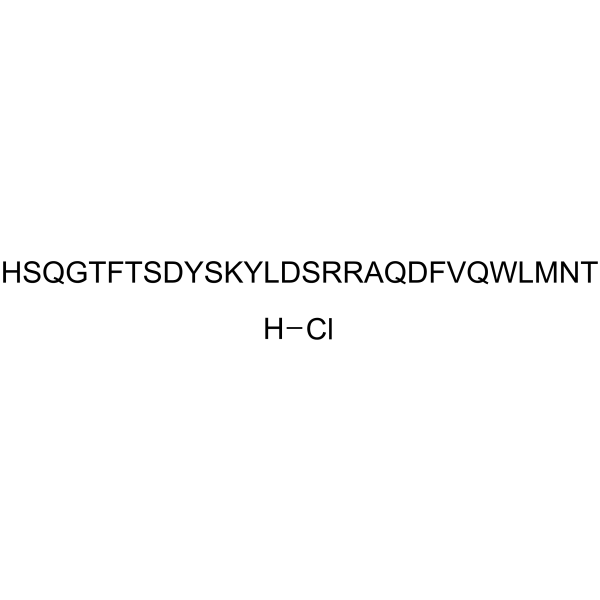
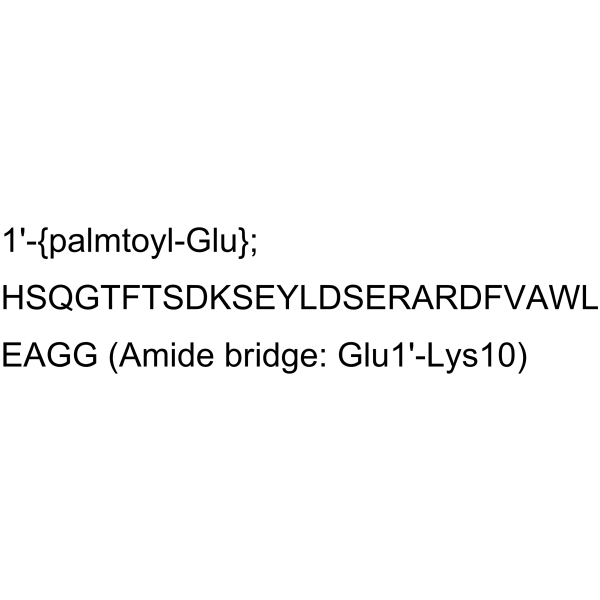
His-{Aib}-Gln-Gly-Thr-Phe-Thr-Ser-Asp-Tyr-Ser-Lys-{Aib}-Leu-Asp-Lys-Arg-Ala-Ala-Lys(AEEA-AEEA-gammaGlu-C18 diacid)-Asp-Phe-Val-Glu-Trp-Leu-Lys-Asn-Gly-Gly-Pro-Ser-Ser-Gly-Ala-Pro-Pro-Pro-Ser-NH2
-
Sequence Shortening
H-{Aib}-QGTFTSDYSK-{Aib}-LDKRAA-K(AEEA-AEEA-gammaGlu-C18 diacid)-DFVEWLKNGGPSSGAPPPS-NH2
-
Shipping
Room temperature in continental US; may vary elsewhere.
-
Storage
Sealed storage, away from moisture
Powder -80°C 2 years -20°C 1 year * In solvent : -80°C, 6 months; -20°C, 1 month (sealed storage, away from moisture)


Solvent & Solubility
In Vitro:
H2O : ≥ 100 mg/mL
* "≥" means soluble, but saturation unknown.


Purity & Documentation
-
Data Sheet (301 KB)
-
SDS (252 KB)
- English - EN (252 KB)
- Français - FR (252 KB)
- Deutsch - DE (252 KB)
- Norwegian - NO (252 KB)
- Español - ES (252 KB)
- Swedish - SV (252 KB)
- Italian - IT (252 KB)
- Korean - KR (252 KB)
- Portuguese - PT (252 KB)
-
Handling Instructions (2659 KB)
References

Calculators
Concentration (start) × Volume (start) = Concentration (final) × Volume (final)


GLP-1R/GIPR agonist-1 (soduim) Related Classifications
HY-P10302A Related Classifications
 Powered by Bioz